

Why is My White Gold Turning Yellow? (And How to Fix It)
Noticing your white gold turning yellow is a small moment of panic. You look down at a ring you have worn every day — often an engagement ring — and there is a warm, brassy tint creeping across the underside of the band and around the base of the prongs. The first thought is almost always the same: did I buy fake gold?
You did not. What you are seeing is the single most normal thing that happens to white gold, it happens to every piece eventually, and it is completely reversible. Here is exactly why it occurs, how long it should take, and what a proper fix involves.

Why Does White Gold Turn Yellow?
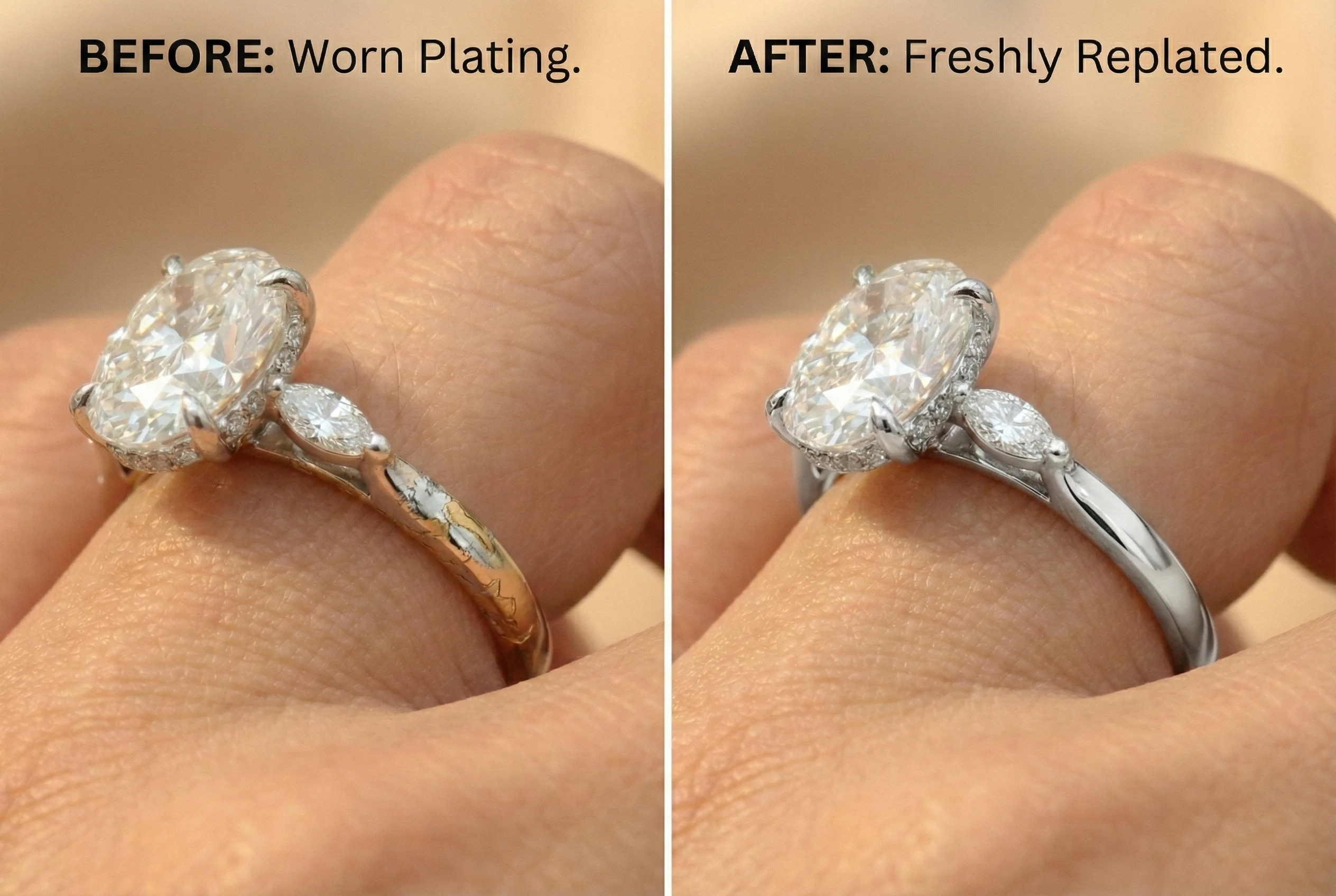
White gold turns yellow because the thin layer of rhodium plating on its surface gradually wears away, revealing the naturally warm, greyish-yellow gold alloy underneath. It is normal wear, not a defect or a sign of poor quality, and it is fixed by professional re-plating — commonly called rhodium dipping.
The Science: There Is No Such Thing as Naturally White Gold
Gold is yellow. That is a property of the element itself, and nothing can change it. To make “white” gold, refiners alloy pure yellow gold with white metals — historically nickel, and increasingly palladium, along with silver, zinc and copper in small amounts.
The result is genuinely lighter than yellow gold, but it is not the bright, icy white you see in a jewelry case. Raw white gold alloy is closer to a pale, slightly warm grey — something like unpolished steel with a champagne cast. In 14k it reads greyer; in 18k, because there is more yellow gold in the mix, it reads warmer still.
To get that showroom brilliance, finished white gold is electroplated with rhodium, a rare member of the platinum group. Rhodium is exceptionally reflective, extremely hard, and does not tarnish — which is why it has been the industry standard finish for white gold for decades. You can read about the element itself at the Royal Society of Chemistry.
The catch is thickness. A typical jewelry rhodium layer is only around 0.75 to 1.0 microns — roughly one-hundredth the thickness of a human hair. It is a finish, not a structural layer. Like the tread on a tyre or the sole of a shoe, it is designed to be replaced.
How Long Should Rhodium Plating Last?
Longevity depends almost entirely on friction, which means it depends on where the piece sits on your body.
| Type of jewelry | Typical time before re-plating | Why |
|---|---|---|
| Engagement ring worn daily | 9–18 months | Constant contact with skin, surfaces, keyboards, bags |
| Wedding band worn daily | 12–24 months | Similar wear, usually less surface detail to catch |
| Ring worn occasionally | 3–5 years | Far less friction |
| Bracelet | 2–4 years | Rubs against desks and sleeves |
| Pendant or necklace | 5+ years | Minimal abrasion |
| Earrings | Often a decade or more | Almost no friction |
The wear pattern is also predictable: the underside of a ring band goes first, because that is the part pressed against your finger and against everything you hold. The top of the ring, which you actually look at, often stays bright for another year. If you are seeing yellow underneath but white on top, that is textbook rhodium wear rather than a quality problem.
What Makes It Happen Faster?
- Body chemistry. Skin acidity varies enormously between people. Someone with acidic perspiration can wear through plating in six months while a colleague with the identical ring goes three years.
- Chlorine and bleach. Pools, hot tubs and household cleaners attack both the plating and the gold alloy beneath it. This is the fastest way to ruin a white gold ring.
- Hand sanitizer and frequent hand-washing. Alcohol gels and detergents strip the natural oils that slightly buffer the surface, and the sheer frequency of contact accelerates abrasion.
- Cosmetics and perfume. Sprayed directly onto the hand or wrist, they leave residues that dull and, over time, degrade the finish.
- Over-polishing at home. Polishing cloths and pastes are abrasive by design. Using them enthusiastically on white gold removes the rhodium far faster than daily wear does.
- Manual work and the gym. Gripping metal, tools or weights concentrates friction on exactly the part of the band that yellows first.
- Karat and alloy. 18k white gold shows the change more warmly than 14k, simply because there is more yellow gold beneath the plating.
Is My Ring Fake? How to Check
Yellowing proves nothing about authenticity — it is a symptom of solid white gold behaving exactly as it should. Gold-plated base metal, by contrast, tends to wear through to a dull grey or coppery colour and often causes green marks on the skin.
To confirm what you own, look inside the band for a hallmark: 14K or 585, 18K or 750. In the United States, the FTC’s Jewelry Guides require karat fineness to be marked with equal prominence to the word “gold”, so a legitimate piece will carry one of these stamps. If you still have the appraisal or grading paperwork, the metal will be specified there too.
The Fix: Rhodium Dipping, Step by Step
Re-plating is routine bench work, not a repair, and most jewelers turn it around in a day or two.
- Stone check. A good jeweler inspects and, if necessary, tightens the setting first — there is no point plating a ring with a loose stone.
- Polishing. The piece is polished to remove scratches and any remaining plating. Skipping this step is why cheap re-plating jobs look patchy.
- Deep cleaning. Ultrasonic and electro-cleaning remove every trace of oil; rhodium will not bond to a contaminated surface.
- Electroplating. The ring is suspended in a rhodium solution and a low electrical current bonds a fresh microscopic layer to the gold.
- Rinse and final inspection. The piece is neutralised, rinsed, dried and checked under magnification.
What It Costs
Rhodium itself is a genuinely precious metal and its price is volatile, but because the layer is measured in microns, only a tiny quantity is used. Most jewelers charge roughly $50 to $120 for a standard ring, with the higher end reflecting extra polishing, stone tightening or intricate settings that must be masked. Many jewelers — ourselves included — offer re-plating at a reduced rate or free for pieces they made.
Questions Worth Asking Your Jeweler
- Will the setting be checked and tightened before plating?
- What plating thickness do you apply? (Around 1 micron is a good standard; heavier “double dips” last longer on rings.)
- Will heat-sensitive stones be protected or removed first?
- Does the price include polishing, or is that extra?
An Important Caution for Certain Stones
Plating involves chemicals, electricity and mild heat. Pearls, opals, emeralds, tanzanite and any porous or fracture-filled stone can be damaged in the process. Antique pieces and rings with coloured accent stones should be masked or have the stones removed first. Always tell your jeweler exactly what is set in the piece.
Can You Re-Plate White Gold at Home?
No — and this is one of the few areas where the DIY answer is unambiguous. Home plating kits use acidic solutions and electrical current, and without professional polishing and cleaning the result is a thin, patchy finish that flakes. Worse, an improperly prepared surface can trap contaminants under the plating. It costs less to have it done properly than to have a botched job stripped and redone.
How to Slow It Down
- Remove rings before swimming, showering and cleaning
- Take rings off at the gym and for manual work
- Apply lotion, perfume and sunscreen before putting jewelry on
- Clean gently with warm water and mild soap rather than polishing compounds — see our guide to cleaning jewelry safely at home
- Store pieces separately so harder stones cannot abrade the finish
- Ask for a slightly heavier plating on rings you wear daily
Alternatives if You Would Rather Not Maintain It
| Option | Maintenance | Trade-off |
|---|---|---|
| Rhodium-plated white gold | Re-plate every 1–2 years | Brightest white finish; ongoing upkeep |
| Palladium white gold, unplated | Occasional polish only | Naturally soft grey-white; no plating to lose, but not “icy” |
| Platinum | Optional polish every few years | Never changes colour; heavier and more expensive |
| Let it go warm | None | Free; many people grow to like the softer antique tone |
If maintenance is the deciding factor, platinum is the genuine zero-plating answer — it is white all the way through and never needs re-coating. We compare the two directly in White Gold vs. Platinum. If you are still deciding on the gold itself, 14k vs. 18k Gold covers how karat affects colour, hardness and skin sensitivity.
Frequently Asked Questions
How much does it cost to make white gold white again?
Typically $50–$120 for a standard ring, including polishing. Complex settings, pavé work or rings that need stones tightened first sit at the higher end.
How often does white gold need rhodium plating?
Every 12 to 24 months for a ring worn daily; far less often for earrings, pendants and occasional pieces. Your own body chemistry is the biggest variable.
Will cleaning my ring fix the yellow tint?
No. Cleaning removes dirt and restores sparkle, but yellowing is the metal beneath the plating showing through. Only re-plating restores the white finish.
Does 14k or 18k white gold turn yellow faster?
Both lose plating at a similar rate, but 18k looks warmer when it does, because there is more pure yellow gold in the alloy. 14k tends to reveal a greyer tone.
Can rhodium plating wear off in a few months?
Yes, and it does not mean you were sold a poor-quality ring. Highly acidic skin, frequent hand sanitizer, chlorine exposure or manual work can wear a micron of rhodium in well under a year.
Is rhodium plating safe for sensitive skin?
Rhodium itself is hypoallergenic and actually acts as a barrier between your skin and any nickel in the alloy underneath. Ironically, that means a nickel-sensitive person may notice irritation only once the plating wears through — a good reason to choose a nickel-free palladium white gold or platinum.
Should I re-plate a ring before proposing or a wedding?
Yes — it is a simple way to make an older or inherited ring look new. Allow one to two weeks, as jewelers are busiest before wedding season.
The Bottom Line
White gold turning yellow is chemistry, not a defect. The metal is an alloy that is naturally warm-grey; the bright white you fell in love with is a rhodium finish designed to be renewed. Treat re-plating the way you treat servicing a watch — a small, predictable piece of upkeep that keeps something valuable looking the way it should.
A fresh dip makes the metal crisp again and, because the diamonds are polished and cleaned at the same time, the whole ring reads brighter. If you would like your Camellia piece refreshed, or you are considering a new one, explore our handcrafted engagement rings and wedding bands, or read about our custom ring process.