

Types of Earring Backs: Which Closure is the Most Secure?
(TL;DR – Quick Summary for Busy Readers)
-
Push Backs (Friction Backs): The most common and easiest to use, but the least secure over time.
-
Screw Backs: Very secure as they twist onto a threaded post, but can take longer to put on and take off.
-
Locking Backs (La Poussette): The ultimate in security and comfort. They feature a dual-action locking mechanism that prevents the earring from sliding off.
-
The Verdict: For valuable diamond studs, always upgrade to Screw Backs or Locking Backs.
Featured Snippet: What is the most secure earring back?
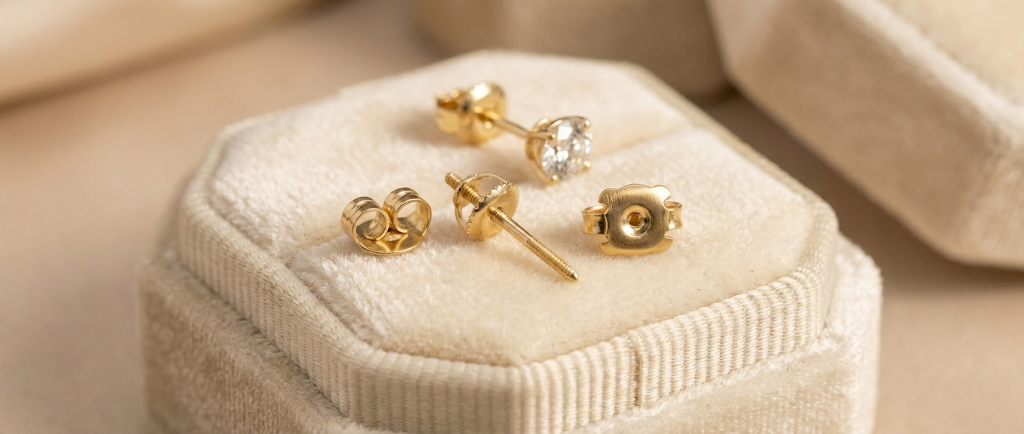
(Optimized for Google’s Answer Box) The most secure earring back is the locking back, also known as a “La Poussette” backing. This premium closure features a dual-action mechanical trigger. To slide the backing onto or off the earring post, you must squeeze both sides of the lock simultaneously. If the back accidentally catches on clothing, it locks into a special groove on the post, completely preventing the earring from falling out.
Are screw backs better than push backs?
Yes, screw backs are significantly more secure than standard push backs. While push backs rely solely on friction to stay in place (which can wear down and loosen over time), screw backs feature a threaded post. You have to literally screw the backing onto the earring like a nut on a bolt.
However, screw backs take a bit more time and dexterity to put on and take off. If you are someone who takes their Diamond Stud Earrings off every single night, you might find screw backs slightly annoying. But for security, they easily beat push backs.
What are friction backs (push backs)?
Friction backs, commonly called “push backs” or “butterfly backs,” are the standard closures found on most everyday earrings. They work by sliding onto a smooth earring post, relying on the tension of the curved metal loops (the “butterfly wings”) to grip the post tightly.
While they are extremely convenient and easy to use, they are not recommended for heavy or highly valuable earrings. Over time, the metal can stretch, reducing the friction and increasing the risk of the earring slipping off unnoticed.

Earring Back Comparison Chart
Here is a quick breakdown to help you choose the right closure for your lifestyle and budget.
| Closure Type | Security Level | Ease of Use | Best For |
|---|---|---|---|
| Push Back (Friction) | Low / Moderate | Very Easy | Lightweight, everyday fashion jewelry |
| Screw Back | High | Moderate (takes time) | Children’s earrings, valuable studs worn 24/7 |
| Locking (La Poussette) | Ultimate | Easy once learned | Heavy or expensive diamond studs |
Which earring back is best for heavy earrings?
For heavy diamond studs or large gemstone earrings, Locking Backs (La Poussette) or large-disc push backs are the best options. Heavy earrings tend to droop forward on the earlobe. A high-quality locking back, or a friction back with a wide, flat metal disc, will stabilize the earring and keep it sitting flush and straight against your ear.
According to jewelry experts at the AGS, regularly checking your earring backs for wear and tear is a crucial part of fine jewelry maintenance. If your push backs feel loose, a jeweler can easily tighten them or upgrade your posts to a more secure system.
Summary
Choosing between the different types of earring backs comes down to balancing convenience and security. For inexpensive fashion jewelry, standard push backs are perfectly fine. However, if you are investing in fine jewelry, especially diamonds, spending a little extra to upgrade to Screw Backs or La Poussette Locking Backs is the smartest way to protect your investment. Remember, it is always cheaper to buy a secure backing than to replace a lost diamond! To keep your secure earrings sparkling, don’t forget to read our guide on How to Clean Gold & Diamond Jewelry at Home.