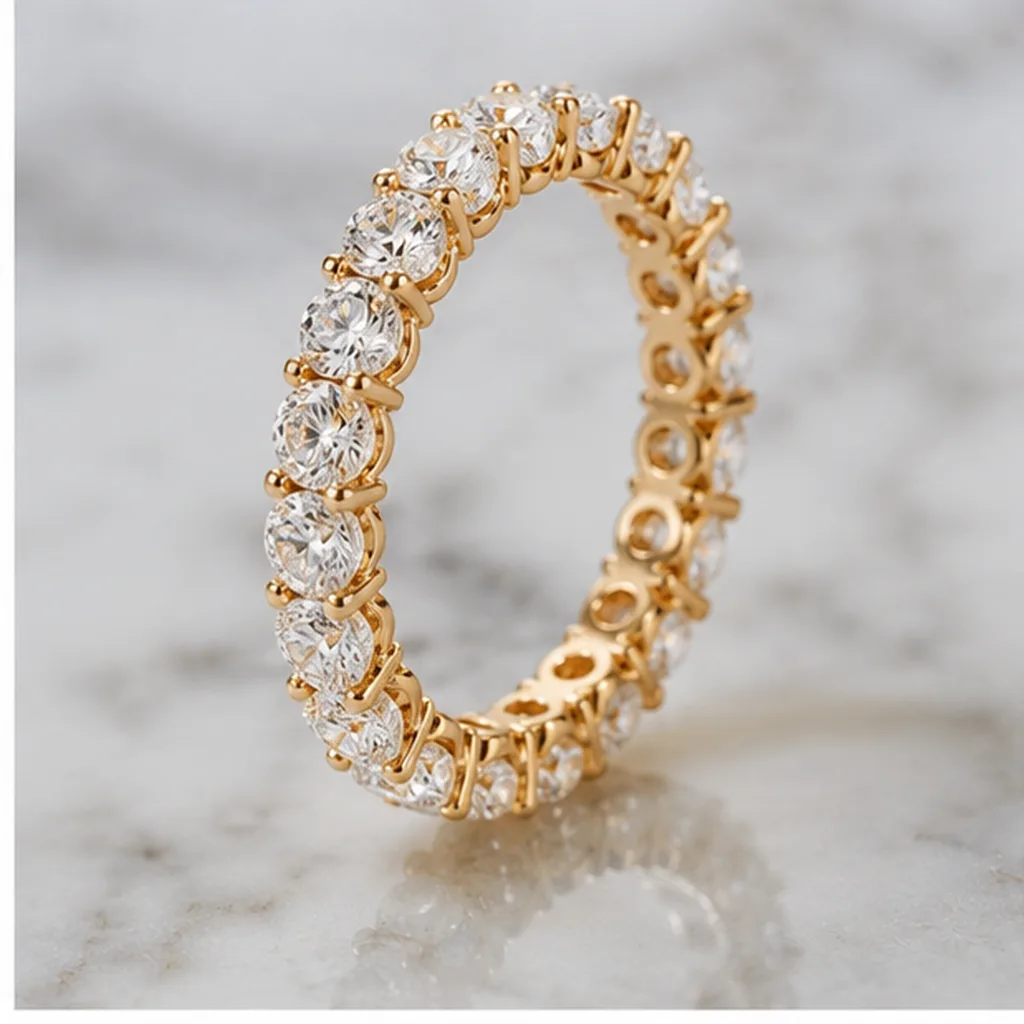


How to Clean Gold Diamond Jewelry at Home
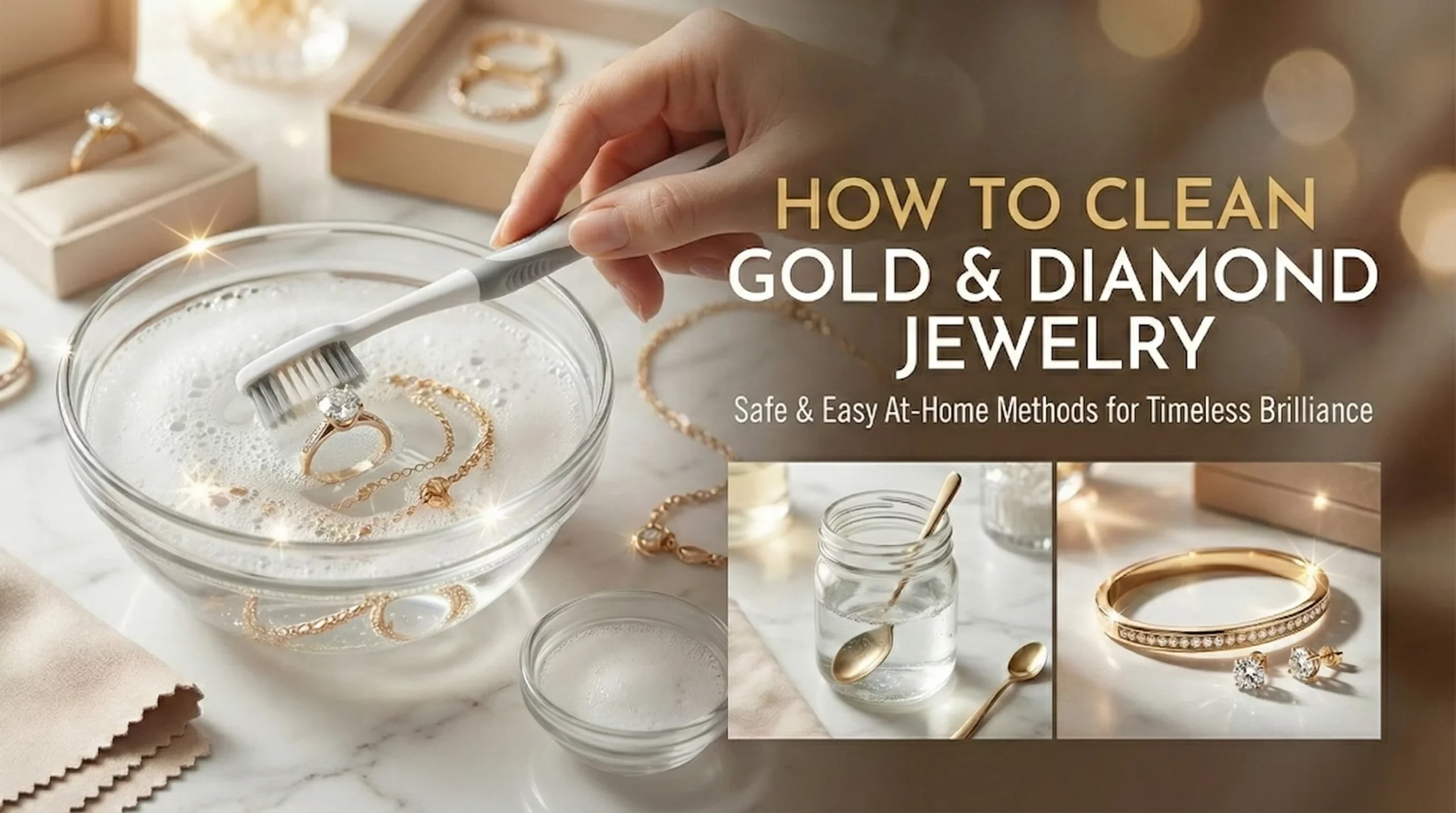
The Complete Guide: How to Clean Gold Diamond Jewelry at Home
Fine jewelry is rarely just an accessory. An engagement ring, an anniversary band or an heirloom pendant carries a story — and, usually, a significant financial value. Yet within a few months of daily wear, that same piece can start to look flat and lifeless. The culprit is almost never damage. It is a microscopic film of hand cream, sunscreen, soap residue, body oil and household dust that settles on the gold and, more importantly, underneath the diamond.
That film matters more than most people realize. A diamond sparkles because light enters through the table, bounces off the internal facets and returns to your eye. When the underside of the stone (the pavilion) is coated in grease, light is absorbed instead of reflected — and a beautifully cut stone can look as dull as a piece of glass. The good news: in most cases a ten-minute cleaning at your kitchen counter restores the brilliance completely.
Below you will find the method professional jewelers actually recommend, the mistakes that cause irreversible damage, and a realistic maintenance schedule for gold and diamond jewelry.
What Is the Safest Way to Clean Gold and Diamond Jewelry at Home?
The safest way to clean gold diamond jewelry at home is to soak it for 15–20 minutes in a bowl of warm water with a few drops of mild dish soap, gently brush it with a soft toothbrush — paying special attention to the back of the stone — rinse in lukewarm water over a plugged drain, and pat dry with a lint-free cloth.
This method is recommended because it is chemically gentle. It removes oils and grease without touching the metal’s structure, without abrading the polish, and without stressing the stone. The Gemological Institute of America (GIA) recommends a similar routine, including a soft toothbrush reserved exclusively for jewelry and particular attention to the underside of the diamond, where oils collect fastest.
What You Will Need
- A small bowl (never work directly over an open sink)
- Warm water — comfortable to the touch, never boiling
- A few drops of mild, dye-free liquid dish soap
- A soft-bristle toothbrush kept only for jewelry
- A lint-free cotton or microfiber cloth
- Optional: a small strainer for rinsing small items safely
Step-by-Step: The Home Cleaning Process
- Prepare the solution. Fill a small bowl with warm water and add a few drops of mild dish soap. Avoid soaps with moisturizers, exfoliating grains or heavy dyes — they leave a residue of their own.
- Soak. Place the jewelry in the bowl and leave it for 15 to 20 minutes. Soaking is the step most people skip, and it is the one that does most of the work: it softens hardened oils so the brush barely has to scrub.
- Brush gently. Remove one piece at a time. Using the soft toothbrush, work around the setting, between the prongs, along the gallery and especially across the back of the diamond. Use light pressure — you are lifting residue, not polishing metal.
- Rinse. Rinse under a gentle stream of lukewarm water to remove every trace of soap. Plug the drain first, or rinse the piece inside a small strainer. More rings are lost down drains than are damaged by cleaning.
- Dry completely. Pat dry with a lint-free cloth and allow the piece to air-dry for a few minutes before storing. Trapped moisture under a stone can leave water spots and, over time, encourage tarnish on the alloy metals.
- Inspect while it is clean. A freshly cleaned ring is the easiest time to check prongs, look for a loose stone and spot thinning metal on the shank.
Common Cleaning Mistakes That Cause Real Damage
Most “jewelry cleaning hacks” circulating online were written for costume jewelry, not for fine gold and diamonds. These are the ones worth avoiding:
- Bleach and chlorine. Gold’s worst enemy. Chlorine attacks the alloy metals in karat gold and can cause stress-corrosion cracking — a failure that often appears first in the thin prongs holding your diamond. GIA explicitly warns against chlorine-based household products. This includes swimming pools and hot tubs.
- Toothpaste. Toothpaste is a mild abrasive designed to scrub enamel. On 14k and especially softer 18k gold it leaves a haze of fine scratches that permanently dulls the finish.
- Baking soda and salt pastes. Same problem: abrasive particles plus soft precious metal equals micro-scratching.
- Boiling water. Sudden temperature swings cause thermal shock. Diamonds with existing feathers, and most colored gemstones, can fracture.
- Over-polishing with a cloth. Polishing cloths remove a microscopic layer of metal each time. On rhodium-plated white gold, aggressive polishing strips the plating faster than daily wear does.
- Ammonia on anything but plain gold and diamond. Ammonia-based solutions work well on solitaire diamonds set in gold, but they should be kept away from pearls, opals, emeralds and any treated or porous stone.
Are Ultrasonic Cleaners Safe at Home?
Ultrasonic cleaners are excellent on a plain diamond in a sturdy gold setting — and genuinely risky on almost everything else. The vibration that shakes dirt loose can also shake a loose stone out of its setting, and the heat plus the cleaning solution can damage treated or porous gems.
GIA advises keeping the following out of an ultrasonic cleaner:
| Category | Examples | Why it is unsafe |
|---|---|---|
| Fracture-filled stones | Clarity-enhanced diamonds, oiled or resin-filled emeralds | The filling is not permanent and can be damaged or removed |
| Organic gems | Pearls, coral, amber, jet, ivory, shell cameos | Porous — damaged by heat and cleaning chemicals |
| Heat-sensitive gems | Tanzanite, opal, moonstone, sunstone, iolite, kunzite, fluorite, topaz, turquoise, zircon, lapis lazuli, malachite | Susceptible to heat and rapid temperature change |
| Phenomenal stones | Star ruby, star sapphire | Should not be used; even transparent ruby and sapphire require caution |
| Fragile settings | Antique, filigree, tension-set or pavé pieces | Vibration can loosen small stones and delicate metalwork |
If you are not certain what is in your piece — and with vintage and inherited jewelry you often cannot be — the safe answer is soap and water at home, and an ultrasonic or steam clean at your jeweler, who can inspect the setting first.
How Often Should You Clean Gold Diamond Jewelry?
Frequency depends far more on how you live than on the piece itself.
| How you wear it | Home cleaning | Professional check-up |
|---|---|---|
| Engagement ring, worn daily | Every 1–2 weeks | Every 6 months |
| Wedding or eternity band, worn daily | Every 2–4 weeks | Every 6–12 months |
| Earrings and pendants, worn often | Every 4–6 weeks | Once a year |
| Occasion pieces | Before and after each wear | Every 1–2 years |
| Hands-on work, gym, gardening, healthcare | Weekly | Every 4–6 months |
Home cleaning restores sparkle. It does not replace a professional inspection, which is the only reliable way to catch a worn prong or a thinning shank before a stone is lost.
Home Cleaning vs. Professional Cleaning
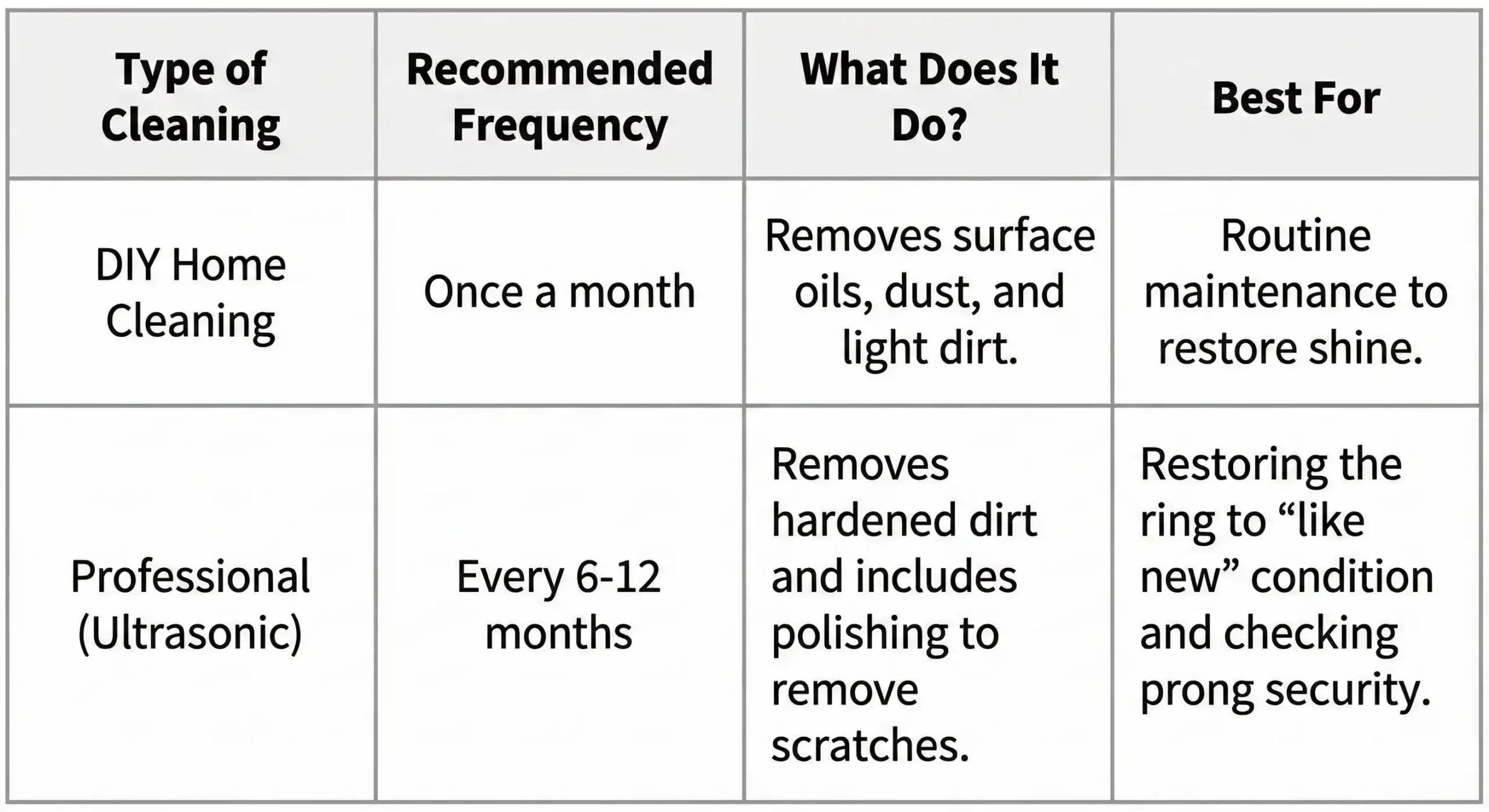
A jeweler’s service does three things your kitchen cannot: ultrasonic and steam cleaning reach into places a brush cannot, magnified inspection reveals wear you cannot see, and any tightening or re-tipping of prongs happens on the spot. Most reputable jewelers — including us — offer cleaning and inspection for their own pieces at no charge. It is the cheapest insurance in fine jewelry.
Seven Habits That Keep Jewelry Cleaner for Longer
- Last on, first off. Apply perfume, hairspray, sunscreen and lotion first; put jewelry on last. Reverse the order at night.
- Remove it at the gym. Sweat is mildly acidic, and gripping a bar or dumbbell is one of the most common ways a ring shank gets bent out of round.
- Never swim in it. Chlorine and salt water both attack karat gold alloys; cold water also shrinks fingers, which is how rings disappear at the beach.
- Take it off for cleaning and gardening. Household cleaners, solvents and soil are harsher on gold than anything else in a normal week.
- Store pieces separately. Diamond is the hardest natural material on Earth, which means your diamond ring will happily scratch your gold chain. Use individual pouches or a partitioned box.
- Check the prongs monthly. Hold the ring next to your ear and tap it gently. A faint rattle means a loose stone — stop wearing it and see a jeweler.
- Keep the receipt and the report. An up-to-date appraisal and grading report make insurance claims dramatically simpler.
Special Case: White Gold That Looks Yellow
If your white gold ring has developed a warm, yellowish tint — usually starting on the underside of the band — cleaning will not fix it. White gold is a gold alloy finished with a thin layer of rhodium, and that layer gradually wears away with friction, revealing the naturally warmer alloy underneath. The fix is a quick professional re-plating, not a stronger cleaner. We explain the whole process in Why Is My White Gold Turning Yellow?
When to Stop Cleaning and Call a Jeweler
- You can see or feel movement in the center stone
- A prong looks bent, flattened or shorter than the others
- The band has a visible thin spot or a hairline crack
- The piece is antique, filigree or contains an unidentified colored stone
- The stone still looks cloudy after a proper soak — this can indicate an internal issue rather than surface dirt
Frequently Asked Questions
Can I clean my diamond ring with vinegar?
It is not recommended. Vinegar is acidic and, while it will not harm the diamond itself, repeated exposure can affect the alloy metals in karat gold and any treated colored stones in the piece. Mild dish soap and warm water is both safer and more effective on the oils that actually cause dullness.
Does rubbing alcohol clean diamonds?
Isopropyl alcohol is very good at cutting through oil on a plain diamond in a gold setting, and jewelers use it for exactly that. Keep it away from pearls, opals, emeralds and anything with glued components, and always rinse afterwards.
Why does my diamond get cloudy so quickly?
Almost always hand cream, soap film or sunscreen. Diamonds are naturally oleophilic — they attract grease. Frequent hand-washing with moisturizing soap is the single most common reason an engagement ring looks dull within days of a cleaning.
Is it safe to clean gold jewelry with a toothbrush?
Yes, provided the bristles are soft and the brush is used gently and kept exclusively for jewelry. Medium and hard bristles, and brushes that have been used on teeth and carry abrasive toothpaste residue, can scratch gold.
How do I clean a pavé or halo setting?
Soak longer — up to 30 minutes — and brush more gently, working from the back where dirt packs in behind the small stones. Avoid ultrasonic cleaners at home: micro-pavé stones are held by tiny beads of metal that vibration can loosen.
Can I clean gold jewelry that has pearls or emeralds in it?
Only with a barely damp, soft cloth and plain water. Pearls are porous and their nacre is easily dulled; emeralds are commonly oil- or resin-treated and soaking can strip that treatment. Both should be professionally cleaned.
Keeping the Sparkle for a Lifetime
Cleaning fine jewelry is not complicated — it is just easy to do badly. Warm water, mild soap, a soft brush and patience will restore almost any gold and diamond piece to the way it looked in the showroom. Everything harsher than that belongs in your jeweler’s workshop, not your bathroom cabinet.
Every Camellia Jewelry piece is handcrafted to be worn every day, and we are always happy to clean, inspect and refresh a ring we have made. If you are considering a new piece — or a vintage-inspired design of your own — explore our handcrafted engagement rings or read about how our custom rings are made.
Related reading: 14k vs 18k Gold · White Gold vs. Platinum · Natural vs. Lab-Grown Diamonds
Sources and further reading: GIA — How to Clean Your Diamond Jewelry; GIA — Ultrasonic Cleaners for Gems.