

Category: Blog
3 ways to propose this 4th of July
A 4th of July proposal is one of the most romantic gestures you can make! The 4th of July combines summer celebrations, fireworks, and a special atmosphere — perfect for proposing to your partner.). Independence Day festivities are a way to show your love not only for your country but for your special someone.
Say It With Food: A 4th of July BBQ Proposal
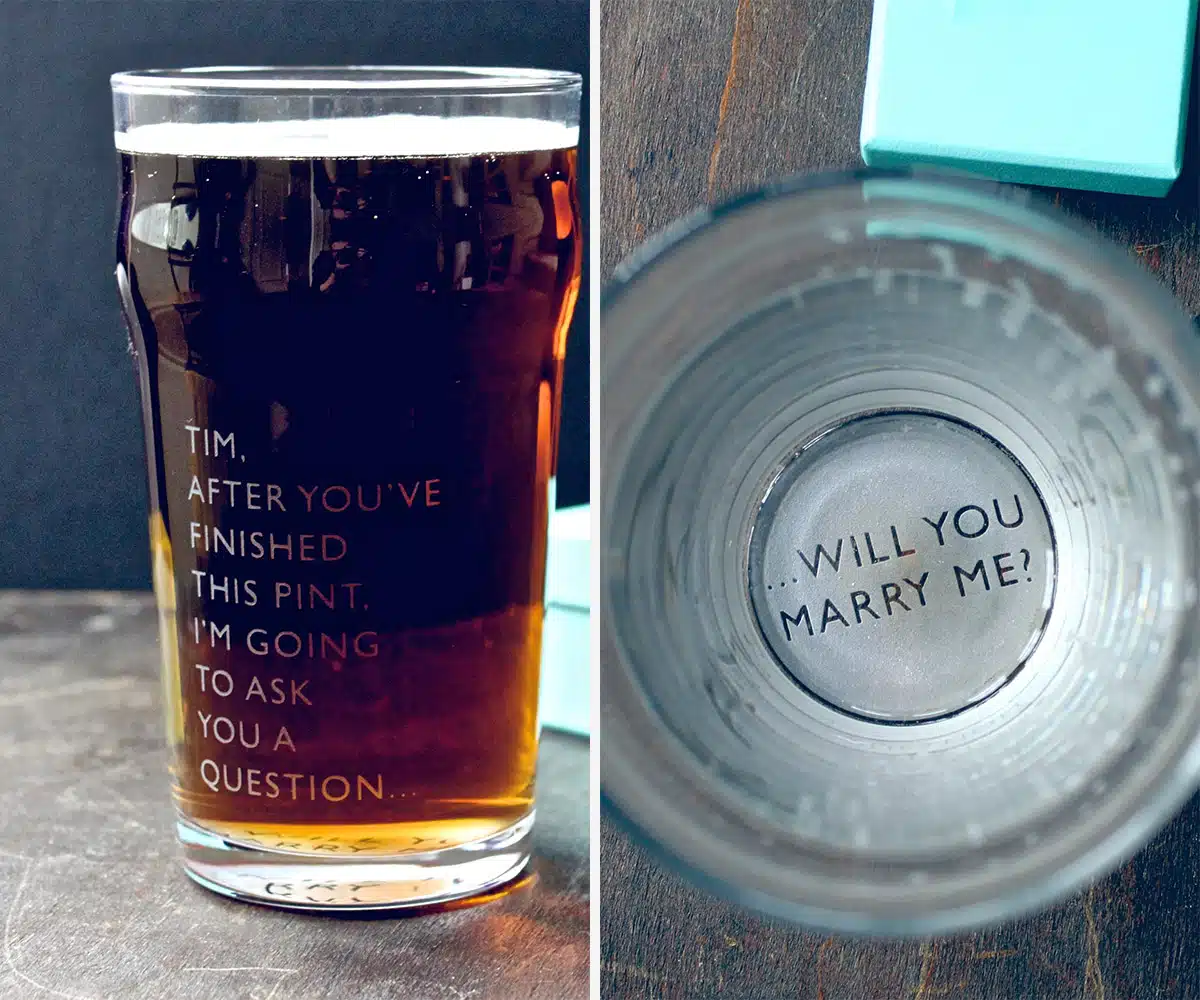
A 4th of July BBQ is a great way to propose! Invite your closest friends and family to share this special moment. Spell love words using hotdogs; add a proposal text at the bottom of the beer glass; drop to one knee in front of everyone or propose a toast, and then asking for her hand in marriage and ask his or her hand in marriage.
(Glass by Vinegar and Brown Paper – you HAVE to see their creations!)
Say it with your dog
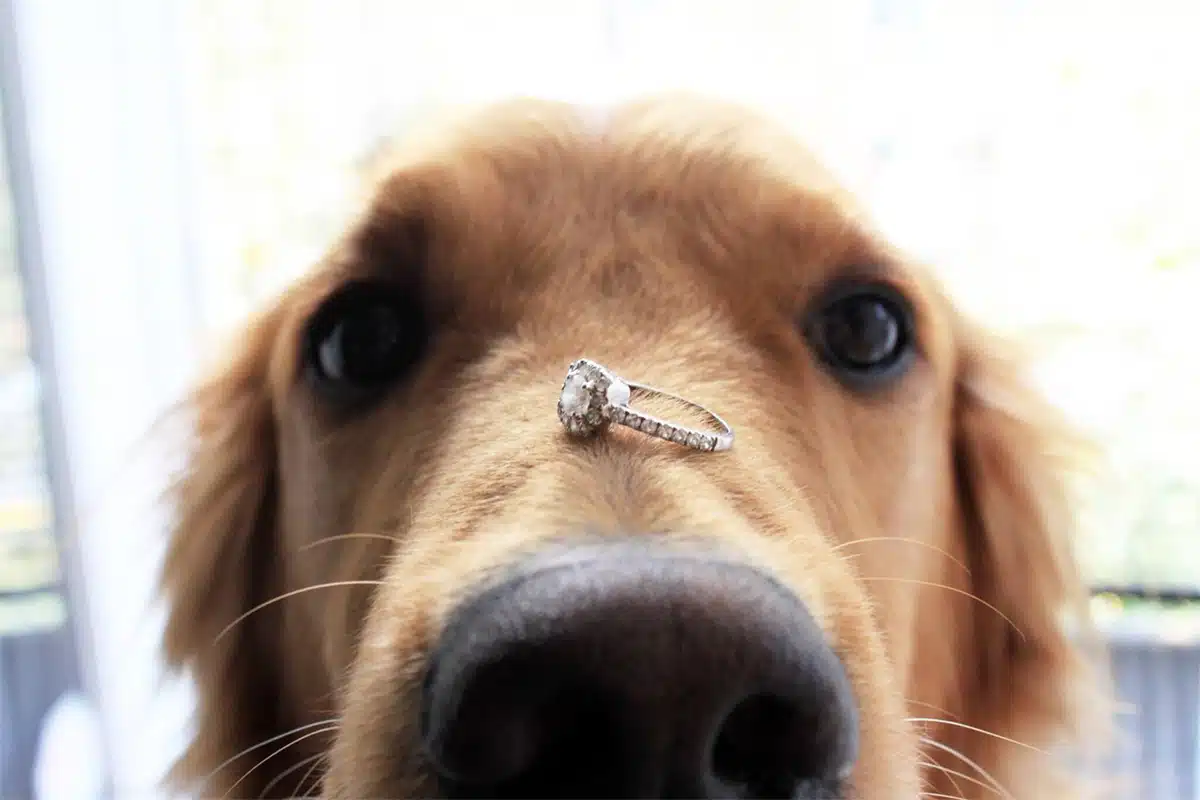
Your furry friends can be part of the magical moment too – have your dog carry a “marry my dad” sign, hold the ring box or bring in a puppy! Dogs work best for this, but cats and other pets can also deliver the surprise!
Say it with fireworks
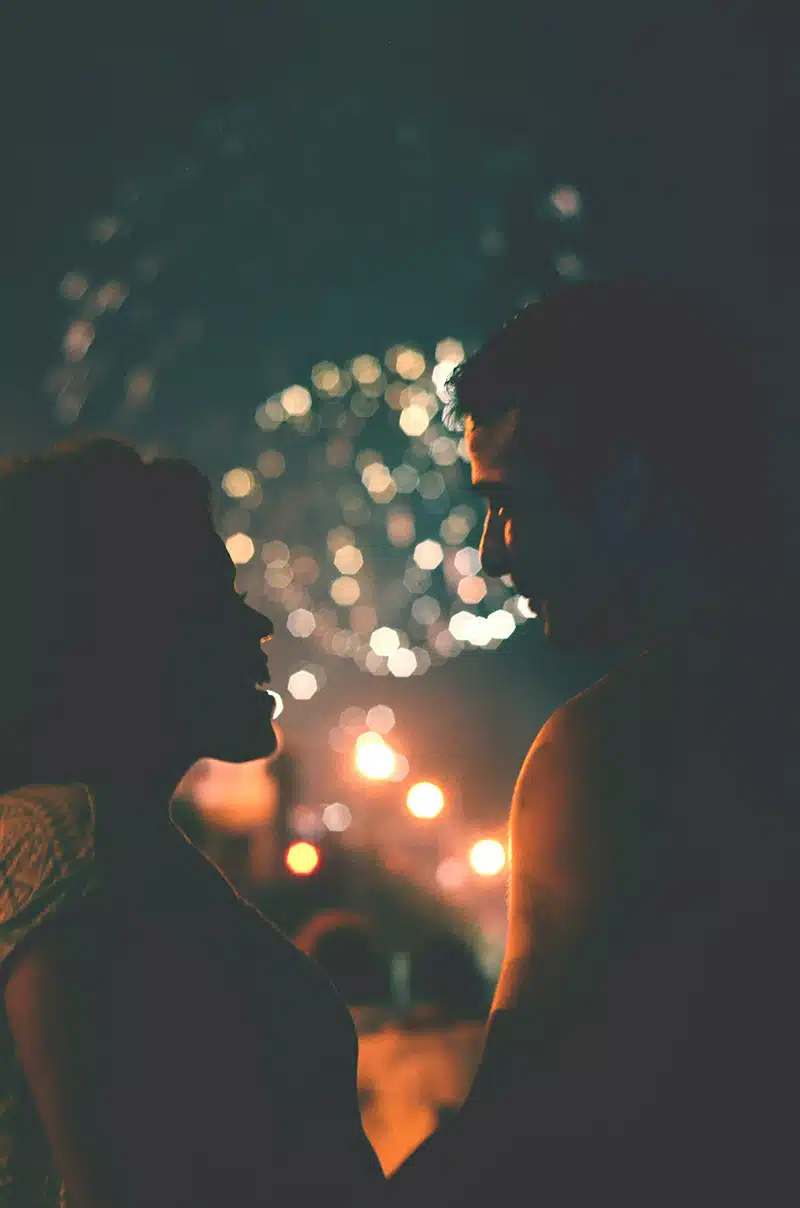
Make sure you have a great spot to both enjoy the fireworks, while not being run over by the crowd – otherwise bending on one knee will just get you stepped on by someone else. The silhouette of a proposal against bright fireworks looks amazing. Ask a friend to capture the moment!
[image via unsplash]
Ready to find the perfect ring for your 4th of July proposal? Browse our engagement ring collection to find a sparkler as brilliant as the fireworks. Additionally, personalized jewelry makes this special day even more unforgettable. Moreover, a custom ring adds a truly personal touch to your proposal story.


5 Wedding Accessories With a Twist
If you feel you’ve seen it all when browsing through bridal magazines or Pinterest boards – we know the feeling. Everything kind of looks the same at the end, so what would make your appearance stand out and truly be unforgettable? We’ve got the solution. Wedding accessories with a twist! They’re special, they’re a great way to make a minimal dress pop, and they also make a perfect way to change your look during the event, instead of a total dress change.
Check our recommendations for utterly unique wedding accessories:
Cape
Yes, cape. Not just for superheroes, but also for brides who are looking modern alternatives to the traditional veil. Bridal capes are definitely statement-making, from ultra-glam to the demure ones. There are so many options to choose from, with so many styles, colors, fabrics, and embellishments – pearls, sequins, feathers and more.
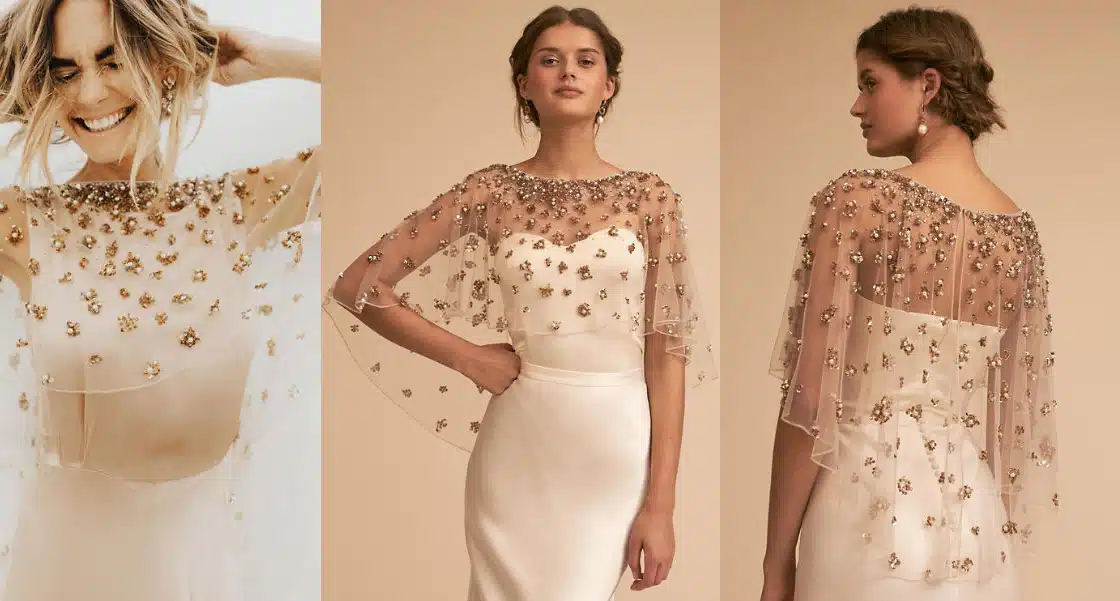
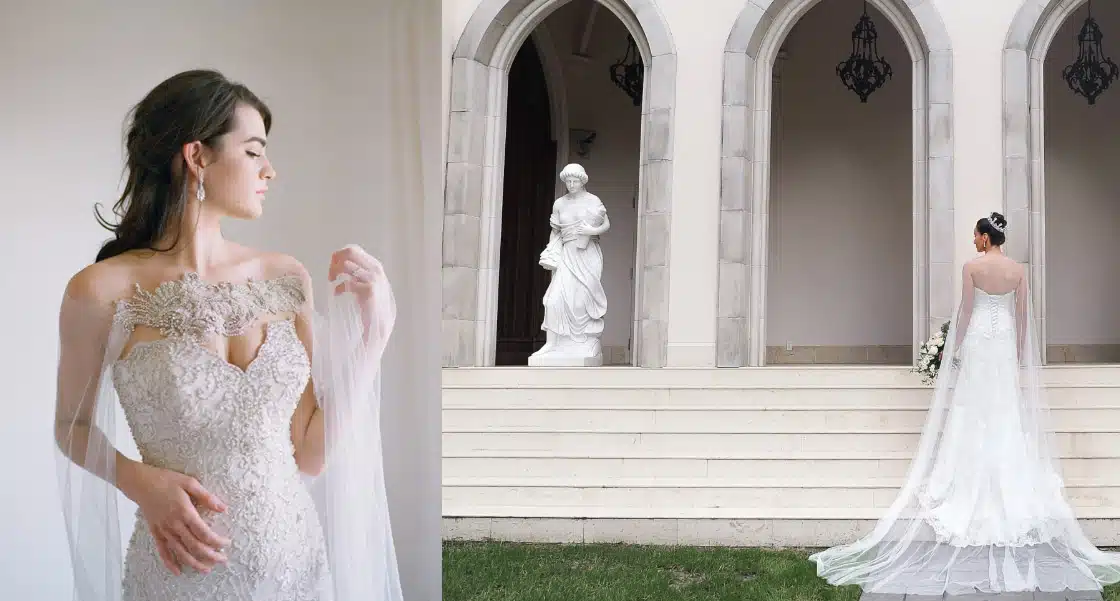
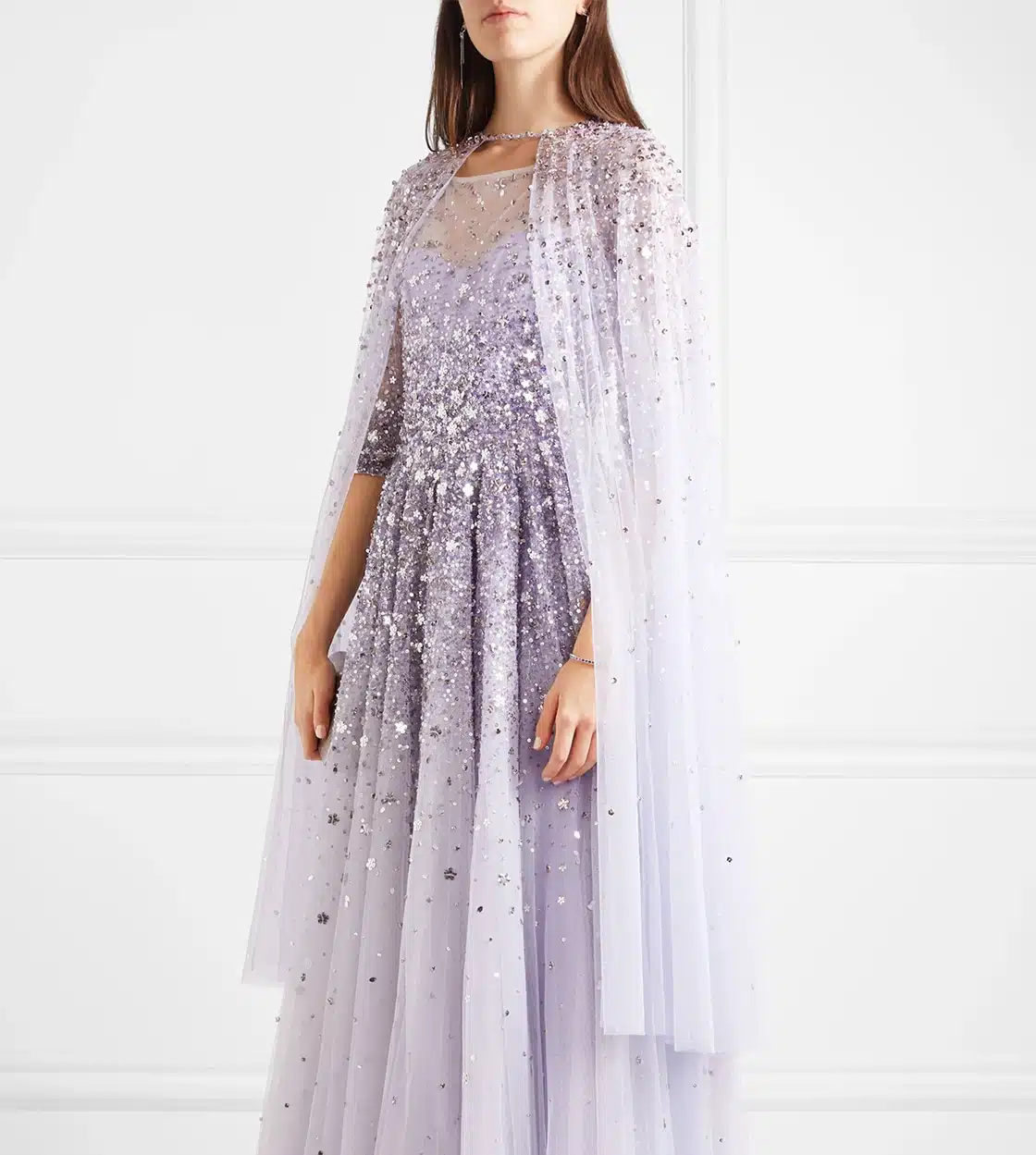
Shoulder necklace
Bridal shoulder necklaces add a glam, wow-factor to your bridal look, putting a twist on the traditional statement necklaces (or being THE statement necklaces of them all). These include bridal shoulder jewelry pieces, jewelry capelets, and crystal boleros, ideal for strapless and off-the-shoulder gowns.
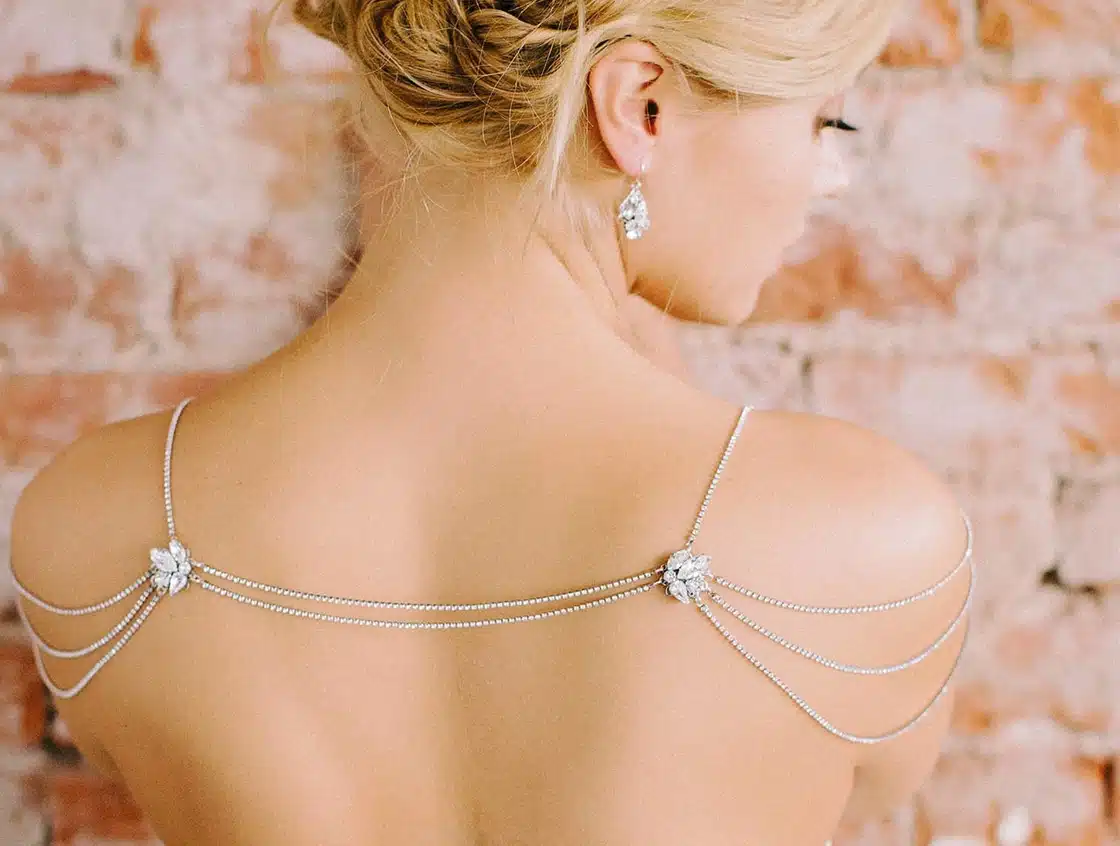

Boucheron Cape de Lumiere (super expensive, but oh so gorgeous)
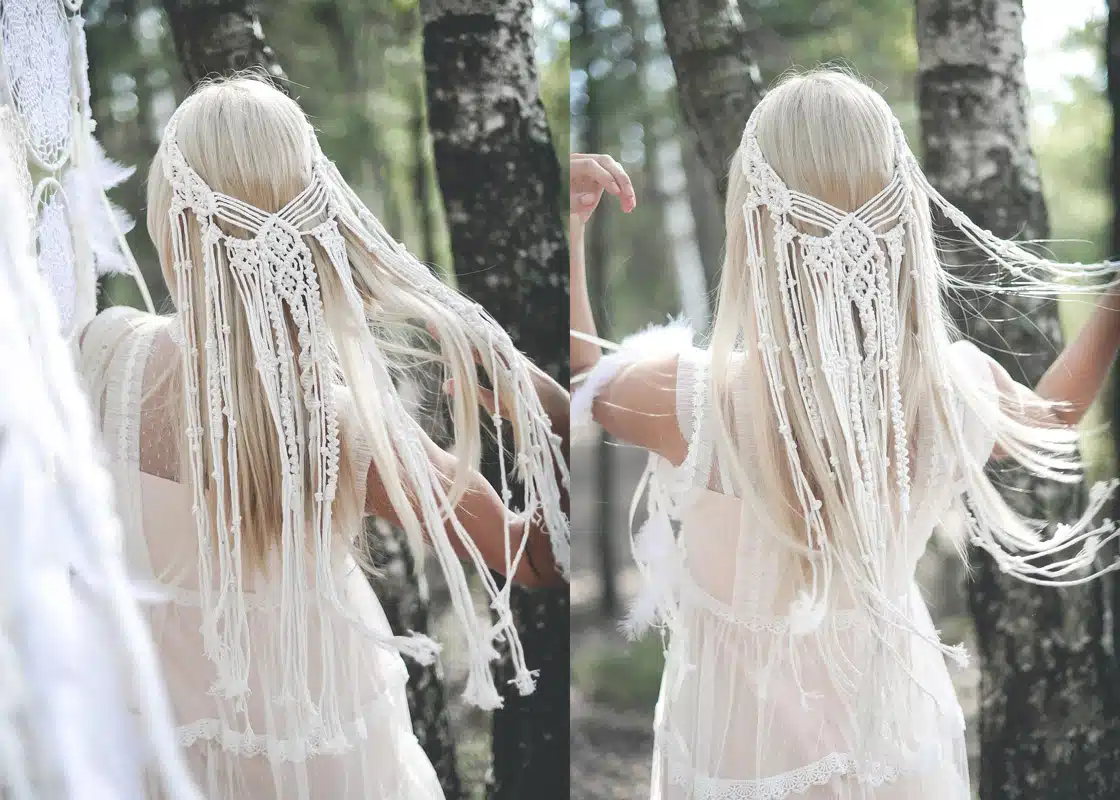
Macramé Wedding Veil
If you love the Boho look, with its handcrafted feel and sense of flow, then a macramé wedding veil is a perfect bridal accessory that will surely turn your guests’ heads.
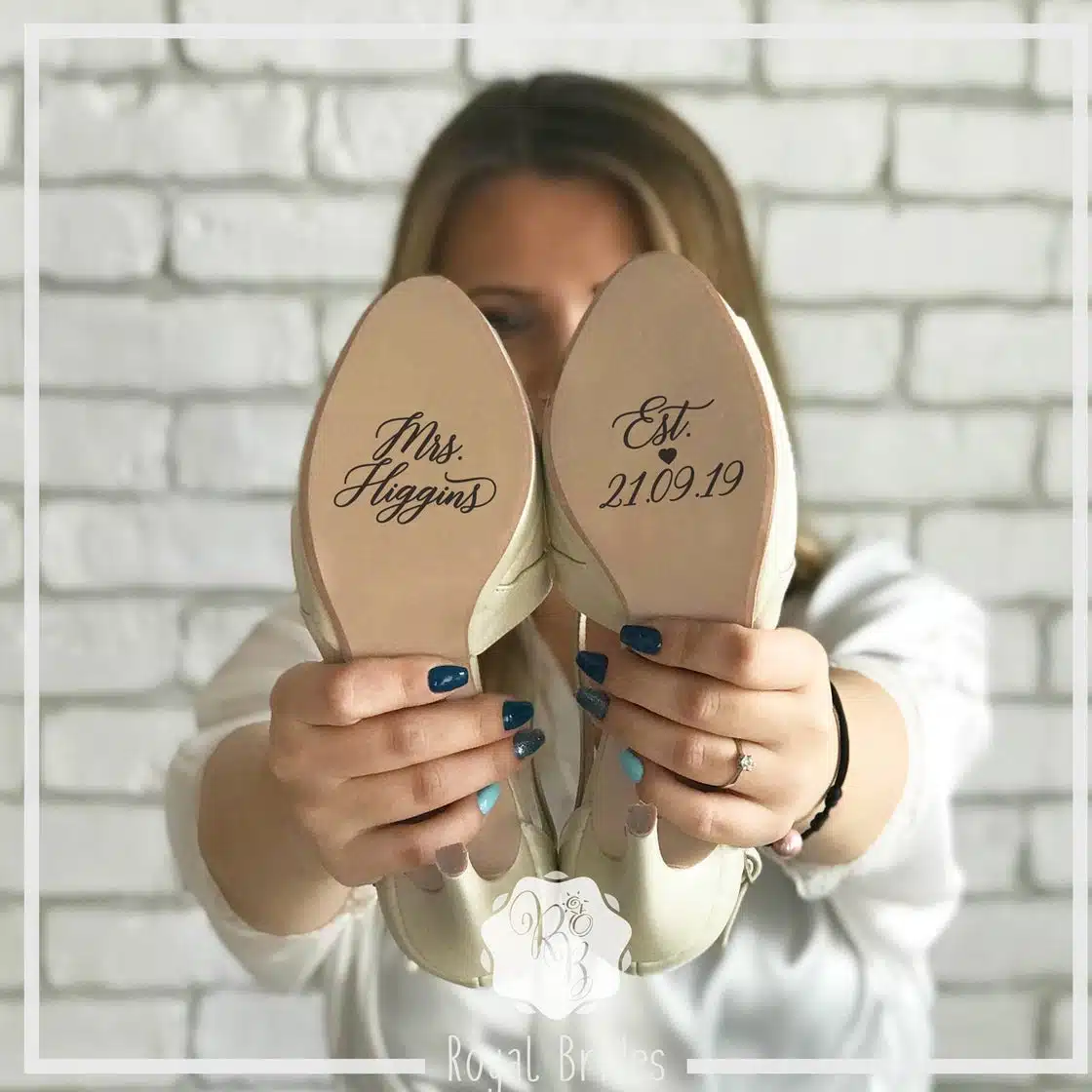
Wedding Shoe Decals
Finding the perfect wedding shoes are as important as finding the perfect dress. They have to be comfortable, to fit, to go with the wedding dress or theme. Wedding shoe stickers are a great way to upgrade the shoes you have, to decorate the soles of your shoes for the walk down the aisle, and to add an extra touch of personalization to your special event.
Hoop Bouquets
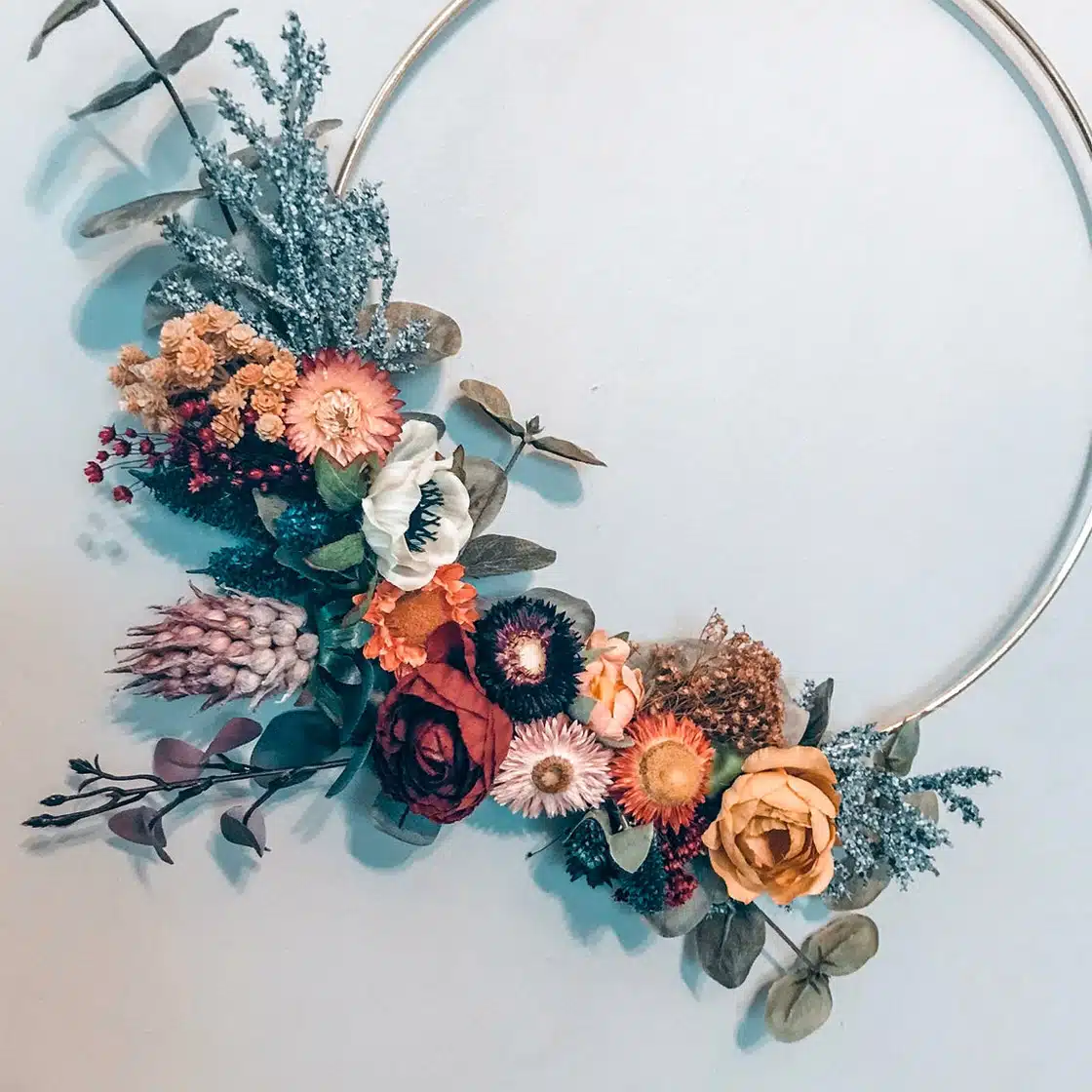
Half-floral arrangements, half-accessories – the wedding bouquets are a blooming trendy take on the bride’s, bridesmaids, and even flower girls bouquets, (and they also make a gorgeous decor option). Classic, rustic, tropical, leafy, based on dried flowers, cascading or minimal- the options are endless also with this accessory. They’re way more practical – since they can be carried easily, and it’s going to be much easier to catch the bride’s bouquet that way!
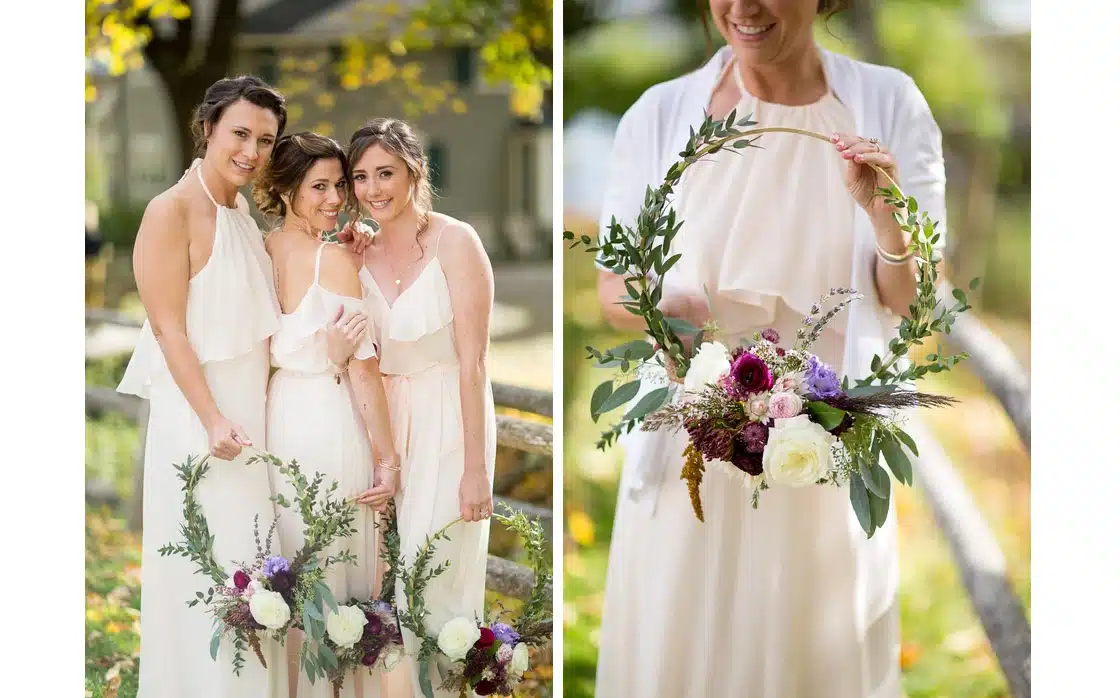
Tracey Reinolds Flower Design | Photos by Erin H. Photography
What’s your favorite of them all?
The Origin of Diamond Cuts- And How They Got Their Names
So by now, we all know the differences between LCD, diamonds, and moissanite. But what about the shapes and cuts? Let’s go back to the roots to discover the stories behind these cuts and how they got their names. The quick guide below gives the lowdown on the origin of diamond cuts.
Princess
This fancy shape was only introduced a few decades ago, but has since become one of the most popular shapes for engagement rings. When looking down on a princess-cut diamond, they can appear as a square, however, from the side, they resemble more of an inverted pyramid.
How long has this gorgeous cut been around? Well, there’s some confusion there. Many believe the history of the princess cut dates back to the 1970’s. This was also when a new shape, “the Barion Cut”, was introduced by Basil Watermeyer. This particular cut was actually more of a combination between an emerald cut and marquise cut. Princess diamonds actually date back to 1961 when a London based diamond cutter, Arpad Nagy, created what was known then as the “profile cut”. That same cut is now known as the princess cut. After a few years, Betzalel Ambar, Ygal Perlman, and Israel Itzkowitz popularized the new name, which is why we all know them now as “princess cuts”.
This square stone features 58 facets, which allows it to really show off the diamond’s unique sparkle. It offers a similar shine to the round brilliant diamond due to their similar facet positions.

Marquise
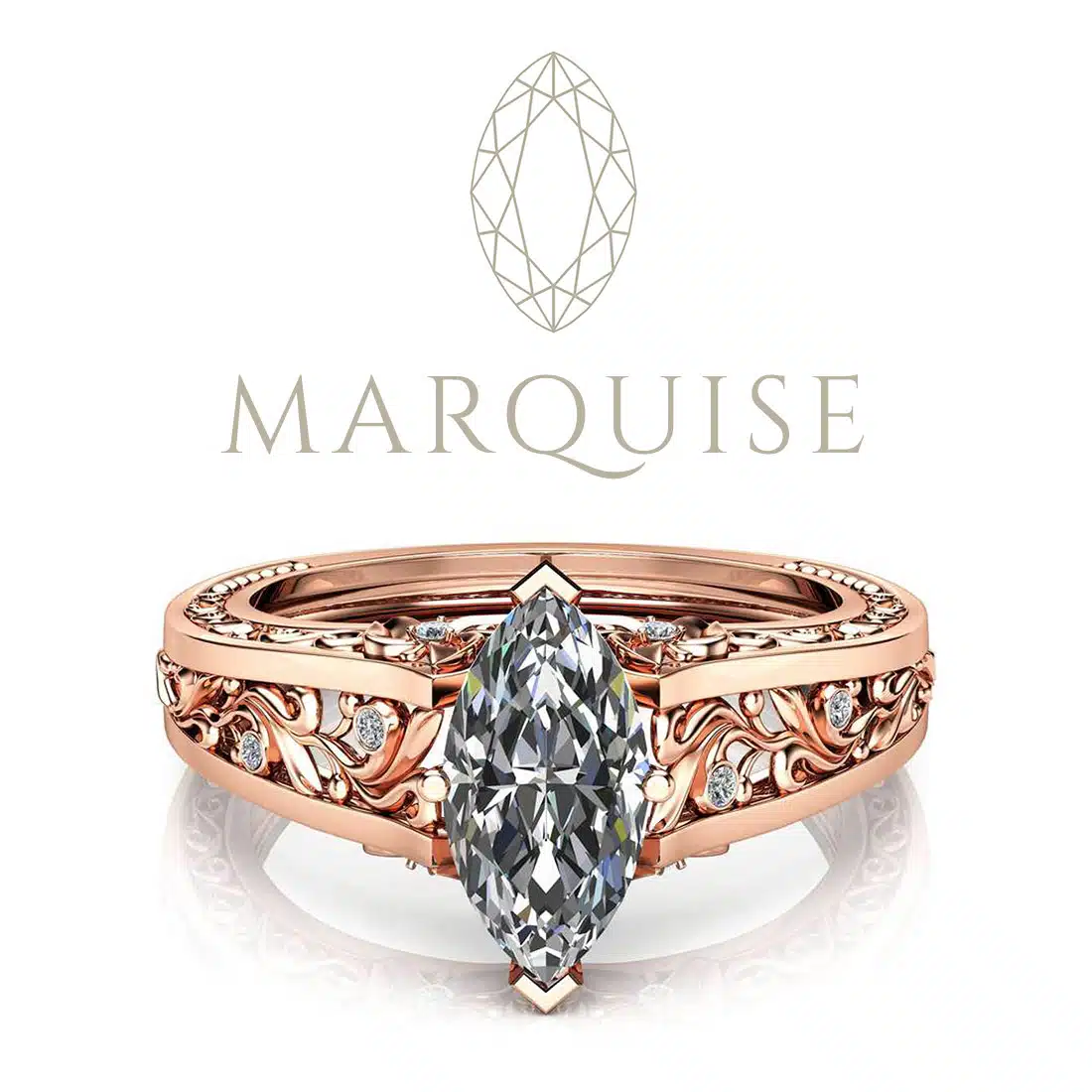
A marquise-cut diamond features 58 facets and an elliptical shape with pointed ends. And this exquisite shape has an interesting history. In the mid-18th century, King Louis XV of France commissioned his court jeweler to cut a diamond in the shape of the lips of his favorite mistress Jean Antoinette Poisson. She was known as the Marquise de Pompadour (or more commonly referred to as Madame de Pompadour). Marquise cuts are also known as “navette” cuts, which means “little ship” in French. Along with a football-shaped cut (hmmm… where’s the romance?); and the eye-shaped cut.
Pear
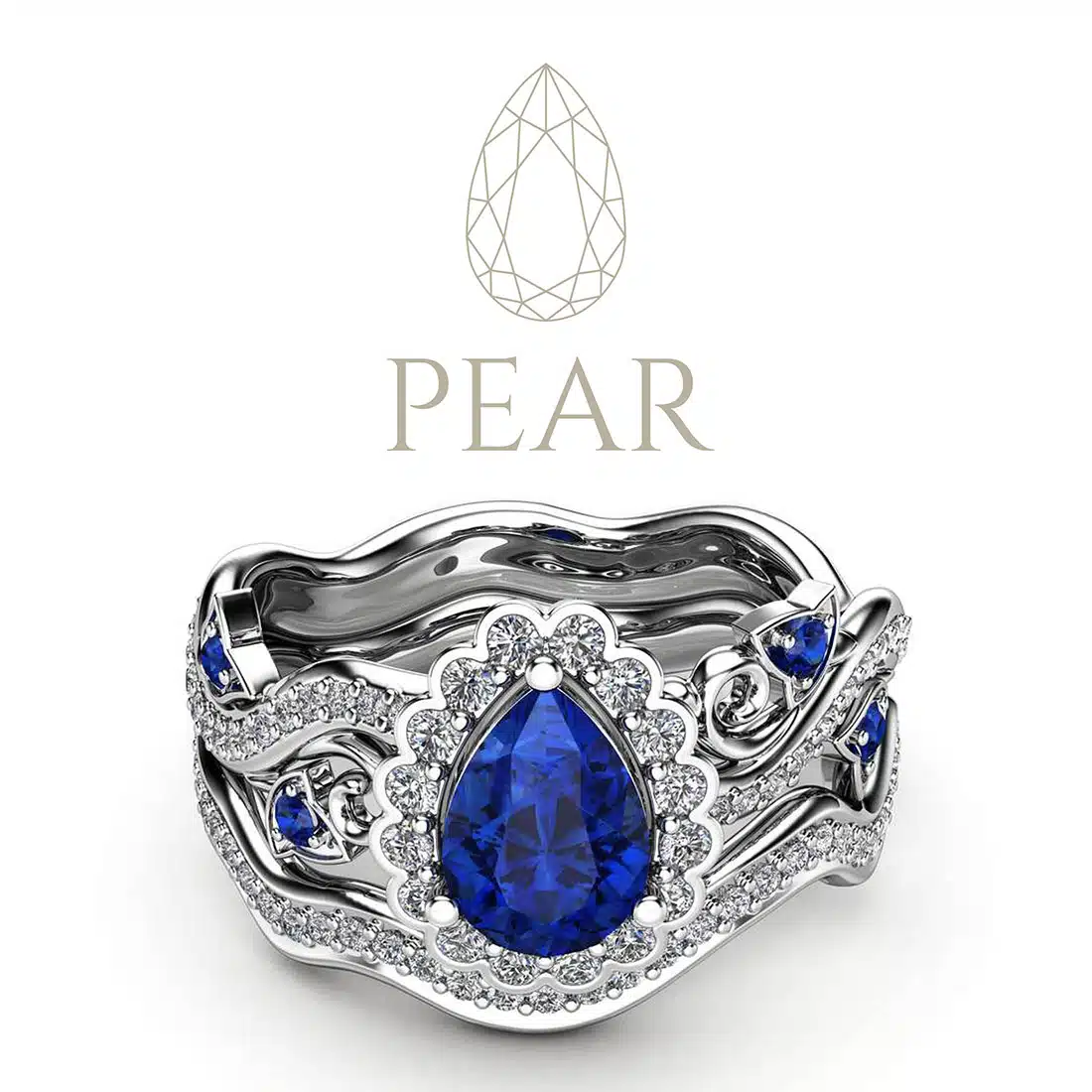
The pear shape, often referred to as the teardrop cut, was invented in 1458 by Flemish diamond polisher, Lodewyk van Bercken. He also invented the Scaife polishing wheel, which transformed the diamond trade. It enabled him to cut facets into diamonds with precision and opened the door to more complex diamond cuts.
This diamond combines the brilliance and design of the round and marquise cuts into one unique shape. Despite the positive response to the shape, when it first debuted many people were not happy with the amount of rough diamond lost during the cutting process. Over time, however, the pear shape grew in popularity.
Cushion
The cushion shape is almost like a rounded square. It gets its name for being shaped like a pillow. Its origins can be traced back to the 1800’s. At the time, the cut was referred to as the “mine cut,” named after the Brazilian diamond mines (called “old mine” once diamonds were found in South Africa as well). While similar in shape, today’s cushion cut has 64 facets while the “mine cut” had 58. The many facets that make up the cushion allow for more light to flow through the stone. Which makes it one of the most brilliant cuts compared to the rest.
Emerald cut
Emerald cuts have been around for thousands of years. Initially, it was used on emerald stones. But, diamond cutters eventually began to incorporate the cut into diamonds as well. The name “emerald cut” was not used until the 1920’s. This is when it reached the peak of its popularity. The emerald cut’s clean lines and symmetry fit in perfectly with the art deco style of the decade. An emerald shaped diamond is created by using step cuts, which, as the name suggests, resemble steps on a staircase.
Asscher
The Asscher cut is one of the first patented diamond cuts in the world. It was invented by Dutch master diamond cutter, Joseph Asscher of the Royal Asscher Diamond Company in 1902. Like the emerald shape but in square format, Joseph was able to create a more brilliant cut by giving the diamond larger step facets, a higher crown, and a smaller table. The classic looking Asscher has 58 facets and cropped corners that give it the appearance of an octagon.
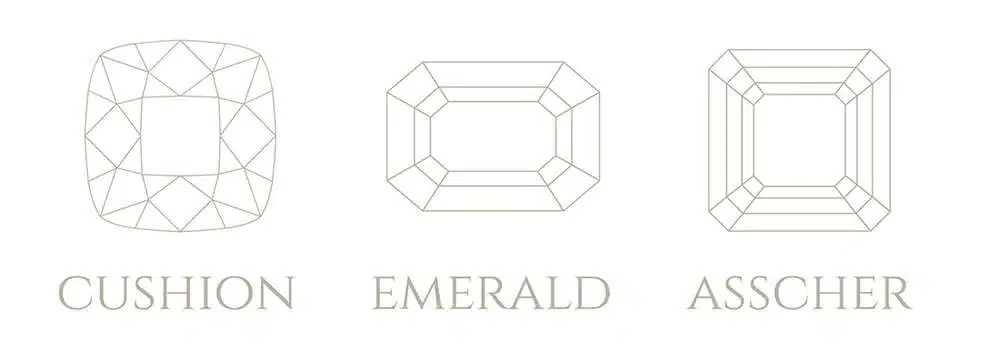
After reviewing the origins of the infamous diamond cuts- Tell us which one’s your favorite? If you’re still not sure, you can visit our collection and browse for some inspiration.
Yellow! Sapphires and Diamonds
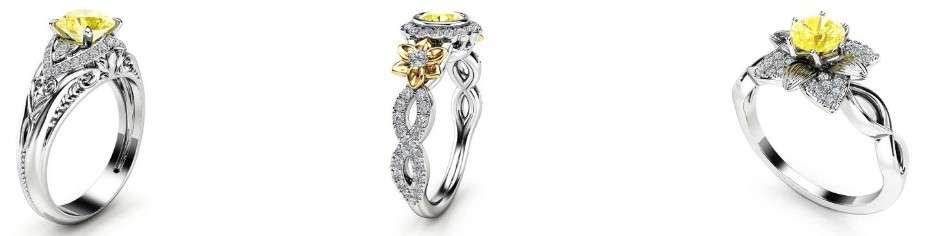
Yellow sapphires come in a wide range of yellows from light to dark and with varying levels of vibrancy. At first glance, yellow sapphire and a yellow diamond may look fairly similar. But there are some major differences between them. Your own preferences, budget, and personal style will be the ones to determine which one is the better option for the engagement ring of your dreams.
Here’s a quick guide to the unique qualities of each:
Shades & Features
We already know diamonds come in a range of colors. From blue to black, from pink to brown, and of course yellow! A yellow diamond (also known as a canary diamond) can range in color from a pale to deep vibrant shades. Yellow diamonds have an undeniable allure that has fueled their popularity for decades. Fortunately, yellow diamonds are also among the most widely encountered. Which typically makes them more affordable than other colored diamonds.
Sapphires (which are often associated with blue – and pink) also come in a range of yellow tones. From light to dark, some featuring orange undertones, or even intensive greenish tones. The one consistency is that the brighter and purer the yellow color, the more valuable the sapphire.
Durability
Both sapphires and diamonds are durable. Sapphires are rated a 9 out of 10 on the Mohs Scale of Hardness. While diamonds are rated a perfect 10. So, even though sapphires are resistant to scratches and other types of damage, diamonds are still the better choice when it comes to durability. You should also know that the color of some yellow sapphires may fade over time if exposed to heat and sunlight for long durations.
As we continue to see colors and personalized choices make the trends in engagement rings and bridal jewelry – yellow certainly makes its mark as a striking choice. Both in yellow diamonds and yellow sapphires.
Which do you prefer? Diamonds or Sapphires? Let us know on our Facebook or Instagram pages
Check Out Our Collection of Yellow Diamonds and Sapphires
Yellow Color Palette for Your Wedding
A yellow wedding color palette is bright and cheerful! This color works beautifully for spring and summer celebrations. However, yellow is no longer an underused color — in fact, its popularity has risen sharply in recent years.
How to Use Yellow in Your Wedding Décor
The secret is to use various shades of yellow and combine it with a completing color. As a result, you get a cheerful, unique wedding decor that’ll bring smiles to everyone’s faces (and tears of excitement in the proper moment, of course). Check out our yellow inspirations for the dream wedding:
Yellow and Mint – It was mint to be
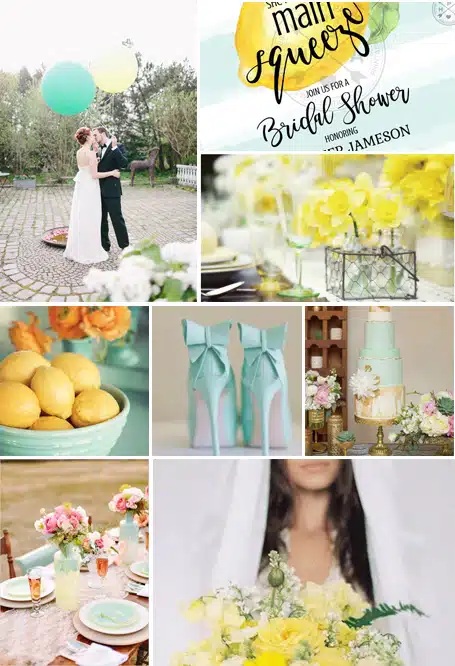
Fresh and playful, this color combo brings the joy of the summer, with the coolness of the mint. Absolutely loving this.
couple with balloons: Carmen and Ingo Photography via burnettsboards | wedding invitation: Hayley Paper Arts | table decor photo: Hoffmann Photographer via Wedding Chicks | lemons in a bowl: Meadow Brook | bow heels: my little white wedding | wedding cake: 100layercake | wedding bouquet photo: Wendy Laurel via Style Me Pretty |
Lemon and Lime – You’re the Zest!
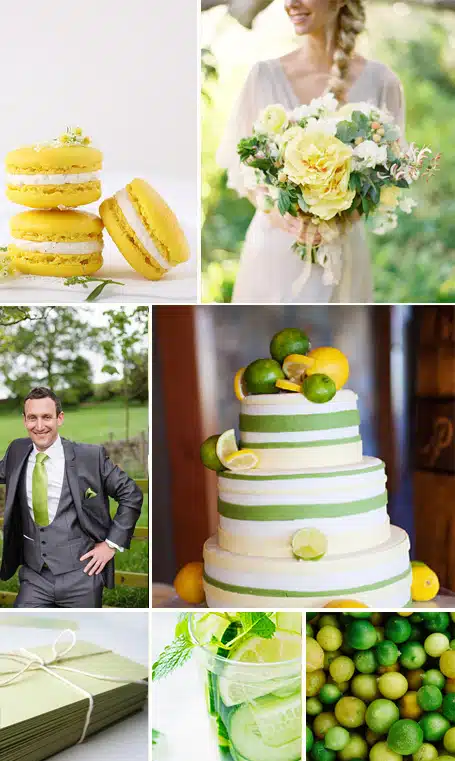
Additionally, you’d want a lemonade tap for this wedding, as the lemon and lime’s palette will sure get everyone’s taste buds working!
macarons: tinywhitedaisies | wedding bouquet: stylemepretty | groom photo: whimsicalwonderlandweddings | wedding cake photo: opiefoto | wedding invitations: Rue Renee | beverage: color palettes | lemons and limes: pinterest
Yellow and Lavender = LOVEnder
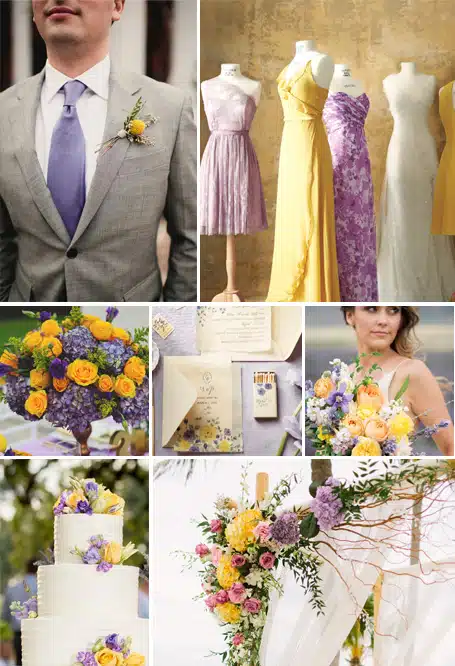
This combo makes a romantic, impressionistic impact. Moreover, your wedding becomes a true work of art.
groom: tinywhitedaisies | bridesmaids dresses: Martha Stewart Wedding | flower arrangement: FH Weddings & Events | stationary: Sarah Mccay | wedding bouquet photo: Calie Rose | huppa decor: Floral Fantasy, photo by Bob Care Photography
Yellow and Dusty Blue – Something old, Something new, Something Borrowed, Something Dusty Blue
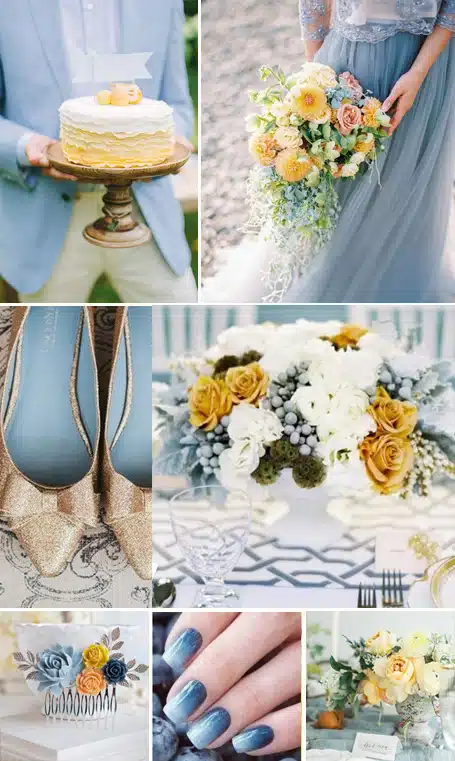
Dusty blue is highly popular, with its romance and elegance appeal. Pairing it with yellow creates beautiful color palettes – from light yellow to mustard to gold, this is the time to get creative!
groom: tinywhitedaisies | bridesmaids dresses: Martha Stewart Wedding | flower arrangement: FH Weddings & Events | stationary: Sarah Mccay | wedding bouquet photo: Calie Rose | huppa decor: Floral Fantasy, photo by Bob Care Photography
Yellow and Coral – We Love Hue!
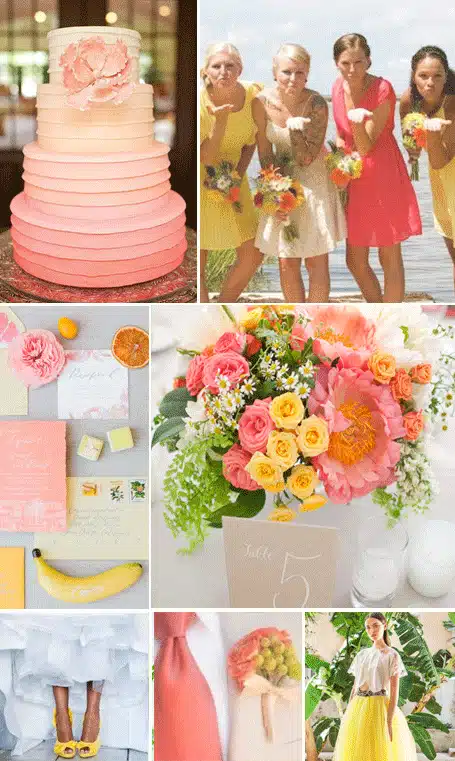
Coral is a fresh and upbeat hue to include in a spring or summer wedding, and when combined with yellow, it’s just a burst of optimism, playfulness, and joy.
cake: Arabia Weddings| gorgeous bridesmaids and bride: pinterest | wedding invitations: Twinkle & Toast | florals: brown paper design photo by Annie McElwain | wedding shoes: Calie Rose | wedding dress: Christos Casterallos
Which color palette is your favorite? Therefore, let us know on our Facebook or Instagram pages
[featured image: Chic Vintage Brides]
Yellow-Inspired Wedding Rings
Yellow extends beyond your wedding décor. A yellow gold engagement ring or a ring with a yellow gemstone adds warmth and elegance to your bridal look. Furthermore, yellow diamonds and yellow sapphires make stunning center stones for a color-coordinated ring. In addition, yellow gold bands complement this palette perfectly for both the bride and groom.
100 Years of Engagement Ring Styles
The first proposal with a diamond engagement ring happened in 1477, when Archduke Maximilian of Austria presented one to Mary of Burgundy. This started the lifelong tradition of asking your significant other’s hand in marriage with a diamond ring. Although this tradition hasn’t changed, styles of engagement rings have evolved throughout the centuries. More specifically, in recent decades, styles have changed due to fashion trends, availability of materials, media effects, and much more.
Let’s take a closer look at how engagement ring styles have changed over the years, via a stylish reference from our own collection:
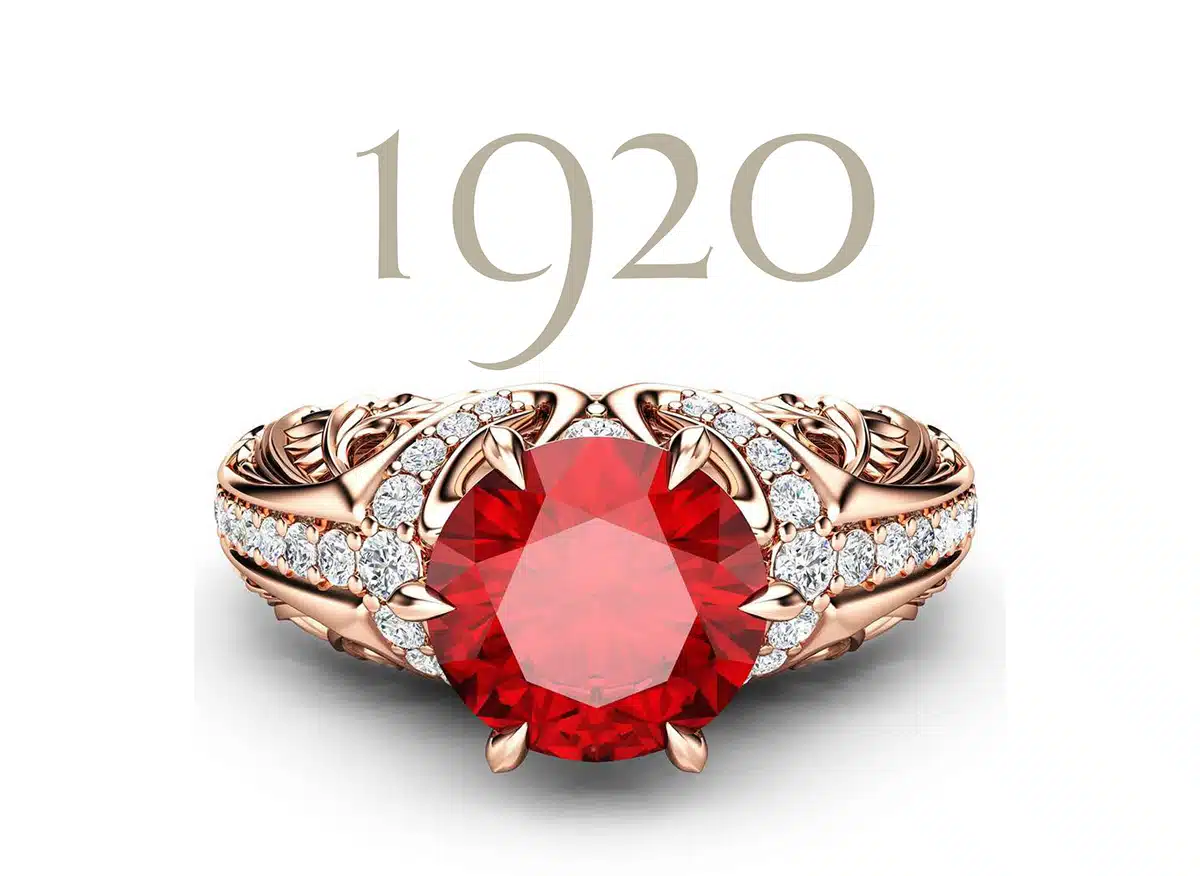
1920’s
In the roaring ’20s, rings began to reflect the clean lines, sleek motifs and modern geometric designs coinciding with the Art Deco period. The bold linear designs featured surrounding diamonds and side stones. While the metals of choice were often white gold or platinum. Additionally, The opening of Tutankhamen’s tomb in 1922 brought with it elements of Egyptian revival – rubies, sapphires, emeralds, and other colored gemstone accents began to add splashes of color to the Emerald-cut and Asscher diamond rings.
1930’s
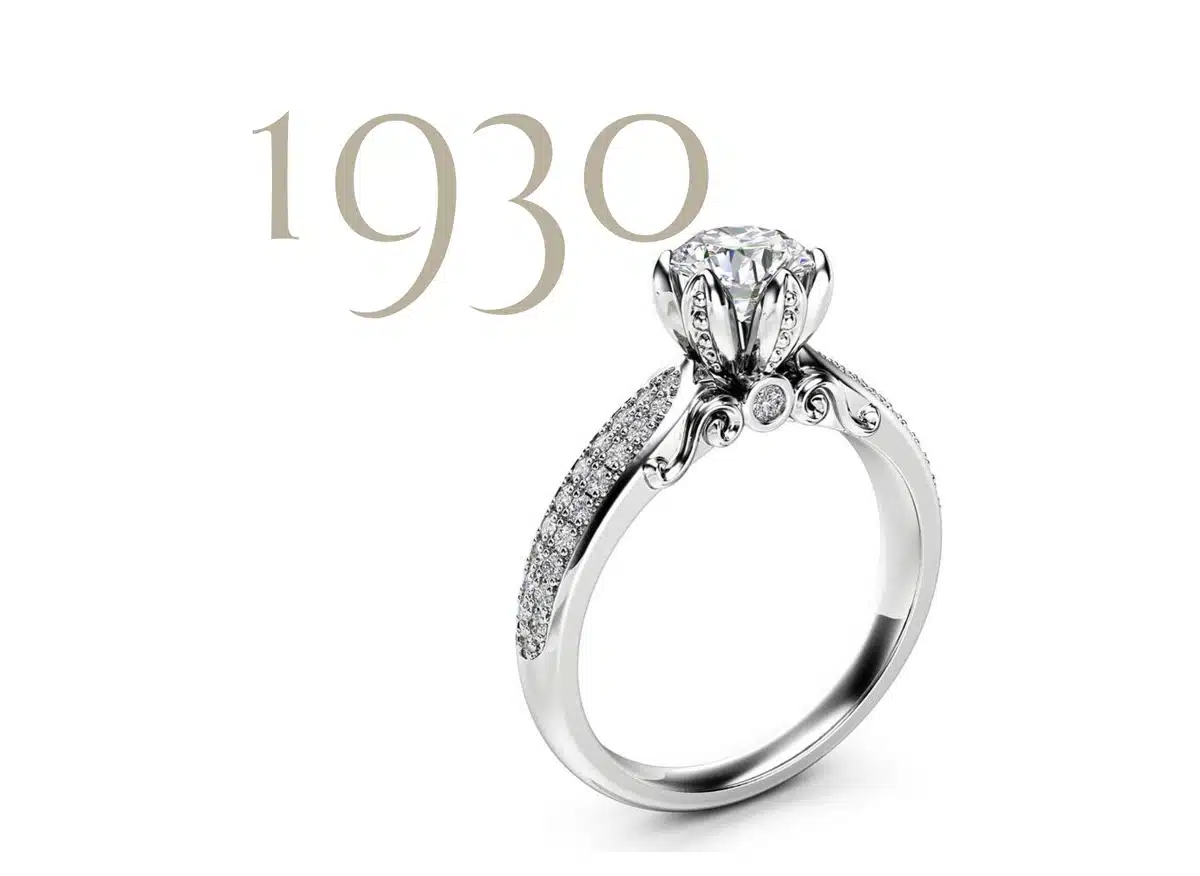
The 1930’s brought two main effects. On one hand, the art deco style was carried over. Only this time complementing the formers with even larger gemstones and bulkier multi-stone settings. The designs were often inspired by great architectural works such as the Chrysler Buildings glittering spire. Platinum and white gold were also very on-trend during this era. On the other hand, most of these luxurious designs were forced to take a back seat for the average couple. The Great Depression forced the proportions to scale down and carats to decrease and couples began to look for more simplified designs with smaller gemstones and detailing.
1940’s
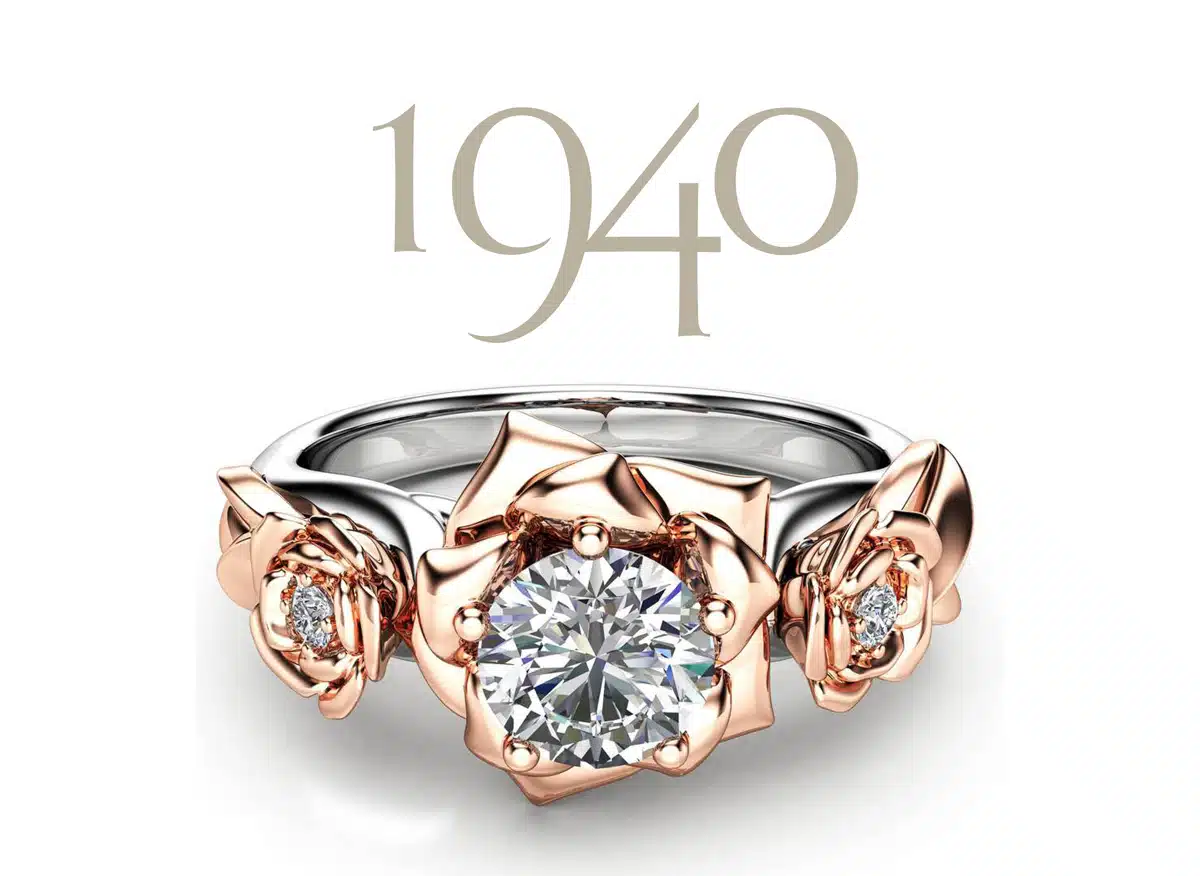
Platinum was requisitioned for war efforts during World War 2. And this caused gold to become the metal of choice for engagement rings.
The 1940’s saw a slow turn away from the sharp lines of the Art Deco era. And this time toward floral-inspired rings with a focus on a solitary stone instead of multiple little stones in a ring.
The 1940’s also marked the decade where diamonds became exclusively associated with engagement rings. Thanks to the 1947 De’ Beers’ campaign which coined the term “A diamond is forever.” It was the De Beers’ ad that changed perceptions and markets. They marketed diamonds as an unbreakable symbol of love. This single ad pushed the popularity of diamonds through the roof and lasted for the remainder of the century.
1950’s
The world began to move past the World War II trauma. Platinum was once again available, making it, along with white-gold, the popular choice for 1950’s engagement ring styles.
This is also the decade where celebrity engagement rings started making headlines. Grace Kelly’s 12 ct. emerald-cut from Prince Rainier III of Monaco in 1956, and Elizabeth Taylor’s 29.4 ct. ring from Mike Todd in the following year. (Suddenly Kim K’s 15-carat ring from Kanye doesn’t seem like THAT a big of a deal, does it? 😊 ) These rings became big topics of conversation and major style setters.
And of course, we couldn’t mention the 50’s without paying tribute to Audrey Hepburn. Her engagement ring from fiancée Mel Ferrer featured a trio of bands, in three different colors of gold. They were meant to be mixed and matched. But quite often Audrey chose to wear them all together – Hello stacked rings style!

1960’s
The 1960s, “classic” diamond engagement ring look has become widely accepted and remains a popular style. However, the other two sides of the scale were inspired by celebrity trendsetters: On one side, Elizabeth Taylor (yes, again) with her massive 33-carat Asscher-cut diamond, given to her by Richard Burton; and on the other side, Jackie Kennedy’s stunning and distinctive diamond and emerald engagement ring. Which made colored gemstones in engagement rings a style statement.

1970’s
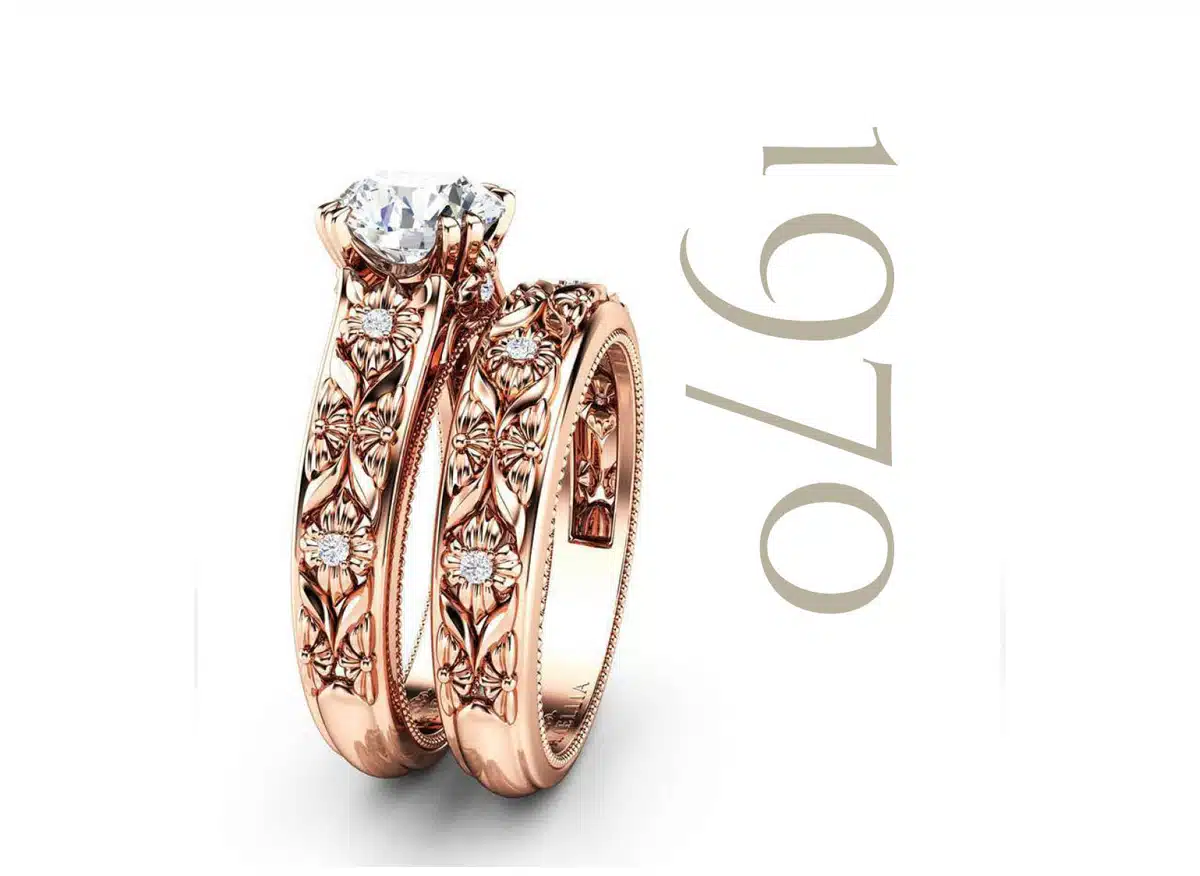
During this decade, brides also began to match their engagement rings to their wedding bands, many of which were yellow- and rose-gold. Coordinating wedding bands to create a complete matching set became a popular trend. And new diamond cuts became trendy in the 1970’s, including princess and emerald-cut diamonds.
1980’s
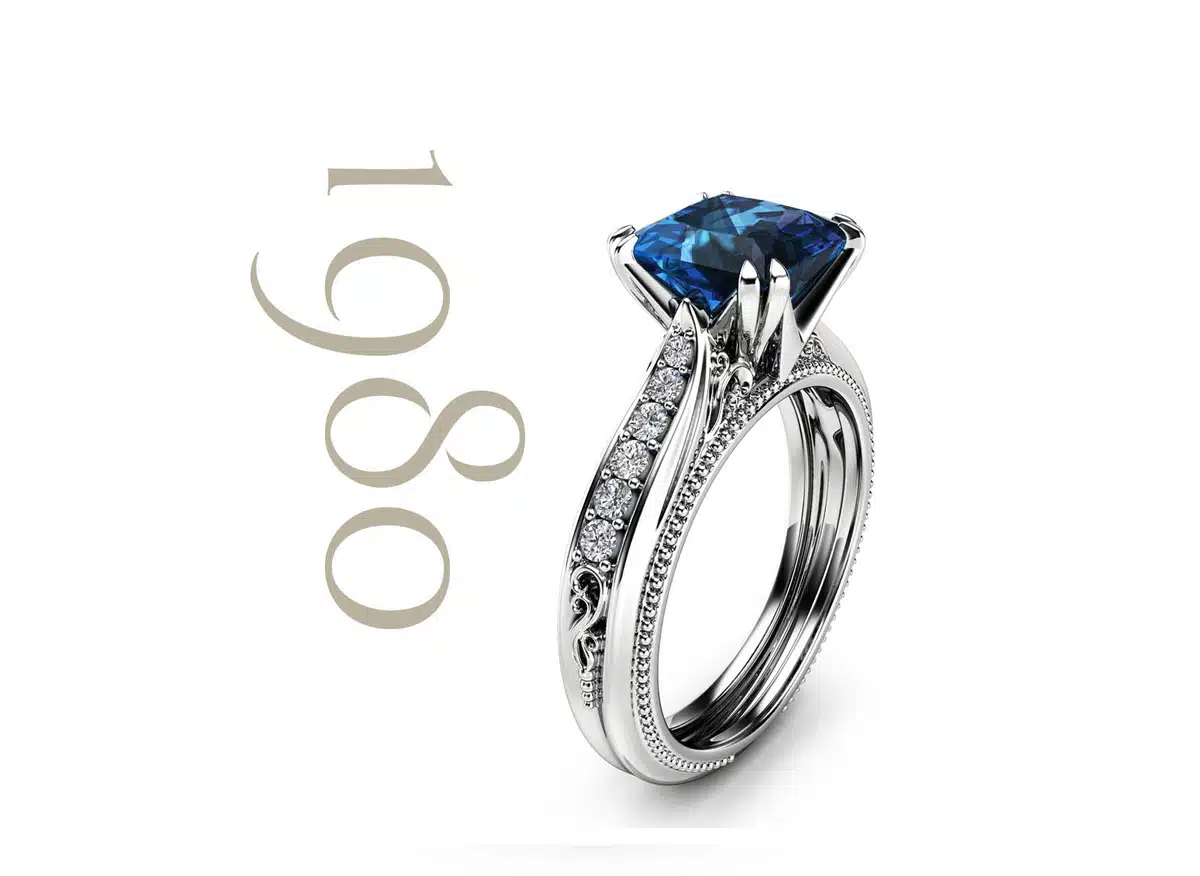
The engagement and wedding of the decade were that of Princess Diana and Prince Charles. But the real star of it, if we may, was her oval sapphire engagement ring. This beauty set off a major sapphire trend and totally changed the nuptials industry. A trend that has come back in full-force when Prince William had given his mother’s ring to Kate Middleton.
With the 80’s came the popularity of pear shapes and marquise cuts, along with the gold metals we know and love. This was a decade of flamboyant style, where bigger, bolder and chunkier are better.
1990’s
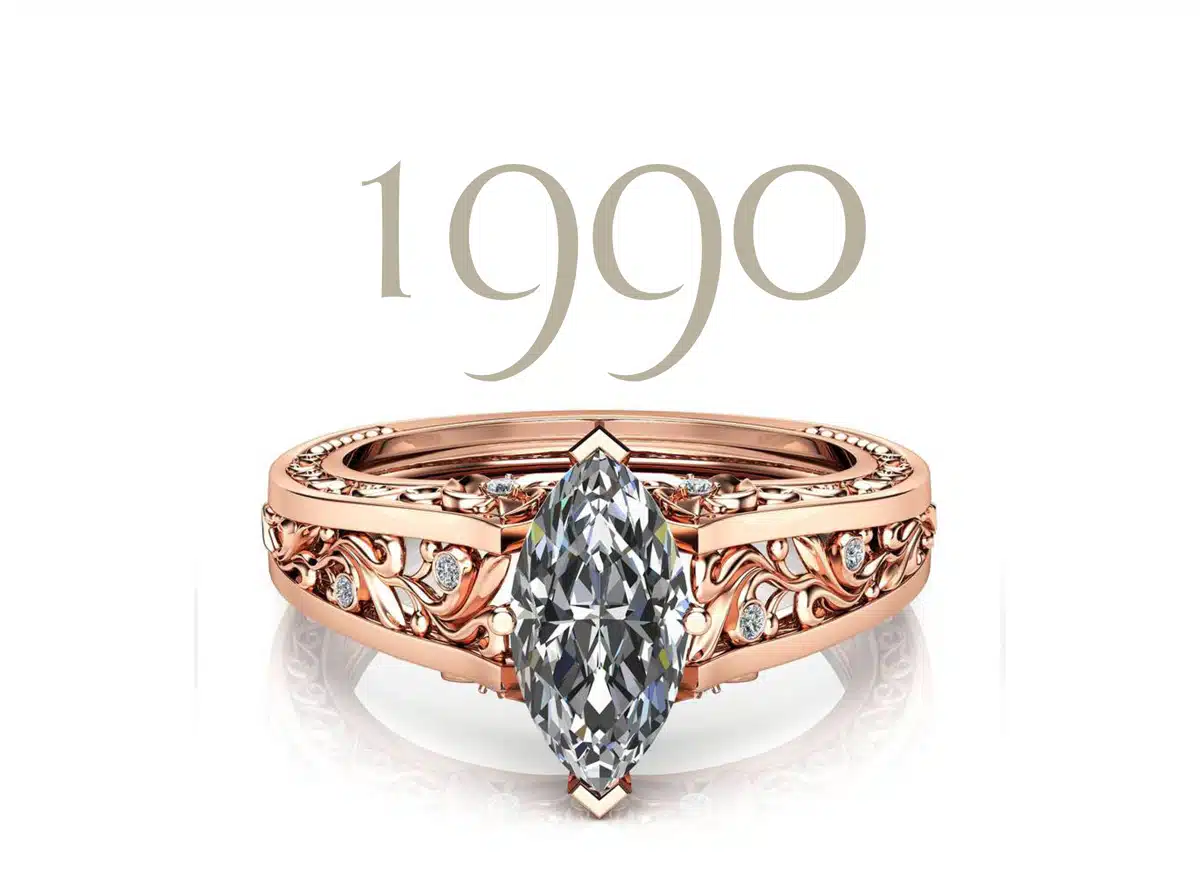
The 1990s saw the rise of even bigger stones and more fancy-cut diamonds. Marquise-cut diamonds became especially popular for their sharp edges and bold look.
Platinum makes a comeback –as does white-gold. Say goodbye to yellow gold for a few years now.
Additionally, thanks to internet usage becoming more popular. Brides-to-be were now able to search for and become inspired by a plethora of engagement ring styles. It wasn’t what their local jewelry shop was showcasing anymore, but her own unique style.
2000’s
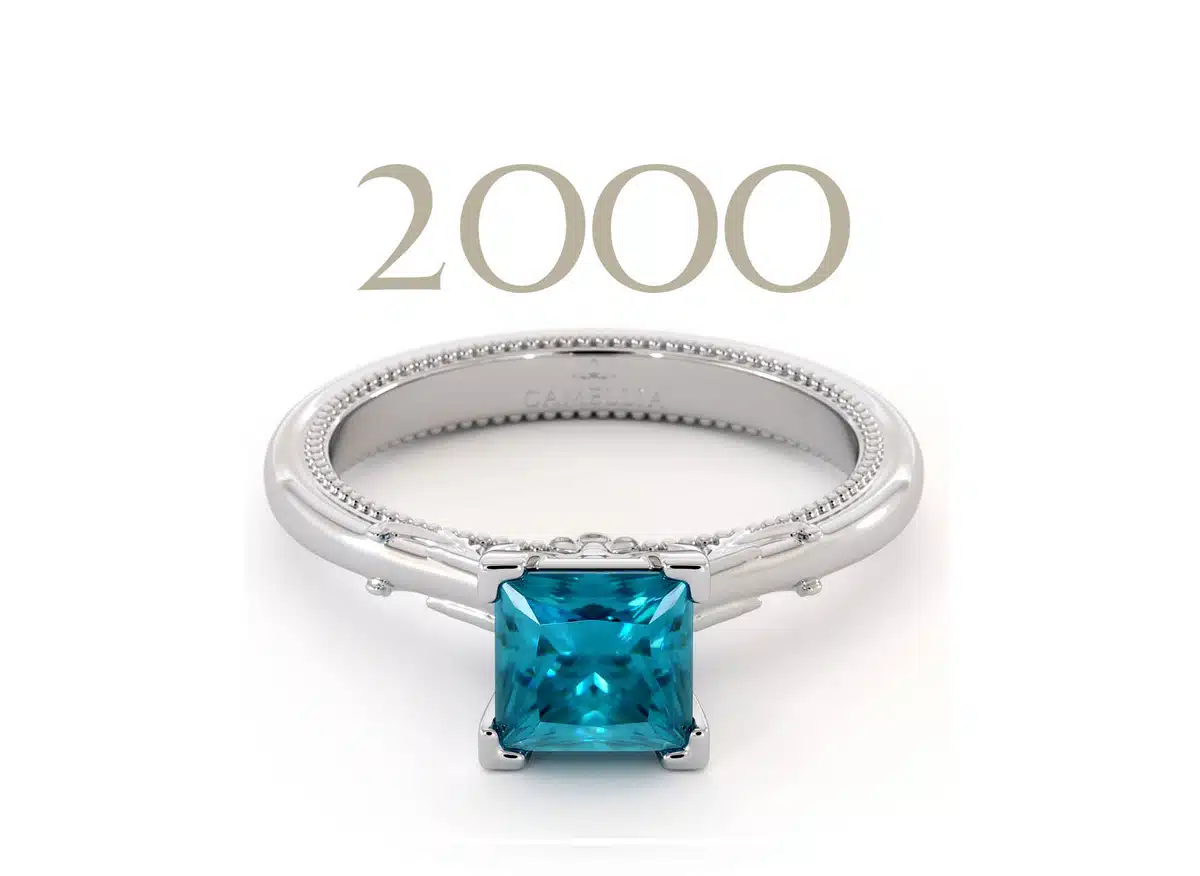
At the turn of the century, engagement rings embraced classic trends such as solitaire rings and princess shaped diamonds. Princess-cut diamonds dominated engagement ring trends in the early 2000’s.
Couples in the 1990s and the early aughts favored square looks and flocked to cluster-style rings that gave a big look for less money. Vintage-inspired rings with pave diamonds, meant to look like those popular in the 20’s, also regained attention.
2010’s
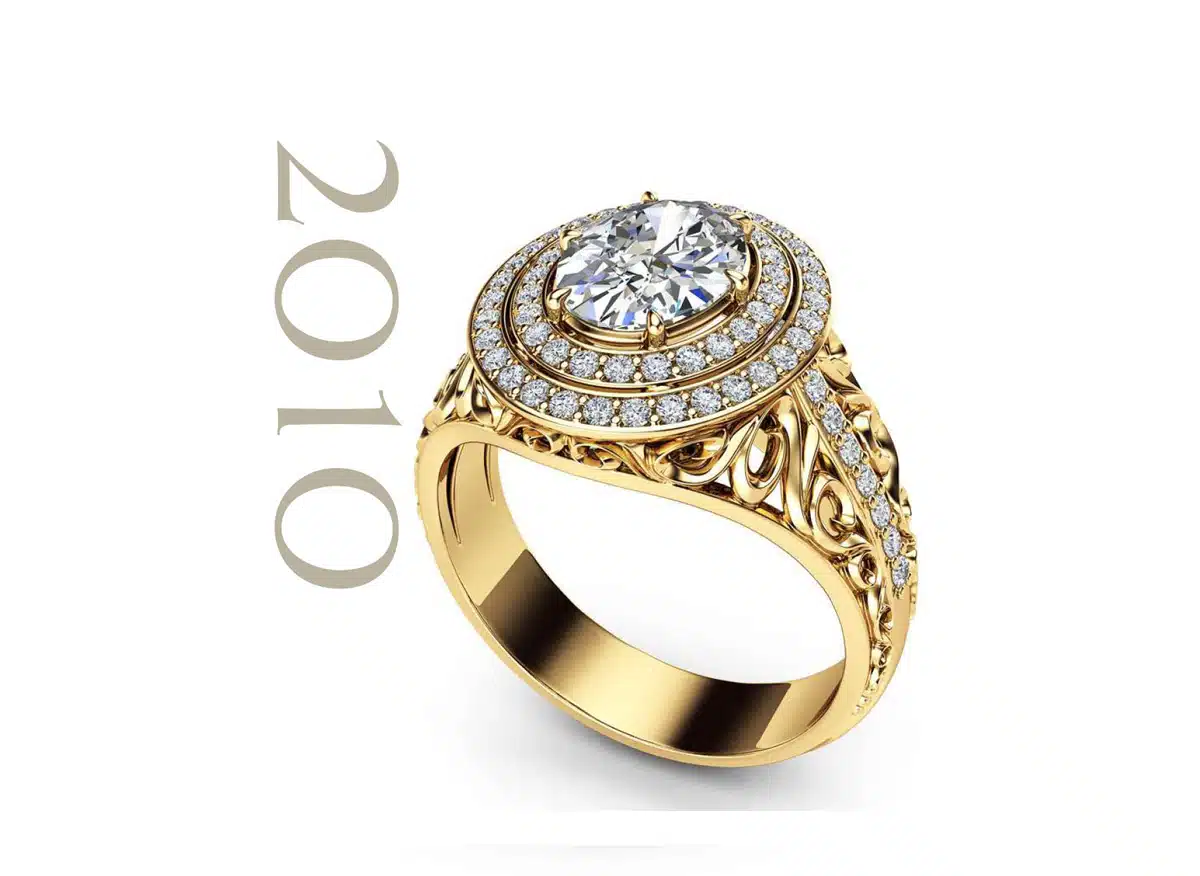
By 2010’s, cushion-cut diamonds and halo engagement rings became the most popular choice for couples. Due to the cushion’s multi-faceted shine, and the halo setting creating the appearance of a larger center diamond and enhancing the engagement ring’s glamor.
Small or pavé-set stones encircling a modest central diamond create the appearance of a larger solitaire look for less. Thinner bands were also trending.
Kate Middleton’s engagement ring, which belonged to the late Princess Diana, re-sparks a mini-trend of blue sapphire centers and accents.
2020
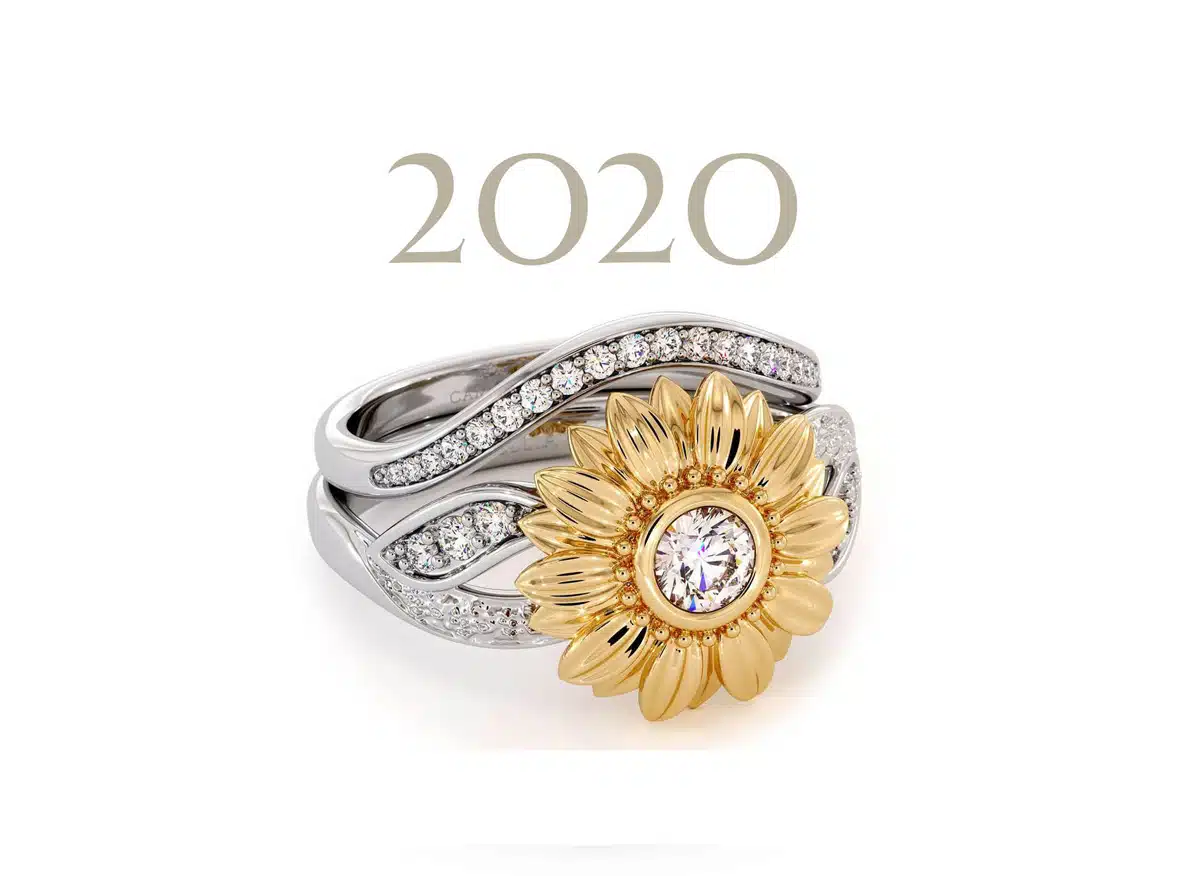
Today’s brides are looking to express their individuality through engagement rings that uniquely fit their style and agenda. Lab-created diamonds, socially responsible mining, and recycled gold are popular wedding jewelry search terms.
Rose gold, two-tones, and fancy colored diamonds are having their moment. As well as antique or antique-inspired, nature-inspired or truly customized designs that reflect the couples’ history, present and future – each of his or her own, and of them together.
What’s your favorite decade and style?
What’s the difference between white, yellow and rose gold?
Eeny…meeny…miny…moe, which color to pick for my beau? We are blessed to be able to choose between so many beautiful and precious materials. But If you’ve wondered what’s the difference between white, yellow and rose gold, look no further than the little, guide below.
What is gold?
While we all know about gold, not everyone knows the behind the scenes of how it gets to our jewelry box. So let’s start by asking “what is gold?”. In technical terms, this beloved metal is a chemical element found in nature with a high atomic number. In its natural state it has a bright red-yellow hue. It’s also dense and malleable – so, to be able to use it, you have to mix it with other metals.
Different shades of gold depend on these added elements. And while the most popular shades are the triad alloy – white, yellow, and rose, you can also find it in shades of bronze, red, and even lime. Next, the following question arises “what’s the difference between them?”.
“Geometry has two great treasures; one is the Theorem of Pythagoras; the other, the division of a line into extreme and mean ratios. The first we may compare to a measure of gold; the second we may name a precious jewel.” ― Johannes Kepler
What’s the difference between white, yellow, and rose gold?
All the shades have almost the same percentage of pure gold, and you usually find them at the same price. But, of course, you have to take into consideration the brand’s value that you work with, where the gold comes from and its karat – 10K, 14K, 18K, 24K. Price also goes up if the color is trendy that year.
We measure the percentage of pure gold by karat. So, 24 karat gold is 100% pure, 18 karats is 75% pure, and so on. The most common metals that jewelers combine with gold are copper, silver, nickel, palladium, and zinc. Some specialists also use “plating” as a technique to add color, that’s why you can find two or even three different shades on the same piece.
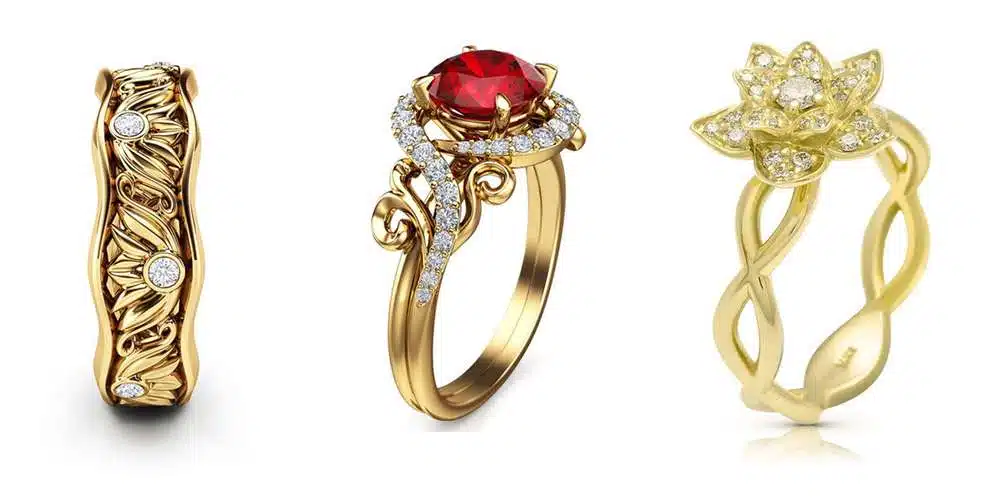
Yellow Gold
In order to get the shiny, vintage yellow gold color, silver, copper and zinc are added. This combo presents the shade of pure gold. But it’s more delicate than other alloys. It can scratch easily and with each polish, you lose a little bit of material. Yellow gold is a classic and will always be in style, even if white and rose catch up with it.
While you get the advantage of using something closer to the original, the big disadvantage is that time will leave a mark on it.
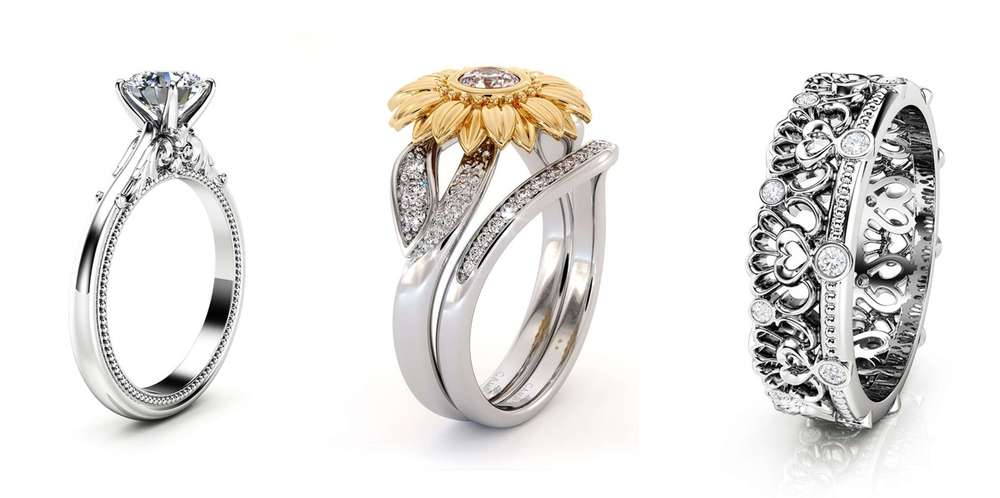
White Gold
This mix is a combination of gold nickel, palladium, and silver. You might be surprised, but yes, there is silver in gold. The strength of the alloy depends on the proportions. For example, nickel makes it hard, so it’s used in rings and brooches; while palladium gives gold flexibility to add soft gemstones to the setting.
This particular alloy usually has a yellowish tint. This is the reason why specialists finish the product with rhodium plating. Rhodium gives the color, but it also offers a protective layer, as yellow gold is soft. The disadvantage here is that, from time to time, you have to re-plate your jewelry.
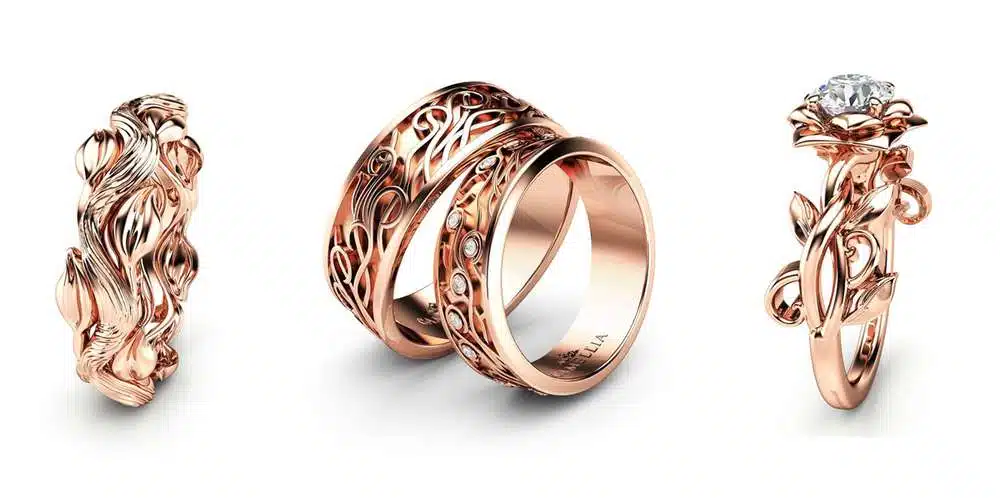
Rose Gold
The last mix of the most popular gold alloy is the rose gold, which is pure gold and copper. It can come in shades of pink, but also red, depending on the copper content. This combination used to be called “Russian Gold”, as that’s where it first appeared, in the 19th century.
When it comes to strength, the last of the pack is very sturdy, all because of copper. The big disadvantage of this romantic combination is that it can cause allergic reactions, so it’s not for everybody.
In the end, the rush for the perfect gold for your jewelry depends on what you want – classic yellow, modern white, or romantic rose? Let us know in a comment below and do check in our shop the perfect ring for your better half.
Staff Picks- 8 Spring Inspired Engagement Rings
Oh hey there spring! The season when everything blossoms and comes to life. It’s the season of re-birth, which makes it the perfect time to invest in new pieces of jewelry that will refresh your look.
From March to May in the northern hemisphere, or September to November in the southern one, Mother Earth dazzles us with birds chirping, rainbow colors and complex textures. In an ode to that, we’ve gathered up 8 of our favorite spring-inspired engagement rings to get your own blossoming going.
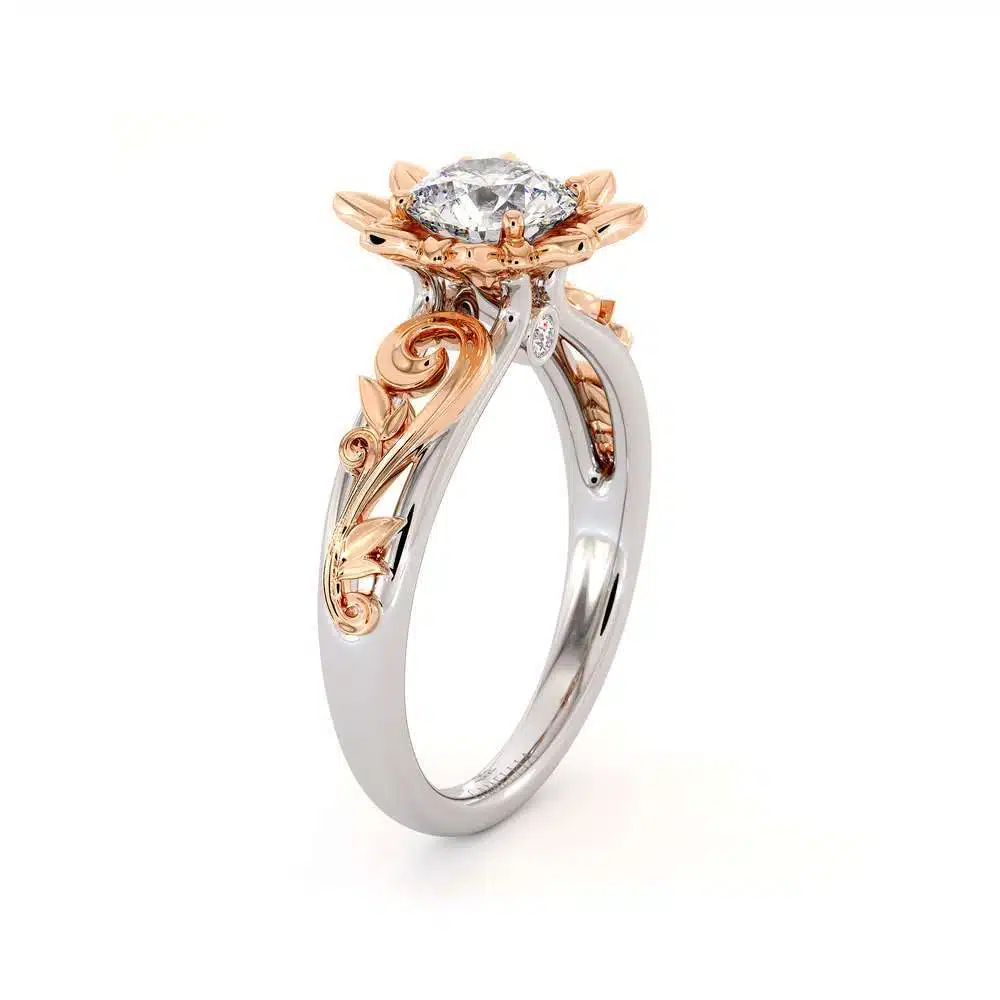
Flower moissanite engagement ring
We begin our spring guide with this 14K two-toned gold moissanite ring. It features a beautiful setting inspired by nature, and it’s the perfect option for those who want something classic while adding a pop of color. If you’re looking to ask your beloved to get married, look no further than this two-toned gem.
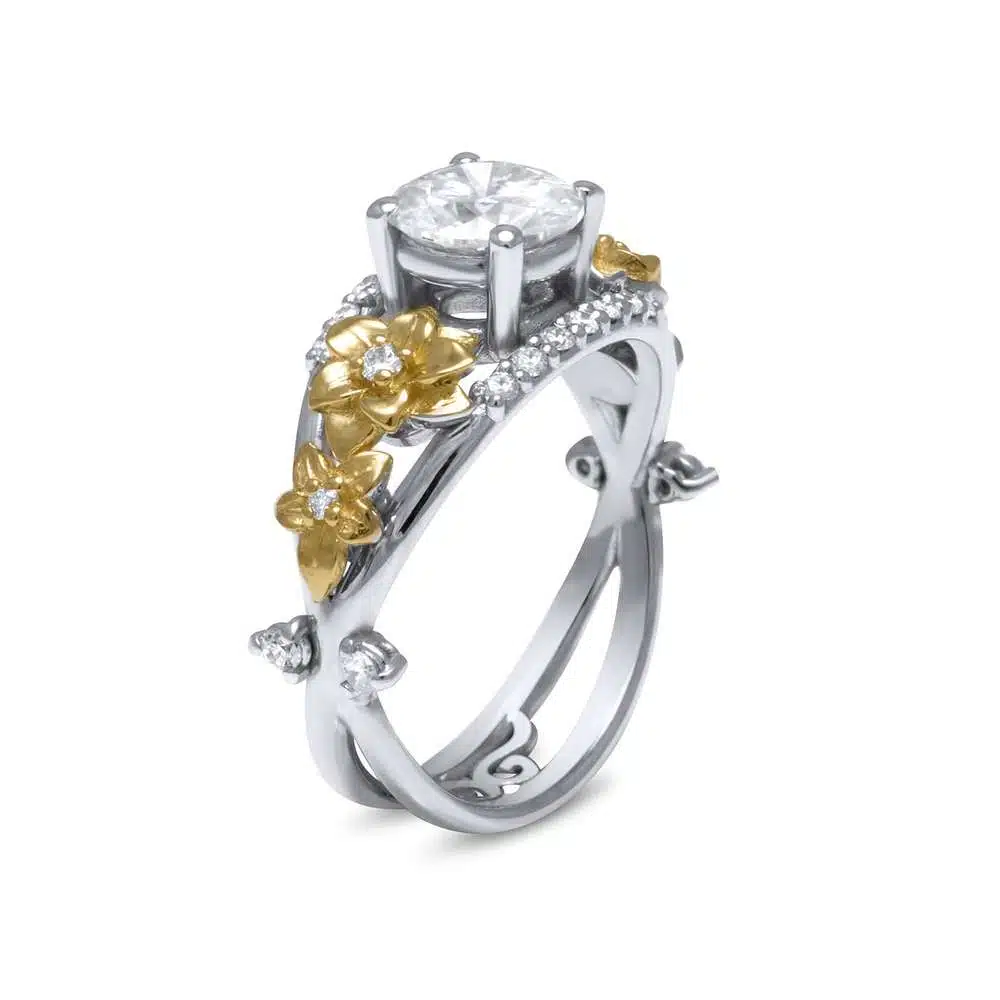
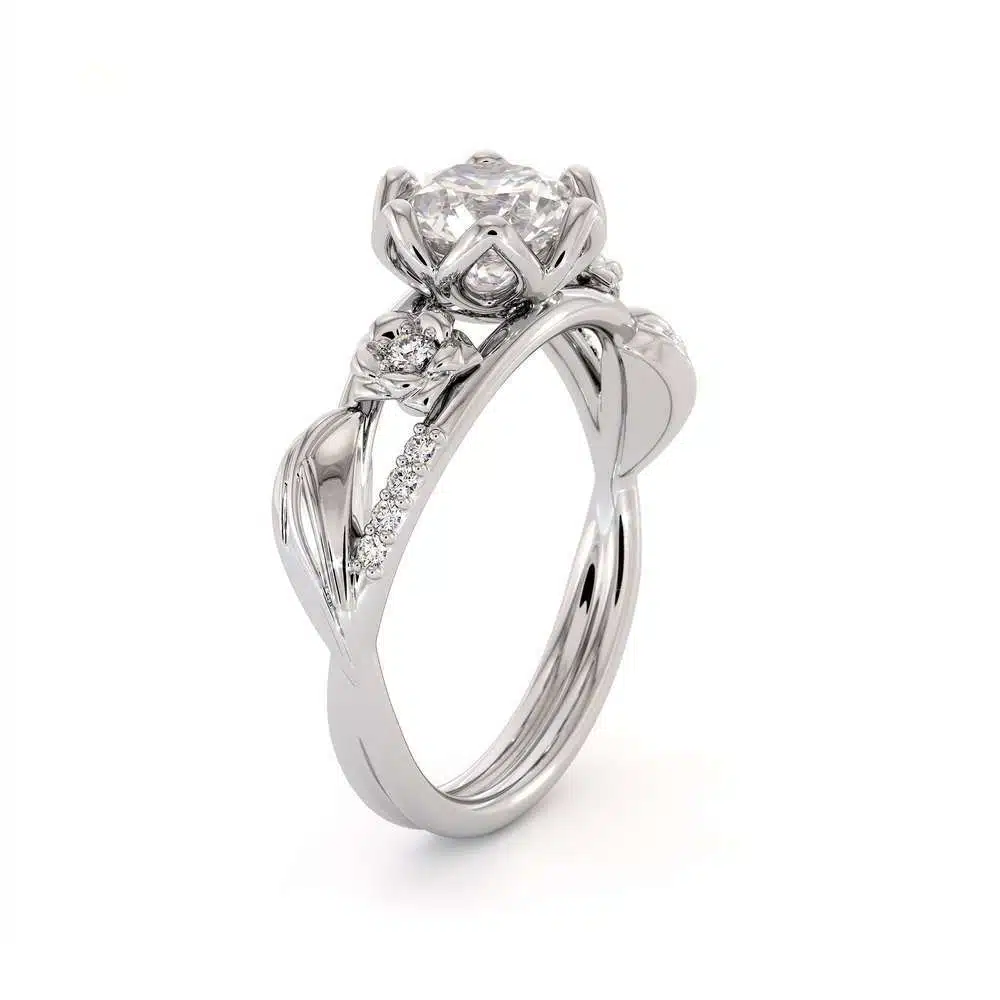
Flower leaf moissanite monochromatic engagement ring
The second option for flower lovers comes in a 14K white gold setting. It’s a unique option for both minimalist and romantic souls. Once placed on her finger, you’ll see her glimpse at it every couple of minutes, because moissanites dazzle under light.
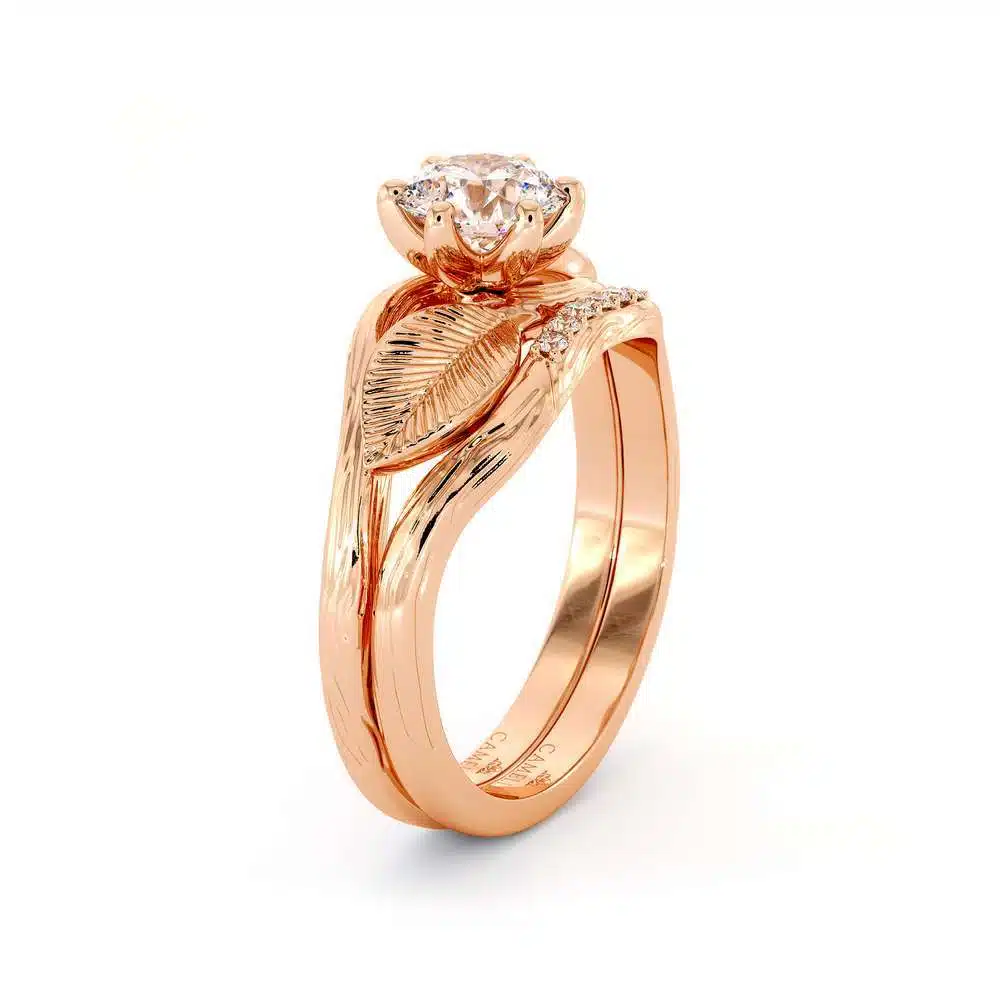
Leaf moissanite engagement ring in rose gold
If you’ve found your princess and looking for your fairytale ring, look no further than this beauty. Its setting is sure to make heads turn, and its vivid blossom will make hearts skip a bit. It will no doubt become a family heirloom, that will share the story of your happily ever after.
Unique leaf engagement ring set in rose gold
Moissanite is a big, sustainable, trend this year. Add this to the unique flower design, you’ll definitely take her breath away. This is statement ring set, inspired by the beauty found in Mother Nature, will capture her heart from the moment she beholds it.
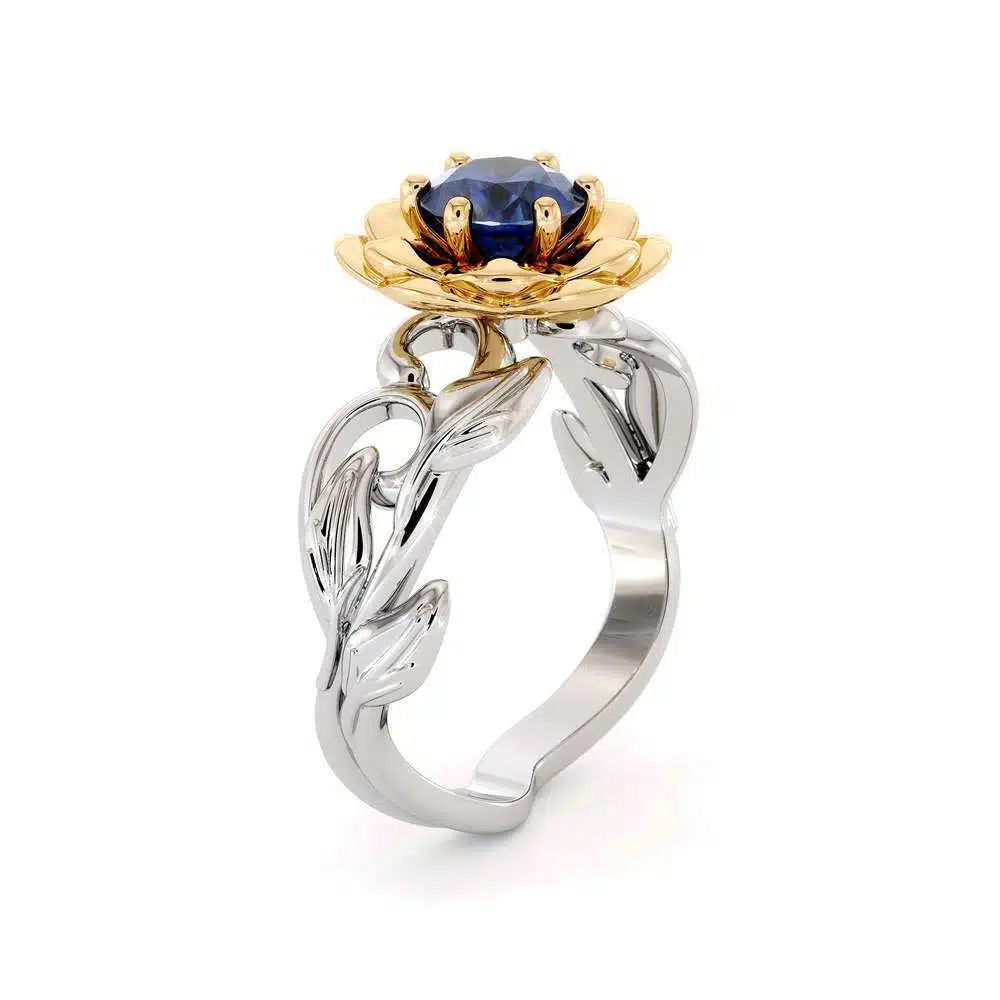
Lotus flower sapphire engagement ring
If you’re into the “Zen” movement, the lotus design is for you. This nature-inspired ring comes in 14K white and yellow gold. Likewise, this double whammy will quench even the most indecisive of souls out there. (it also makes a great gift for anniversaries, birthdays or Mother’s Day!).
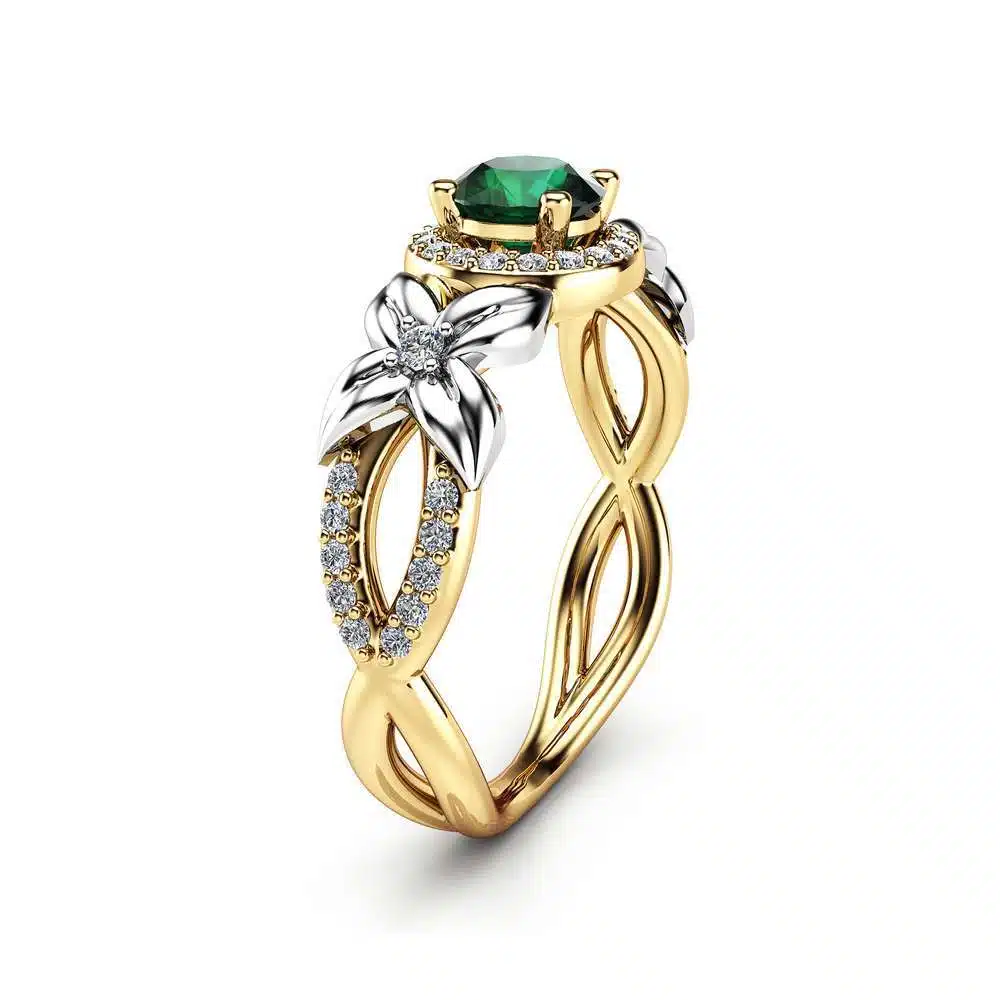
Floral emerald halo engagement ring
Custom handcrafted in the finest detail, this unique engagement ring features a halo emerald beautifully set in two-tone swirled mounting design with stunning flower detail.
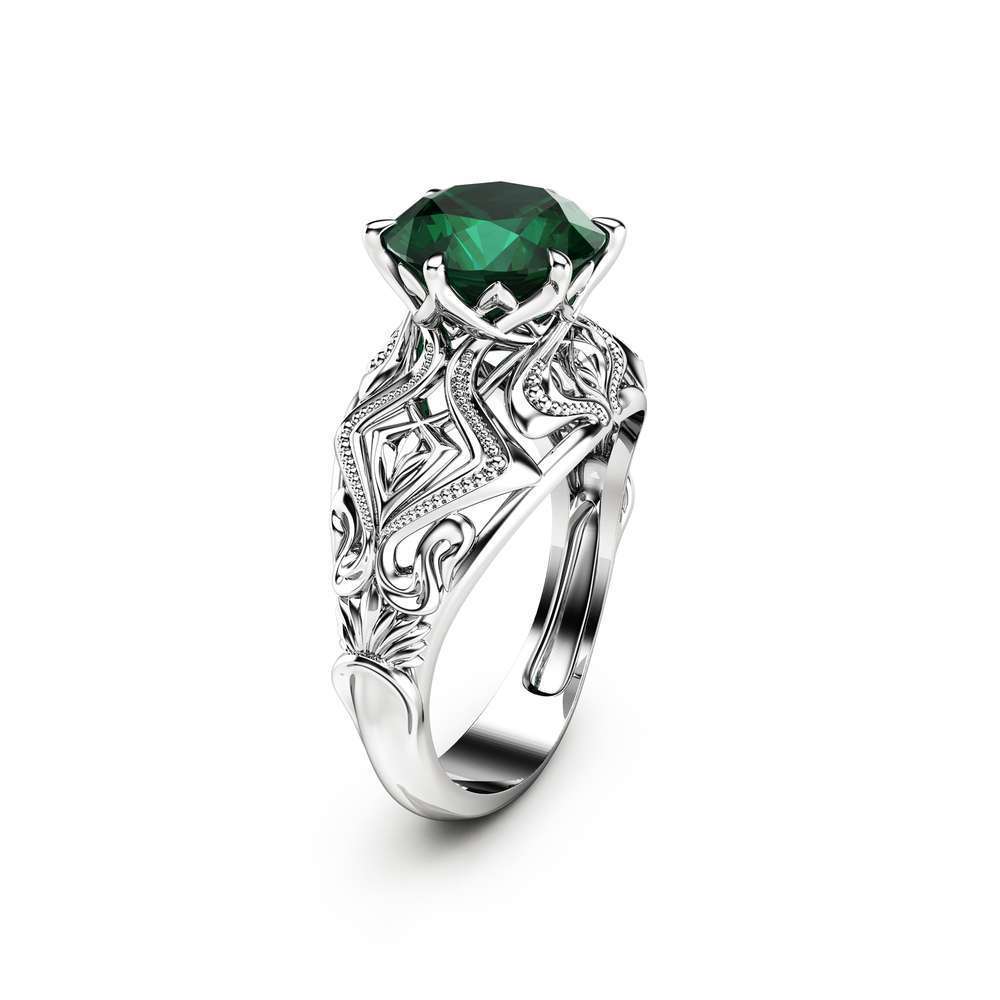
Unique solitaire emerald engagement ring
If natural green is what you’re looking for, then this gorgeous emerald ring is a great option to pop the question!
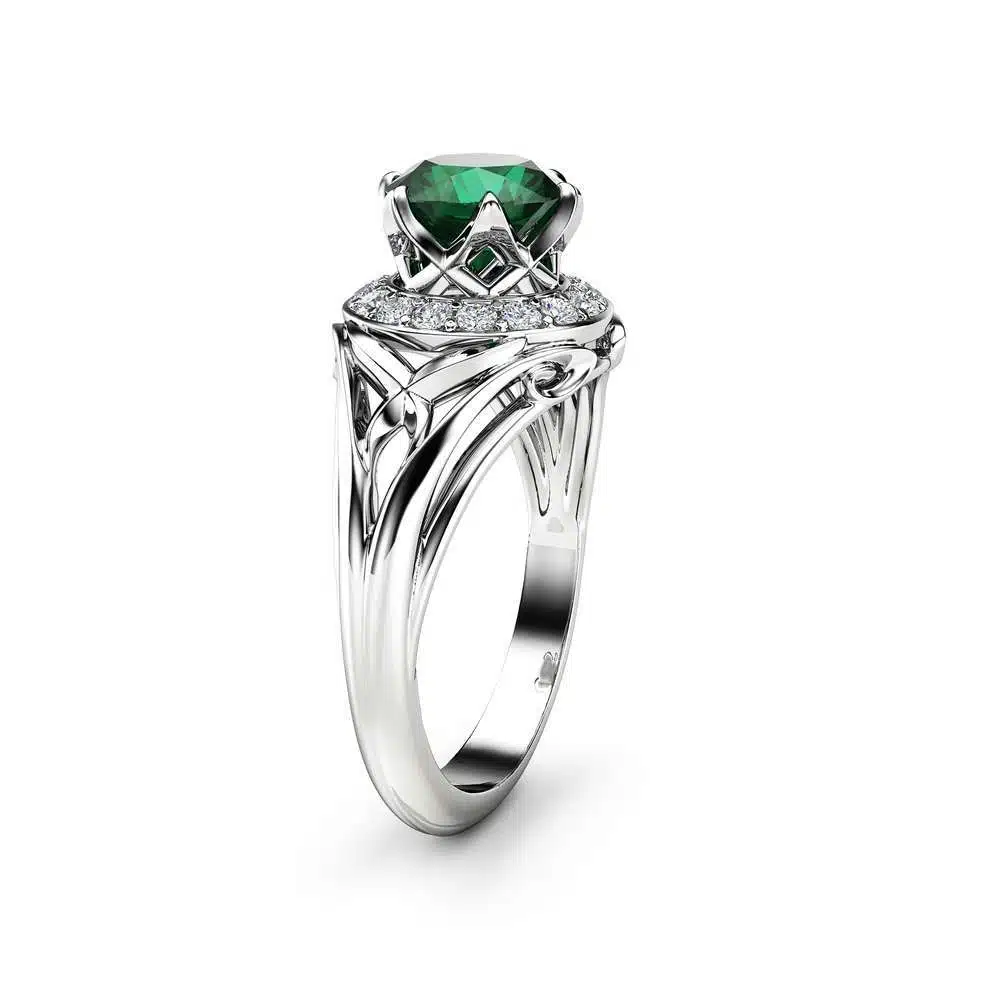
Art deco diamonds and emerald engagement ring
Last, but definitely not least. We’re excited to present this art deco stunner! The color green symbolizes growth, which makes an emerald is a great stone for engagement rings
Are you excited to know what summer will bring? I know we are. Until then you can discover more unique pieces in our shop. Regardless of which season your hemisphere is in, there’s something for everyone. Be sure to comment below and let us know your favorite picks.
[Cover Photo by Anton Atanasov from Pexels]
Moissanite – An Eco-Friendly & Sustainable Alternative to Diamonds!
In today’s world, it’s more important than ever to find sustainable and ethical solutions, and jewelry should be no exception. Although it’s no secret that diamonds aren’t exactly the “poster gem” for being eco friendly, many of us still dream of that classic look and feel they bring. But what if there was a conflict-free alternative? A stone that looked and felt exactly like a diamond, and to top it off – a fraction of the cost. And no, we’re definitely NOT referring to cubic zirconia. We’re talking about Moissanite! An eco-friendly and sustainable alternative to diamonds.
Moissanite is also a precious stone. First discovered in 1893 by French chemist Henri Moissan, as he was examining mineral samples from a meteor crater. And, this is why moissanite is also sometimes commonly referred to as “a gem born of the stars.” At one time these beauties used to be quite scarce. But, are now made in the majority of jewelry laboratories.
And since they’re developed in labs it obviously has less impact on the environment. And likewise, it leaves a much smaller carbon footprint. Additionally, unlike diamonds, Moissanites are very eco-friendly. And their history is absent from many of the conflicts that remain a concern to those seeking ethical jewelry options.
Of course, if you still prefer diamonds but want to be friendly to Mother Earth, you can also opt for man-made diamonds, made in the lab and often known as LCD (Lab Created Diamonds) or LGD (Lab Grown Diamonds). These are made with the same base, but in a fast-forward process, vs. the slow and steady way nature usually makes them.
If you’re looking to be more sustainable with your jewelry this year, Moissanite rings are the best option. You can have them as the main stone, or you can add them to a mix with other colorful gems. And you could even take it a step further and use recycled gold too. There is an abundance of advantages when it comes to choosing Moissanite over diamonds. And if you want to learn more about how they differ, check out our Moissonaite Vs. Diamond post on our blog.
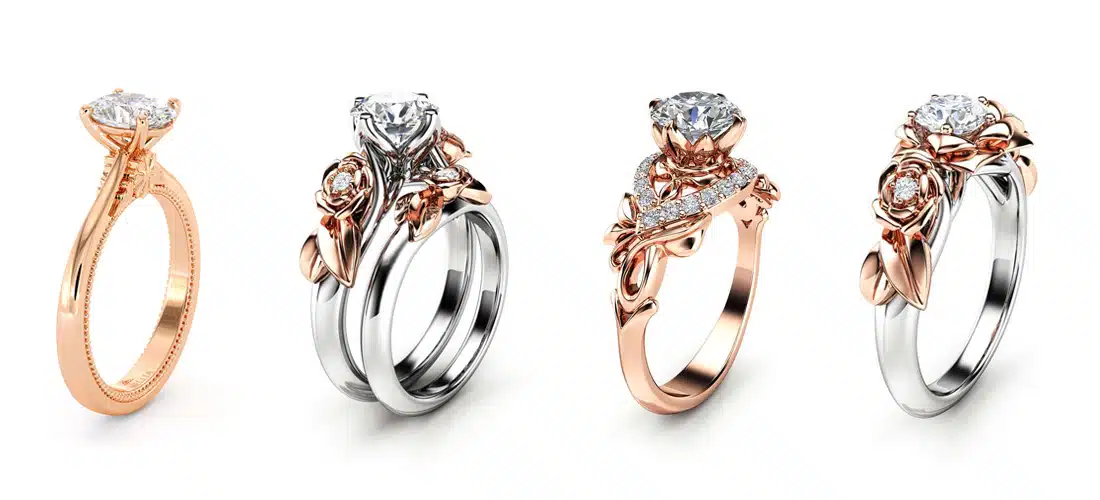
In the meantime be sure to look at the Moissanite collection from Camellia.
Moissanite Vs. Diamonds – What’s the Difference?
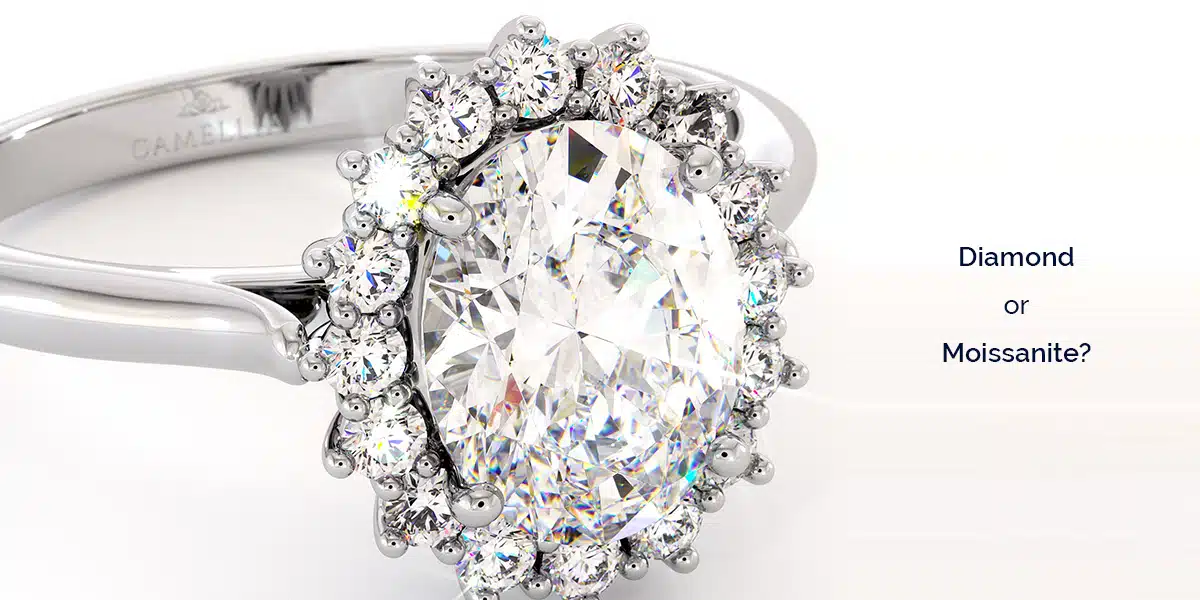
Today, there’s a multitude of options when it comes to engagement rings. And while we’re all familiar with the classic diamond ring, there’s one (not so little) stone out there that serves a great alternative and deserves some serious attention. But, if you’re still wondering what’s the difference between diamonds and moissanite, then look no further than the guide below.
When we think of a classic engagement ring we tend to think of one with diamonds. Although, in today’s economy being budget-savvy is a big trend when it comes to jewelry. No doubt, we all want something that’s kind to our wallets, but also something special and eye-catching, that will stand the test of time in terms of durability. In a few words, a diamond is a precious stone, clear, made of pure carbon, which is the hardest substance on Earth. While, moissanite is a natural mineral, a silicon carbide. It was discovered by Henri Moissan, a French chemist, in 1893.
Moissanite – the space rock
Finance & Style
Moissanite gems are becoming a big trend among couples who may not have the money to invest in a standard engagement ring. Because, while moissanite and diamonds may look similar, they certainly don’t resemble each other’s prices. Depending on the cut and clarity moissanite can be up to 90% less expensive per carat than a diamond of the same size. In addition to them being a fraction of the cost, there’s also the added bonus of having the freedom to choose larger stones along with personalized designs. Thus, eliminating the worry that your wallet won’t match up to the final product.
Durability or “Toughness”
Although they’re all beautiful, not all gemstones are created equally. Certain gemstones like emeralds and sapphires are not ideal for daily wear (due to the fact that they tend to be brittle and most have tiny natural cracks that make them vulnerable to chipping and shattering). The Mohs scale of mineral hardness is a qualitative scale characterizing scratch resistance of various minerals – the higher the number is, the durable the material is. When it comes to toughness the only thing to come between diamonds and moissanite is boron. As Moissanite ranks 9.25 on the Mohs scale coming in 2nd only to diamonds, which rank as 10. This is great news because it means not only is Moissanite cost-effective but you can wear it or (show it off) on a daily basis.
Appearance
When comparing quartz, diamonds, and Moissanites, side by side, a lot of couples go for the Moissanite rings. Moissanites are actually more eye-catching and clearer. They have incredible brilliance, unlike the quartz, especially with the round shapes. Another advantage is that these gems have more dispersion. The stone breaks down light into spectral colors, so when you look at it against a light source, a rainbow appears. And finally, it goes without saying that the bigger the stone the more noticeable the dispersion. And thanks to the cost it means you can get a bigger stone at an even better price.
In conclusion, Moissanites are a fabulous alternative to diamonds. Not only are they cost-effective, but also durable and aesthetically-pleasing thanks to their dispersion levels that create even more sparkle! Last but certainly not least finally they are also extremely eco-friendly! Bottom line- moissanite gems are a great investment, considering both the budget and the lasting quality.
Check out some of our Moissanite rings and let us know what you think!
Color palettes – 6 rings based on international wedding locations
If you’re a globe-trotter at heart or you want to match your engagement ring to a special location, then this guide is for you! We’ve drawn inspiration from the color palettes of 6 rings and matched them to international wedding locations. Because sometimes just looking at jewelry that reminds you of a special place can be more fun than buying a plane ticket…
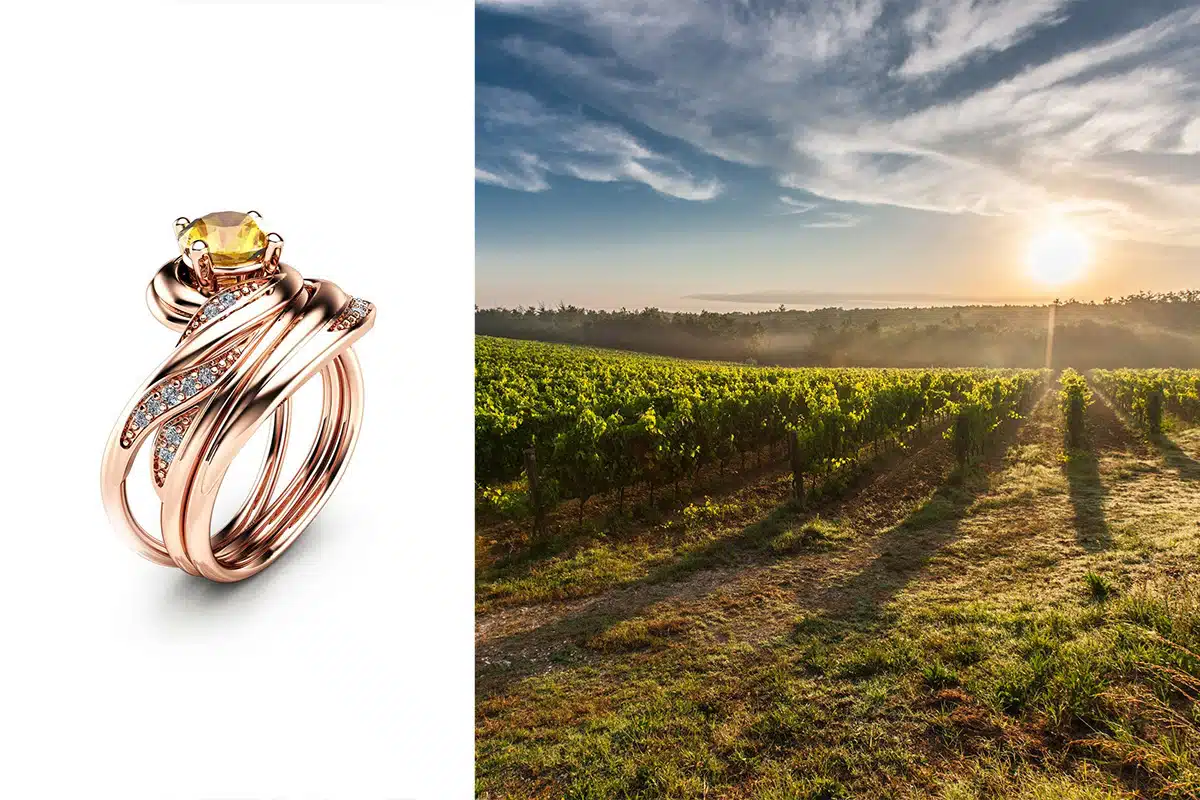
Tuscany x the Yellow Sapphire Engagement Ring Set
Tuscany is located in the central part of Italy. Its capital Florence is known for art and architecture. But, Tuscany is known for its relaxing vibes, good wine, and romantic sunsets. In order to represent Tuscany, we chose the Yellow Sapphire engagement ring. This ring has a silky setting in 14k rose gold, which is sure to make your better half think of dancing beneath the stars.
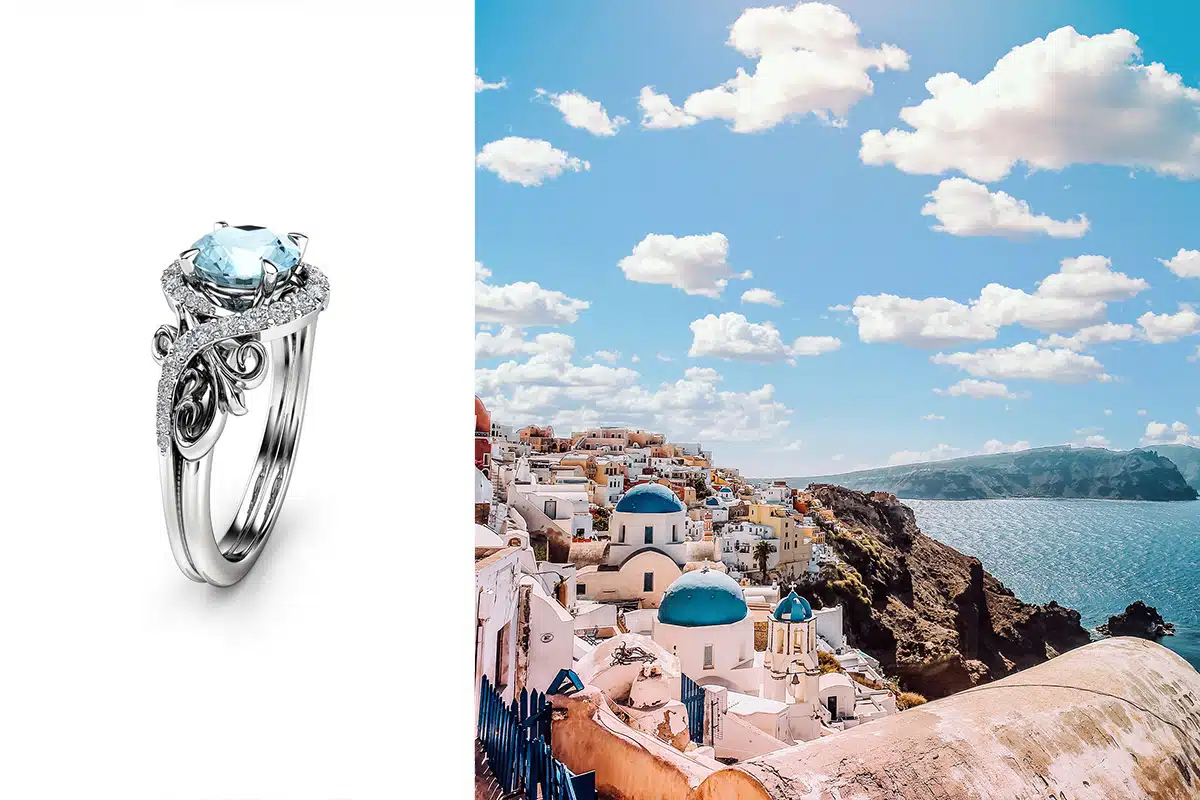
Santorini x the Halo Aquamarine Engagement Ring
Santorini is part of the Greek Cyclades Islands. It’s known for its white and blue architecture, amazing food and friendly people. For this destination, we picked the Halo Aquamarine engagement ring, set in 14k white gold. This is a ring that would make its wearer feel like a goddess.
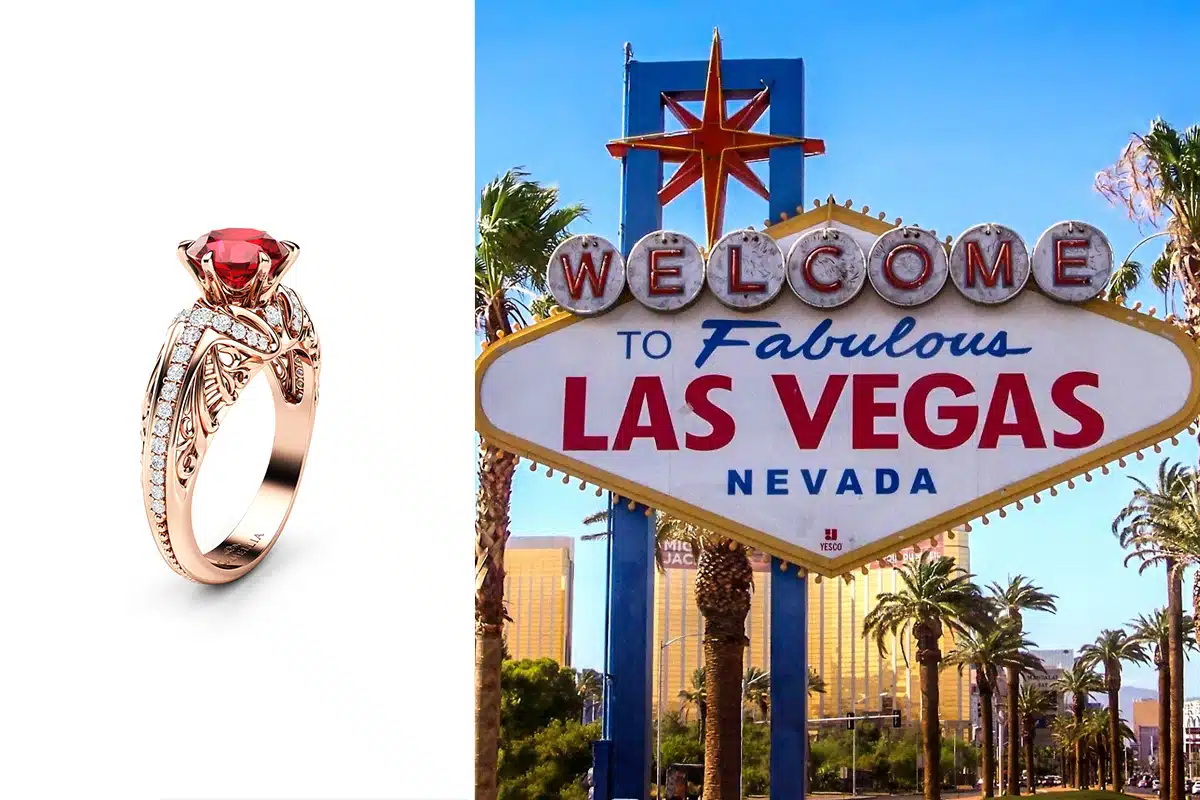
Las Vegas x the art deco ruby engagement ring
Also known as the the Marriage Capital of the World! This is a destination everyone should try at least once in their lives. Las Vegas is certainly not, it’s a bold city booming with action. And so, we’ve chosen none other than the Art Deco Ruby engagement ring in a vintage setting – it’s big, it’s shiny and it screams FABULOUS!
Hawaii x the Victorian Topaz Engagement Ring
Located on the Pacific Ocean, Hawaii is truly nature’s gem. Surrounded by lagoons, filled with greenery, it’s both an exotic and a romantic place. In celebration of this unique destination, we’ve chosen a special Victorian Topaz engagement ring, set in 14k white gold, to say Aloha with love (AloVa?!)
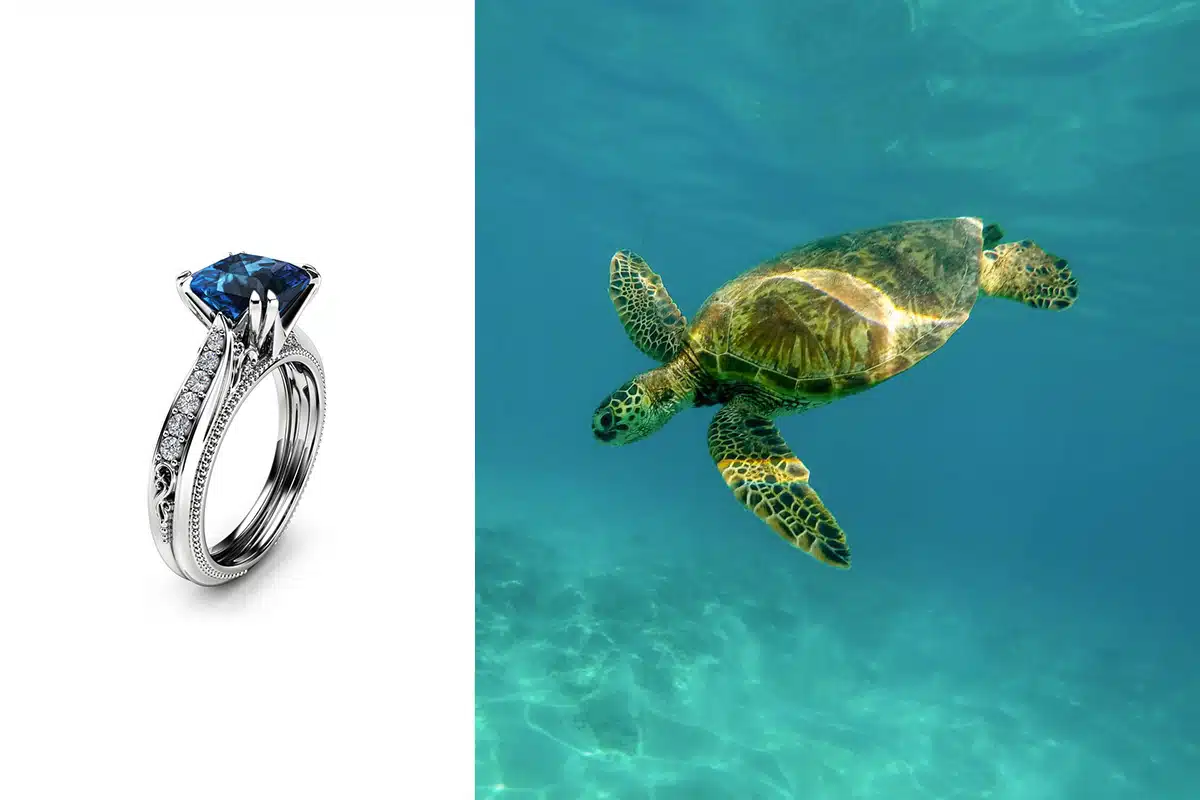
Paris x the Natural Diamond Engagement Ring
The most romantic city in the world, where art, fashion, architecture, gastronomy, and culture meet. For this unique combination, we’ve chosen a Classic Natural Diamond as an engagement ring in a 14K white gold setting. A ring that maintains its classic beauty with love in its details.
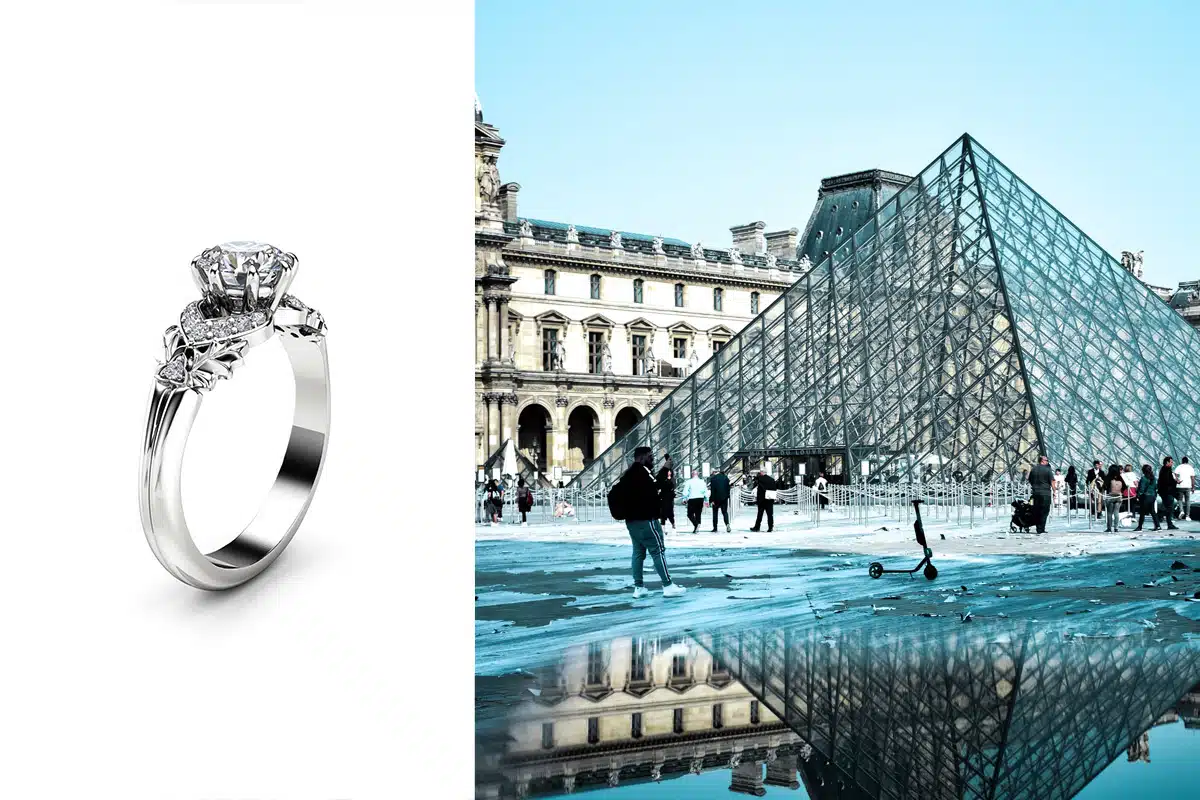
Bali x the Pear Cut Emerald Engagement Ring Set
Bali is an island in Indonesia known for volcanic mountains, sandy beaches, and adventurous coral reefs. And while it is a place full of greenery, yoga and relaxation, there are also exciting sunrises and dangerous creatures. And so, for this destination, we’ve chosen a Pear Cut Emerald Engagement Ring Set, set in 14k two-tone gold.
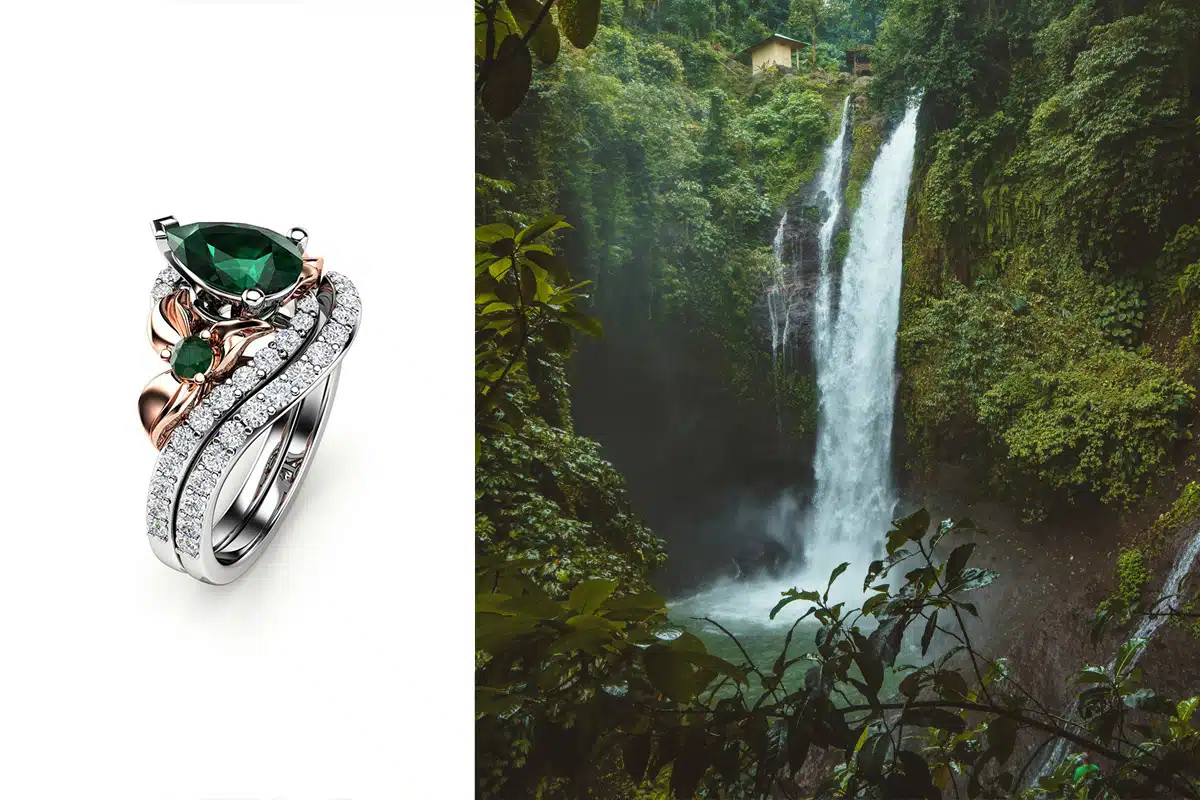
Want to do some more window shopping? Check out our online shop to see more destination-worthy rings. And don’t forget to let us know which one’s your favorite in the comments below
[image credit: Pexels]
Everything to Know About Blue Diamonds
Blue, diamonds are some of the rarest stones out there, with lots of stories to tell. Here’s the lowdown on these big blue beauties!
The blue diamond is a precious stone with rare qualities. People consider this color to be a symbol of eternity, truth, devotion, peace, chastity and spirituality. If you’re more into Hollywood, one of the most expensive diamonds in the world was the grayish blue one owned by Elizabeth Taylor.
What are Blue Diamonds?
A blue diamond is everything the name tells you. It’s as rare as any colorful diamond – from pink, to violet and red – but its deep shade brings lots of popularity, as does its size. The darker and bigger, the higher the price.
This diamond is mysterious and has a lot of controversies around it. Some people think it’s not a natural diamond color, but nature creates blue diamonds. Like the rest of the diamonds, its value is set by color, intensity, size and cut.
It takes millions of years for heat and carbon to turn into this precious stone. The color is set by elements like boron and nitrogen. It is expensive and you can’t find it in a lot of places, some are in South Africa and Australia, with vintage ones coming from India.
Natural or man-made blue diamonds?
“Hope Diamond”, “The Imperial Blue” and the “Blue Moon of Josephine” are some of the most expensive diamonds ever bought. This color has broken a lot of records. And the prices will continue to rise as the demand increases and the supply decreases. And that’s where lab made and treated diamonds come into to play.
Don’t worry if you have a budget to respect. There are plenty of beautiful man-made blue diamonds that will still turn heads. In addition, being friendly with Mother Earth and also trying to deliver a special present has never been easier.
The Process of Man-Made Blue Diamonds
Man-made diamonds are actually white diamonds that have gone through a coloring treatment brought on by heat. They start out as white diamonds that some people don’t care for, because they aren’t actually white. As a result, they lose their value. But the coloring process can produce a variety of gorgeous shades. Lab made ones follow the natural process of creating diamonds. The only differences being that it’s faster, and safer for the environment.
Blue Diamonds & Alternatives
The blue diamond makes a wonderful center piece on an engagement ring, as well as on a wedding band. But, if you want something blue that isn’t a diamond, opt for gemstones like blue sapphire, blue topaz, blue spinel and aquamarine. By the way, they can also go well together if you want to mix and match on a friendly budget. Check out our collection and find the perfect fit for your shade of blue.