




Category: Blog
Birthstones by Month: A Complete Guide and Meanings
Birthstones by month assign a special gem to each birth month, turning any ring, pendant or pair of earrings into a deeply personal gift. Here is the full modern list with meanings.
The tradition is ancient, yet it still feels fresh today. In fact, many people choose a stone simply because it marks a birthday, an anniversary or the arrival of a child. As a result, a birthstone adds meaning that a random gem never could.
Quick answer: January is garnet, February amethyst, March aquamarine, April diamond, May emerald, June pearl/moonstone, July ruby, August peridot, September sapphire, October opal/tourmaline, November topaz/citrine, and December turquoise/tanzanite.
The full birthstone list
Below you will find each month and its stone, along with the quality it traditionally represents. While some months share more than one gem, the first stone listed is usually the most popular choice.
- January – Garnet: protection and friendship.
- February – Amethyst: calm and clarity.
- March – Aquamarine: serenity and the sea.
- April – Diamond: strength and eternal love.
- May – Emerald: rebirth and devotion.
- June – Pearl, Moonstone, Alexandrite: purity and intuition.
- July – Ruby: passion and vitality.
- August – Peridot, Spinel: good fortune.
- September – Sapphire: wisdom and loyalty.
- October – Opal, Tourmaline: hope and creativity.
- November – Topaz, Citrine: warmth and joy.
- December – Turquoise, Tanzanite, Zircon: luck and friendship.
Together, these twelve gems cover a wide range of colors, hardness levels and price points. Therefore, there is a birthstone to suit almost any style and budget. Moreover, learning the birthstones by month makes it easy to plan a thoughtful gift well ahead of time.
Using birthstones in jewelry
Birthstones personalize engagement rings, stacking bands, mother’s rings and pendants. Pairing two partners’ stones, or a couple’s and a child’s, creates a meaningful custom piece.
Beyond engagement rings, birthstones shine in everyday pieces you can layer and mix. For example, a simple pendant lets the color take center stage, while a stackable ring adds a subtle pop next to a wedding band. In addition, birthstone earrings make an easy, wearable gift for almost anyone.
Choosing birthstones by month as a gift
Start with the recipient’s birth month, then decide which piece fits their lifestyle. If they work with their hands, a durable stone in a protective setting makes sense. However, if the piece is mostly for special occasions, a softer, showier gem can be perfect.
Next, think about their taste in color and metal. Warm gold suits earthy stones like garnet and citrine, while cool platinum flatters blue and green gems. Above all, matching the birthstones by month to the person’s style turns a simple gift into something they will treasure.
Caring for birthstone jewelry
Care depends on the stone, so a little knowledge goes a long way. Harder gems like diamond, sapphire and ruby handle daily wear with ease. Softer stones such as opal, pearl and turquoise, on the other hand, need gentler treatment.
Generally, clean most pieces with warm water, mild soap and a soft brush. Meanwhile, store each item separately so harder stones do not scratch softer ones. Finally, have prongs checked once a year to keep every stone secure.
FAQ
Can I use a birthstone in an engagement ring?
Absolutely — just confirm the stone is hard enough for daily wear or choose a protective setting for softer gems like opal.
Why do some months have more than one birthstone?
Different traditions and modern updates added alternatives, often to offer more affordable or available options.
Which birthstones are best for daily wear?
Diamond, sapphire and ruby are hardest; softer stones like opal and pearl need gentler handling.
Are birthstones the same in every country?
Not always. While the modern list is widely used, some regions keep older or alternative stones, so it is worth checking local tradition.
Can I give a birthstone that is not my own month?
Of course. Many people choose a stone for its color or meaning rather than their birth month, and that is perfectly fine.
Educational guide by Camellia Jewelry — handcrafted vintage & nature-inspired engagement rings since 2010.
Sources & references


Ruby Engagement Rings: The Bold, Romantic Red Gemstone
Ruby engagement rings make a passionate statement. As the red variety of corundum, ruby combines fiery color with near-diamond durability, making it both a meaningful and practical center stone.
Quick answer: Rubies are 9 on the Mohs scale, so they wear extremely well. The most prized color is a vivid “pigeon’s blood” red. Ruby symbolizes love, passion and protection, and is July’s birthstone and the 15th and 40th anniversary gem.
Color is everything
A ruby’s value rests mostly on color. The ideal is a saturated, slightly purplish red, often described as pigeon’s blood. Lighter or browner stones cost less but can still be lovely set in warm gold.
Because color drives so much of the price, it helps to view stones in different lighting before you decide. For example, daylight reveals the true body color, while warm indoor light can make a red gemstone glow even more. As a result, many buyers prefer to compare several rubies side by side.
In addition, a touch of fluorescence can make certain rubies appear more vivid in sunlight. Therefore, if you love a lively, almost neon glow, ask about fluorescence when you shop. Ultimately, a ruby ring looks its best when the center stone shows rich, even color across the whole surface.
Built for daily wear
At Mohs 9, ruby shares sapphire’s toughness and easily handles everyday use, unlike softer reds such as garnet or spinel.
Consequently, these rings suit active hands and busy routines. While no gem is scratch-proof, ruby resists daily knocks far better than most colored stones. Moreover, its hardness means the polish stays bright for years with only simple care.
To keep the setting secure, have the prongs checked once a year. Meanwhile, a quick clean with warm water, mild soap and a soft brush keeps the stone sparkling. Because ruby is so durable, it remains a smart choice for a ring you plan to wear every single day.
Symbolism
Few stones carry as much romantic weight as ruby, long associated with love, vitality and devotion — a fitting symbol for an engagement.
Throughout history, cultures have treasured ruby as a stone of passion and protection. In fact, ancient warriors once wore rubies for courage, while royalty prized them as symbols of power. Today, that heritage gives these rings a sense of depth and meaning beyond their beauty.
Ruby is also July’s birthstone and the traditional gift for the 15th and 40th anniversaries. Therefore, a ruby ring can mark not just an engagement but many milestones to come. For couples who want a bold, personal story, this red gemstone offers plenty to celebrate.
How to choose ruby engagement rings
Choosing a ruby comes down to four things: color, clarity, cut and carat weight. Above all, color matters most, so start there and let the vivid red lead your search. Next, look at clarity, since a few tiny inclusions are normal and often prove the stone is natural.
Then consider the cut, because a good cut returns light and makes the color pop. Finally, balance carat weight against your budget. In general, a slightly smaller stone with superb color beats a large, dull one. With these steps, ruby engagement rings become much easier to compare with confidence.
Ring settings that flatter ruby engagement rings
The right setting can make a red gemstone shine even brighter. Yellow gold, for instance, warms the stone and gives a classic, vintage feel. Rose gold, on the other hand, echoes the ruby’s blush tones for a soft, romantic look.
White metals like platinum create crisp contrast that makes the red appear deeper. Additionally, a halo of small white diamonds frames the center stone and adds sparkle. Whichever style you pick, ruby engagement rings pair beautifully with almost any metal, so choose the one that fits your personality.
FAQ
Are rubies good for engagement rings?
Yes — they are hard, durable and rich in symbolism, making them an excellent diamond alternative.
What is the best ruby color?
A vivid, slightly purplish red known as pigeon’s blood is the most prized.
Is a ruby harder than an emerald?
Yes. Ruby is Mohs 9 and far more durable than emerald at 7.5–8.
How much do ruby engagement rings cost?
Prices vary widely because color drives value. However, a fine natural ruby often costs less than a comparable diamond, so it can be a great value.
How do I care for a ruby ring?
Clean it with warm water, mild soap and a soft brush. Also, store it separately and have the prongs checked once a year.
Educational guide by Camellia Jewelry — handcrafted vintage & nature-inspired engagement rings since 2010.
Sources & references
Pear Shaped Diamonds: A Buyer’s Guide to the Teardrop Cut
The pear shaped diamond blends the brilliance of a round with the elegance of a marquise, creating a graceful teardrop that flatters the hand and looks larger than its carat suggests. From choosing the right length-to-width ratio to avoiding the bow-tie and wearing the point correctly, smart choices make all the difference between a stunning stone and a so-so one. This buyer’s guide walks you through every decision, including symmetry, clarity, settings and value, so you get maximum beauty for your budget. Read on to master this romantic, distinctive shape.
Quick answer: A pear shaped diamond is a teardrop combining a rounded end and a single point. It looks larger per carat than a round, elongates the finger, and offers excellent value. Pick a balanced ratio, check for a faint bow-tie, and protect the point with a secure setting.
Key takeaways
- Shape: A teardrop with one rounded end and one tapered point.
- Size: Appears larger per carat and elongates the finger.
- Ratio: A 1.45–1.75 length-to-width ratio suits most hands.
- Protection: A V-prong shields the vulnerable point from chips.
What is a pear shaped diamond?
A pear shaped diamond, also called a teardrop, is a hybrid of the round brilliant and the marquise. It has one gently rounded end and one tapered point, joined by curved shoulders and wings. As a brilliant-style cut, it carries 58 facets that scatter plenty of light and fire. The silhouette is feminine, vintage-leaning and distinctive without being flashy. Worn pointing toward the fingertip, it slims and lengthens the hand. This blend of sparkle, individuality and flattering form has made the pear a favorite for engagement rings, pendants and statement earrings alike.
Why a pear shaped diamond looks bigger
Like other elongated shapes, the pear spreads its carat weight across a longer surface, so it presents a larger face-up area than a round of equal weight. The visual gain is often around 8 to 10 percent, which the eye reads instantly. That means a 1.00 ct pear can look like a 1.10 ct round from above. Pears also tend to price lower per carat than rounds because of softer demand, so you gain size and save money at the same time. That double benefit is a big reason the shape keeps growing in popularity. Understanding the 4 Cs of diamonds helps you balance carat against cut quality, which ultimately controls how lively your teardrop looks and how much sparkle you get for every dollar spent.
Choosing the right ratio and symmetry
Ratio defines the personality of a pear shaped diamond. The length-to-width ratio tells you how slender or plump the teardrop appears. A ratio of 1.45 to 1.75 is the popular sweet spot, giving a classic, balanced look.
Symmetry is non-negotiable
Because the eye instantly spots a crooked teardrop, symmetry is critical. The point should line up directly with the apex of the rounded end, and the left and right wings should mirror each other. Even, gently curved shoulders look elegant, while flat wings can make the stone seem skinny or unbalanced.
Avoiding the bow-tie effect
Most elongated brilliant cuts, including pears, can show a bow-tie: a dark shadow stretching across the center where light leaks out. A faint bow-tie is normal and often barely noticeable. A pronounced one, however, creates a dull dark zone that no setting can fix. Grading reports do not measure the bow-tie, so you must view the stone in person or on high-quality video. Tilt it under different lights to judge how the shadow behaves. A well-cut pear keeps the bow-tie subtle and sparkles evenly from the rounded end to the point.
Pear shape buying checklist
| Factor | What to look for | Why it matters |
|---|---|---|
| Length-to-width ratio | 1.45–1.75 | Balanced classic teardrop |
| Bow-tie | Faint or none | A heavy one dulls the center |
| Symmetry | Point aligned with apex | Crooked stones look off |
| Setting | V-prong on the point | Protects the vulnerable tip |
| Clarity | VS or eye-clean SI | Keeps the stone bright |
Settings, wear and protecting the point
The tapered point is the pear’s most delicate area and the spot most vulnerable to chipping if it catches on clothing or hard surfaces. A V-shaped prong, sometimes called a chevron prong, cradles and shields the tip, so always insist on one for daily wear. Most people wear the point facing the fingertip for the slimming, elongating effect, though pointing toward the hand is a stylish, less common alternative. Halo, three-stone, bezel and east-west designs all suit the shape and each lends a different mood. A halo in particular boosts perceived size and adds extra sparkle around the teardrop. Browse our engagement rings to see protective settings in action, and schedule regular professional prong checks to keep the stone secure for years to come.
Is a pear shaped diamond right for you?
Choose a pear if you love a romantic, individual look with brilliant sparkle and a flattering, elongating line. It rewards careful shopping: get the ratio, symmetry and bow-tie right and you will own a stone that looks larger than its carat and costs less than a round. If you prefer a foolproof, points-free shape that demands no inspection, a round or oval may suit you better. For those willing to choose thoughtfully, the teardrop delivers timeless charm and outstanding value.
Does a pear shaped diamond look bigger than a round?
Yes. Its elongated form spreads carat weight across a longer surface, so a pear appears roughly 8 to 10 percent larger face-up than a round of the same carat weight, giving more visible size for your budget.
Which way should you wear a pear shaped diamond?
Most people wear the point facing the fingertip, which slims and elongates the finger. Pointing it toward the hand is a valid stylish alternative. There is no strict rule, so wear it whichever way feels most flattering to you.
What is the best ratio for a pear diamond?
A length-to-width ratio between 1.45 and 1.75 gives the classic, balanced teardrop most buyers prefer. Lower ratios look rounder and plumper, while higher ratios appear longer and more slender, so choose to suit your taste.
How do I avoid the bow-tie effect?
View the diamond in person or on video under varied lighting. A faint bow-tie is normal, but reject stones with a heavy dark band across the center. Grading reports do not measure it, so visual inspection is essential.
Are pear shaped diamonds durable?
They are durable overall, but the single point can chip if unprotected. A V-prong setting shields the tip, and routine prong checks keep the stone secure. With proper care, a pear lasts a lifetime of daily wear.
Are pear diamonds cheaper than round?
Usually yes. Pears typically cost less per carat than round brilliants because of lower demand and less rough waste during cutting. Combined with their larger face-up look, this makes them an excellent value choice.
Educational guide by Camellia Jewelry — handcrafted vintage & nature-inspired engagement rings since 2010.
Sources & references
Emerald Cut Diamonds: The Complete Guide to This Elegant Shape
The emerald cut diamond is the connoisseur’s shape, prized for its clean lines, vintage glamour and hypnotic “hall of mirrors” effect. Unlike sparkly brilliant cuts, it trades fireworks for sophistication and a larger look per carat. This complete guide covers its pros and cons, ideal clarity and color, the best length-to-width ratios, the most flattering settings and how to buy one wisely. We will also explain why this elegant step cut is so forgiving on the finger yet so demanding when it comes to quality. Read on to decide whether it belongs on your hand.
Quick answer: An emerald cut diamond is a rectangular step-cut stone with long, parallel facets that create a sleek hall-of-mirrors flash rather than sparkle. It looks larger per carat than most shapes, flatters the finger and suits anyone who loves understated, vintage-inspired elegance.
Key takeaways
- Style: Step-cut facets give a refined hall-of-mirrors flash, not brilliant sparkle.
- Clarity: Choose VS2 or better, since the open table reveals inclusions.
- Size: Looks larger per carat than a round thanks to its broad surface.
- Ratio: A 1.30–1.50 length-to-width ratio is the classic sweet spot.
What is an emerald cut diamond?
An emerald cut diamond is a rectangular shape with cut-off corners and long, straight facets arranged in parallel rows, known as a step cut. The style originated centuries ago for cutting emerald gemstones, which are brittle and crack easily, and the trimmed corners helped protect them. Jewelers later adopted the same cut for diamonds, where it became a hallmark of refined taste. Instead of the scintillating sparkle of a brilliant cut, an emerald cut produces broad, mirror-like flashes of light and dark. This dramatic interplay is often called the hall-of-mirrors effect. The look is clean, architectural and unmistakably elegant, which is why it remains a favorite for Art Deco and vintage-inspired designs and a perennial choice for those who prefer understated luxury.
The hall-of-mirrors effect explained
The signature appeal of an emerald cut diamond is its luminous depth. Long parallel facets act like a series of mirrors, reflecting light back and forth and producing dramatic flashes rather than tiny pinpoints of fire. When you tilt the stone, light rolls across the surface in bold sheets. This subtle, sophisticated sparkle reads as understated luxury. Because the facets are large and open, the diamond also showcases exceptional transparency and a glassy, icy clarity. People who find brilliant cuts too flashy often fall in love with this calmer, more refined personality the moment they see it move in the light.
Why an emerald cut diamond looks bigger
One of the biggest draws is value for size. An emerald cut has a large, open table and a relatively shallow profile, so more of its weight sits near the surface rather than hidden in depth. The result is a generous face-up footprint that looks larger than a round brilliant of the same carat weight. In practice, a 1.00 ct emerald cut can appear similar in size to a 1.20 ct round, a difference your eye notices immediately. Combined with typically lower per-carat prices than rounds, this makes the shape an excellent way to maximize presence on a budget. The elongated rectangle also draws the eye lengthwise, slimming and lengthening the finger for an elegant, refined line that suits almost every hand.
Choosing clarity, color and ratio
The open table that makes this shape so beautiful also makes it less forgiving, so the 4 Cs deserve careful attention. Read our 4 Cs of diamonds guide for a full primer.
Clarity matters most
Because there is no busy faceting to hide flaws, inclusions show easily. Aim for VS2 or higher to keep the stone eye-clean. For color, an emerald cut shows tint slightly more than a round, so G or better is a safe target in white metals.
Emerald cut at a glance
| Attribute | Recommendation | Why |
|---|---|---|
| Clarity | VS2 or higher | Open table reveals inclusions |
| Color | G or higher (white gold/platinum) | Shape shows tint readily |
| Length-to-width ratio | 1.30–1.50 | Classic balanced rectangle |
| Setting | Solitaire, three-stone, halo | Highlights clean lines |
| Best for | Lovers of vintage elegance | Understated, timeless look |
Best settings and styles
An emerald cut diamond shines in settings that echo its clean geometry. A simple solitaire lets the stone’s clarity speak for itself, while four-prong or corner-claw mounts protect the cut corners and frame the rectangle beautifully. Three-stone designs with tapered baguettes are a timeless Art Deco pairing. A slim halo of round brilliants adds extra sparkle without overwhelming the center. This shape is a natural fit for vintage engagement rings, where milgrain detailing and geometric lines complete the period look. East-west orientation also gives a striking modern statement.
Pros and cons to weigh
Every shape has trade-offs worth weighing before you commit. On the plus side, the emerald cut delivers elegant flashes, a large face-up size, lower per-carat pricing and a sophisticated, finger-lengthening profile. It also pairs effortlessly with both vintage and minimalist modern designs. On the downside, it demands higher clarity and color to look its best, hides fewer flaws, and produces less fire than a brilliant cut, which may disappoint sparkle lovers. The trimmed corners are sturdy thanks to their angled facets, making the shape more durable than pointed cuts like the pear or marquise. If you value refinement over flash and want genuine size for your spend, this cut rewards you with quiet, timeless beauty for a lifetime.
Are emerald cut diamonds less sparkly?
Yes, but intentionally. The step-cut facets create broad mirror-like flashes rather than the small, fiery sparkles of a brilliant cut. Many buyers prefer this calmer, more sophisticated light play that reads as understated, timeless elegance.
What clarity should I buy for an emerald cut?
Aim for VS2 or higher. The large open table and step facets offer nowhere for inclusions to hide, so a higher clarity grade keeps the diamond eye-clean and showcases its prized glassy transparency.
What is the best length-to-width ratio?
A ratio between 1.30 and 1.50 gives the classic balanced rectangle most people picture. Below 1.30 looks squarer, while above 1.50 appears very elongated. Choose based on your taste and finger length.
Does an emerald cut look bigger than a round?
Yes. Its broad, open table and shallow profile place more weight near the surface, so an emerald cut appears larger face-up than a round of equal carat, often looking 15 to 20 percent bigger.
Are emerald cut diamonds durable?
They are quite durable. The trimmed, angled corners remove the vulnerable points found on pear and marquise shapes, reducing chipping risk. With a protective setting and normal care, an emerald cut wears well every day.
Are emerald cut diamonds good value?
Generally yes. They often cost less per carat than round brilliants and look larger face-up, so you get more visible size for your budget, provided you invest in adequate clarity and color.
Educational guide by Camellia Jewelry — handcrafted vintage & nature-inspired engagement rings since 2010.
Sources & references
Oval vs Round Diamond: Which Engagement Ring Shape Wins?
When it comes to choosing a classic center stone, the oval vs round diamond debate is one couples wrestle with most. Both shapes are brilliant cuts that deliver exceptional sparkle, yet they flatter the hand differently and carry different price tags. This guide compares size appearance, sparkle, cost, durability and finger flattery in plain English. We will also look at the best settings for each and how value really stacks up. By the end, you will know exactly which silhouette suits your style and budget.
Quick answer: In the oval vs round diamond comparison, an oval looks larger per carat and tends to cost less, while a round brilliant delivers the most fire and timeless symmetry. Choose oval for an elongating, modern look and round for maximum sparkle and resale stability.
Key takeaways
- Size: An oval appears roughly 8–10% larger than a round of equal carat weight.
- Sparkle: The round brilliant returns the most light and fire of any cut.
- Price: Ovals usually cost 10–25% less per carat than comparable rounds.
- Flattery: The oval’s elongated outline slims and lengthens the finger.
Oval vs round diamond: how they look on the hand
Shape changes everything about how a diamond reads on the finger. The round brilliant is perfectly symmetrical, so it draws the eye to a tidy, sparkling circle that feels classic and complete. The oval, by contrast, is elongated. That extra length stretches across more of the finger, creating a slimming, elegant line that many people find flattering. If you have shorter fingers, the oval can make them appear longer and more graceful. Round stones suit almost everyone and never look dated, which is part of their universal charm. Both shapes sit beautifully in solitaire, halo and three-stone designs, so personal taste and hand shape should guide your final choice more than any rule. Try each on before deciding, since the same carat can feel entirely different across the two outlines.
Which looks bigger per carat?
Carat is weight, not size, and that distinction matters here. Because an oval spreads its weight across a longer surface, it presents a larger face-up area than a round of the same carat. The visual gain is roughly 8 to 10 percent. So a 1.00 ct oval often looks like a 1.10–1.15 ct round from above. For shoppers who prioritize presence, this is the oval’s headline advantage. Round brilliants concentrate weight beneath the table, which boosts sparkle but trades away a little surface spread. If looking big for the budget is your goal, the elongated shape wins.
Sparkle, fire and brilliance compared
The round brilliant was engineered over a century to maximize light return, and it still sets the benchmark for sparkle. Its 57 or 58 facets are optimized for both brilliance (white light) and fire (colored flashes). Ovals are a modified brilliant cut, so they sparkle generously too, though slightly less uniformly. Some ovals show a faint dark band across the center called the bow-tie effect.
Watch for the bow-tie
A mild bow-tie is normal, but a heavy one dulls the stone. Always view an oval in person or on video. A well-cut oval keeps the bow-tie subtle and scatters light evenly from end to end, rivaling a round’s liveliness.
Oval vs round diamond price difference
Budget is often the deciding factor in the oval vs round diamond question. Round brilliants are the most in-demand shape and require more rough to cut, so they command a premium. Ovals retain more of the rough and sell for less per carat, typically 10 to 25 percent below a comparable round. Pairing that saving with the oval’s larger look means real value, since you gain visible size while spending less. The gap widens as carat increases, so at one carat and above the savings can fund a higher color or clarity grade. Understanding the 4 Cs of diamonds helps you spend wisely on either shape, since cut quality affects both beauty and cost more than carat alone. Always prioritize an excellent cut, because a poorly cut stone of either shape looks dull no matter how large.
At-a-glance comparison
| Feature | Oval Diamond | Round Diamond |
|---|---|---|
| Face-up size | Looks ~8–10% larger | Compact, true to carat |
| Sparkle | Brilliant, slight bow-tie risk | Maximum fire and brilliance |
| Price per carat | 10–25% lower | Highest demand, premium |
| Finger effect | Elongating, slimming | Universally flattering |
| Durability | Pointed ends need protection | No vulnerable points |
Choosing the right setting for each shape
Settings can enhance or protect each shape. Ovals have two gently pointed ends, so prongs or a bezel at the tips guard against chips. East-west settings, where the oval lies horizontally, give a fresh, modern twist. Round brilliants are the most versatile of all, sitting comfortably in solitaire, pavé, halo and vintage-style mounts alike. A halo amplifies either shape’s perceived size and adds extra sparkle. Whatever you choose, secure prongs and a comfortable profile matter for daily wear. Explore mounts in our engagement rings collection to see how each silhouette comes to life.
Which shape should you choose?
There is no universally correct answer, only the right choice for you. Weighing the trade-offs makes it clearer. The round brilliant’s strengths are unmatched sparkle, a foolproof shape with no fragile points and the strongest resale demand, though you pay a premium and lose a little face-up size. The oval’s advantages are a larger look per carat, a flattering elongated line and meaningful savings, with the only cautions being a possible bow-tie and two gently pointed ends. So pick a round brilliant if you want the most sparkle, the best resale value and a look that never goes out of style. Pick an oval if you love an elongated, contemporary silhouette, want maximum face-up size and prefer to stretch your budget further. Consider your partner’s wardrobe, hand shape and lifestyle. Both shapes are timeless in their own way, so trust your instincts and choose the diamond that makes you smile every time you glance down.
Does an oval or round diamond look bigger?
An oval looks bigger. Because its weight spreads across a longer surface, an oval appears roughly 8 to 10 percent larger face-up than a round diamond of the same carat weight, making it a popular choice for maximizing visual size.
Is an oval diamond cheaper than a round?
Yes. Ovals typically cost 10 to 25 percent less per carat than round brilliants because they waste less rough during cutting and have lower market demand, giving you more size and savings for the same budget.
What is the bow-tie effect in oval diamonds?
The bow-tie is a dark, bow-shaped shadow across the center of an oval caused by light leakage. A faint bow-tie is normal, but a strong one dulls sparkle, so always inspect an oval in person or on video.
Which shape sparkles more?
The round brilliant sparkles most. Its 57 to 58 facets are precision-engineered for maximum light return. Ovals are also very brilliant as a modified brilliant cut, but their sparkle is slightly less uniform than a round’s.
Are oval diamonds harder to keep clean?
Slightly. The elongated shape and pointed ends can collect debris near the prongs. A quick soak in warm water with mild dish soap and a soft brush once a week keeps either shape sparkling beautifully.
Which shape holds its value better?
Round brilliants hold value best. As the most popular and liquid diamond shape, they enjoy steady demand and easier resale. Ovals are increasingly sought after but remain a slightly more fashion-driven, trend-sensitive choice.
Educational guide by Camellia Jewelry — handcrafted vintage & nature-inspired engagement rings since 2010.
Sources & references
Moissanite vs Diamond: Sparkle, Price and Durability Compared
The moissanite vs diamond debate comes down to sparkle, price and durability, and the right answer depends on what you value most. Both stones are stunning, brilliant and built for everyday wear, yet they differ in cost and character. Because moissanite costs a fraction of a diamond, it lets you choose a larger or more elaborate ring. This guide compares the two head to head so you can decide with confidence.
Quick answer: In the moissanite vs diamond comparison, moissanite has more rainbow fire and costs up to 90% less, while diamond is harder, more colorless and holds resale value better. Both are exceptionally durable for daily wear, so the choice comes down to budget, sparkle preference and long-term value.
Key takeaways
- Price: moissanite costs roughly a tenth of a comparable diamond.
- Sparkle: moissanite shows more colorful fire; diamond shows whiter brilliance.
- Hardness: diamond is a 10 on the Mohs scale; moissanite is 9.25.
- Value: diamond retains resale value better than moissanite.
What is moissanite vs diamond?
A diamond is pure crystallized carbon, the hardest natural material on earth, formed over billions of years or grown in a lab. Moissanite is silicon carbide, a different mineral that is exceptionally rare in nature, so nearly all moissanite sold today is lab-created. Although the two look similar at a glance, they are chemically distinct gemstones. In the moissanite vs diamond comparison, this difference in composition explains their contrasting optical behavior, hardness and price. Understanding what each stone actually is makes the rest of the comparison much clearer.
Moissanite vs diamond: sparkle and brilliance
Both stones sparkle beautifully, but they do it differently. Moissanite has a higher refractive index, which gives it more fire — the flashes of rainbow color you see as it moves. Some people adore this disco-ball effect, while others find it too intense in larger sizes. Diamond, by contrast, balances white brilliance with subtle fire for a classic, restrained sparkle. As a result, the better choice depends on taste. If you love vivid color flashes, moissanite wins; if you prefer timeless white light, diamond does.
Does the difference show?
In smaller stones the difference is subtle, but above one carat moissanite’s extra fire becomes more obvious, especially in bright light. Some buyers see this as a feature and choose moissanite precisely for that lively, colorful flash. Others prefer the calmer, classic look of a diamond. Either way, viewing both stones in person is the surest way to know which sparkle style you prefer.
Moissanite vs diamond: price comparison
Price is where the two stones diverge most dramatically. A one-carat moissanite typically costs a few hundred dollars, while a comparable natural diamond can run several thousand. Even lab-grown diamonds, though cheaper than natural, cost considerably more than moissanite. Because of this gap, many couples choose moissanite to afford a larger center stone, a more intricate setting or a shorter timeline to purchase. In short, the moissanite vs diamond price difference gives budget-conscious buyers far more flexibility without sacrificing visible beauty.
Moissanite vs diamond: durability and daily wear
Durability matters for a ring you wear every day, and both stones excel. Diamond tops the Mohs hardness scale at 10, making it the most scratch-resistant gem available. Moissanite sits just below at 9.25, which is still harder than sapphire and more than tough enough for daily wear. Both resist chipping and hold a brilliant polish for life. Therefore, while diamond is technically harder, the practical durability difference is small. For everyday rings, you can confidently choose either stone without worrying about damage. It is worth remembering that hardness measures scratch resistance, not toughness against a hard knock. As a result, both stones still benefit from a protective setting and sensible everyday care, just like any fine ring you intend to wear for decades.
| Factor | Moissanite | Diamond |
|---|---|---|
| Hardness (Mohs) | 9.25 | 10 |
| Fire / color flash | Very high | Moderate |
| Price (1ct) | Low | High |
| Resale value | Minimal | Stronger |
| Origin | Lab-created | Natural or lab |
Moissanite vs diamond: color and clarity
Modern moissanite is engineered to be near-colorless, comparable to a D–F diamond, and it is consistently eye-clean because it is lab-grown under controlled conditions. Diamonds, however, span the full color and clarity range, so quality and price vary widely. In very large sizes, some moissanite can show a faint warm or greenish tint under certain lighting, though premium grades minimize this. For most buyers, both stones look crisp and clean once set, so color and clarity rarely tip the decision on their own. Because moissanite is grown to a consistent standard, you also avoid the guesswork of comparing dozens of clarity and color grades. With a diamond, however, that wider range is part of the appeal, letting you fine-tune quality and price to your exact preference.
Which should you choose?
Choose moissanite if your priority is maximum size and sparkle for the lowest price, or if you simply love its fiery brilliance. Choose a diamond if you value the tradition, the slightly harder surface, the whiter brilliance and the stronger resale value that comes with a natural or lab-grown stone. Neither choice is wrong. Ultimately, the moissanite vs diamond decision is personal, balancing budget against the qualities that matter most to you and your partner. There is no universally correct stone, only the one that fits your priorities. Some couples even split the difference, choosing moissanite for a bold center stone today and upgrading to a diamond on a future anniversary. Whatever you decide, both stones can anchor a ring you will treasure for a lifetime.
Can people tell moissanite from a diamond?
Usually not at a glance. Most people cannot tell the difference in daily wear. A trained jeweler can spot moissanite’s stronger fire and double refraction under magnification, but to the casual eye both stones look like sparkling white gems.
Is moissanite as durable as a diamond?
Nearly. Diamond is a 10 on the Mohs hardness scale and moissanite is 9.25. Both far exceed everyday wear demands and resist scratching well. The small gap rarely matters in practice, so moissanite is excellent for daily rings.
Why is moissanite so much cheaper?
Moissanite is lab-created in weeks, while diamonds are mined or grown over far longer and carry stronger demand. The streamlined production and abundant supply make moissanite dramatically less expensive, often around a tenth of a comparable diamond’s price.
Does moissanite hold its value?
Not strongly. Moissanite has minimal resale value because it is inexpensive and widely available. Diamonds, especially natural ones, retain value better. If long-term worth matters to you, a diamond is the better financial choice.
Does moissanite get cloudy over time?
No. Moissanite does not become cloudy or lose its sparkle. Like diamond, it may collect skin oils and lotion that dull its shine, but a simple cleaning with soap and water restores its full brilliance.
Is moissanite a good engagement ring stone?
Yes. Moissanite is durable, brilliant, eye-clean and affordable, making it a popular engagement ring choice. It lets couples afford a larger stone or finer setting, so it suits buyers who prioritize size and sparkle over resale value.
Educational guide by Camellia Jewelry — handcrafted vintage & nature-inspired engagement rings since 2010.
Sources & references
Diamond Cut Grades Explained: Why Cut Matters Most
The diamond cut grade is the single factor that controls how much a diamond sparkles, which is why experts call it the most important of the four Cs. Cut describes how well a stone’s facets are proportioned and polished, not its shape. Because light return depends on precise angles, a brilliant cut can outshine a larger or higher-color stone. This guide explains how cut grades work and which to choose.
Quick answer: A diamond cut grade measures how well a diamond’s proportions, symmetry and polish return light to the eye. GIA grades round diamonds from Excellent to Poor. Cut matters most because it controls brilliance and fire, so always choose Excellent or Ideal for maximum sparkle.
Key takeaways
- Definition: the diamond cut grade rates proportions, symmetry and polish, not shape.
- Impact: cut controls sparkle more than color, clarity or carat.
- Choose: Excellent or Ideal cut for round diamonds; never go below Very Good.
- Effect: a great cut makes a stone look larger, brighter and livelier.
What is a diamond cut grade?
A diamond cut grade assesses how effectively a diamond has been faceted to interact with light. It is judged on three elements: proportions, symmetry and polish. Proportions cover the angles and relative sizes of the facets, symmetry measures how precisely they align, and polish rates the smoothness of each facet surface. Together these determine how much light enters the stone and bounces back to your eye. Importantly, cut is the only one of the four Cs shaped entirely by human skill rather than nature, which is why craftsmanship makes such a dramatic difference.
How the diamond cut grade scale works
GIA grades the cut of round brilliant diamonds on a five-tier scale: Excellent, Very Good, Good, Fair and Poor. An Excellent cut returns the most light and shows intense brilliance and fire. Very Good performs almost as well and can offer slightly better value. Good is acceptable but noticeably less lively, while Fair and Poor stones look dull or dark. For round diamonds, staying at Very Good or above is wise. As a result, most informed buyers focus their search on Excellent and Very Good grades only.
What about fancy shapes?
GIA does not assign an overall cut grade to fancy shapes like oval or pear. For those, judge proportions, length-to-width ratio and the symmetry and polish grades, and view the stone in motion to assess sparkle. Because there is no single grade to lean on, fancy shapes reward a careful eye even more. Look out for a bow-tie shadow across the center, and favor even, balanced proportions that keep light bouncing across the whole face of the stone.
Why the diamond cut grade matters most
Cut earns its top ranking because it governs the three things your eye actually notices: brilliance, fire and scintillation. Brilliance is white light return, fire is the rainbow flashes, and scintillation is the sparkle as the stone moves. A poorly cut diamond leaks light through its bottom and sides, so it looks lifeless even with flawless color and clarity. By contrast, an ideal cut maximizes every flash. In short, you can compromise slightly on the other Cs, but a low cut grade ruins a diamond no matter what. Think of cut as the engine that powers everything else you paid for. Without it, premium color and clarity simply sit there unused, because there is no light show to display them. With a great cut, even a modest stone comes alive.
Diamond cut grade vs the other Cs
It helps to see how cut stacks up against color, clarity and carat. While carat adds weight and color and clarity add subtle refinement, only cut transforms how a stone performs in the light. Spending on cut delivers the most visible return per dollar. For example, a one-carat Excellent-cut stone can look bigger and brighter than a slightly heavier stone with a mediocre cut. The table below summarizes how to prioritize cut against the other factors.
| Factor | What it affects | Priority |
|---|---|---|
| Cut | Sparkle, brilliance, fire | Highest — never compromise |
| Color | How white the stone looks | Medium — near-colorless is fine |
| Clarity | Visible flaws | Medium — aim eye-clean |
| Carat | Weight and size | Flexible — adjust to budget |
How to choose the right diamond cut grade
For a round brilliant, set Excellent as your target and treat Very Good as the lowest acceptable grade. Then look beyond the single word and check the report’s symmetry and polish ratings, which should also be Very Good or Excellent. Whenever possible, view the diamond in video or in person, because numbers cannot fully capture how a stone dances in the light. Finally, avoid stones cut too deep or too shallow, since those proportions trade away brilliance for extra weight you cannot see.
Common diamond cut mistakes to avoid
The biggest mistake is prioritizing carat weight over cut, which leaves buyers with a large but lifeless stone. Another is assuming all certified diamonds sparkle equally, when cut quality varies widely even among graded stones. Some shoppers also overpay for top color and clarity while accepting a mediocre cut, which is exactly backwards. Lastly, beware of stones cut for weight retention rather than beauty. These look heavier on paper but appear small and dull face-up, so always let the cut grade lead your decision.
What is the best diamond cut grade?
Excellent is the best cut grade for round diamonds. It returns the most light and produces the strongest brilliance and fire. Ideal, a similar top tier used by some labs, performs the same way and is equally worth choosing.
Is cut more important than carat?
Yes. Cut controls sparkle, which is what makes a diamond look alive, while carat only adds weight. A well-cut smaller stone often looks brighter and even larger than a heavier stone with a poor cut.
What is the lowest cut grade I should buy?
Very Good is the lowest grade most experts recommend for round diamonds. It returns nearly as much light as Excellent at a slightly lower price. Below Very Good, sparkle drops noticeably, so it is best avoided.
Do fancy shapes have a cut grade?
GIA does not give an overall cut grade to fancy shapes like oval, pear or emerald. Instead, judge their proportions, length-to-width ratio, symmetry and polish, and view the stone moving to assess how well it sparkles.
Does cut affect how big a diamond looks?
Yes. A well-cut diamond reflects light across its full face, making it appear larger and brighter. A poorly cut stone can look smaller and darker even at the same carat weight, because light escapes instead of returning.
What is the difference between cut and shape?
Shape is the outline, such as round, oval or princess. Cut is the quality of the faceting and proportions within that shape. A round diamond is a shape; an Excellent round is a high cut grade.
Educational guide by Camellia Jewelry — handcrafted vintage & nature-inspired engagement rings since 2010.
Sources & references
Diamond Color Scale Explained: From D to Z
The diamond color scale ranks how white or how tinted a diamond is, running from D at the top to Z at the bottom. It is one of the four key grading factors, and it has a real effect on price. However, the differences between neighboring grades are subtle, so you rarely need a colorless stone to get a white look. This guide explains the scale and which grade to choose in each metal.
Quick answer: The diamond color scale grades stones from D (completely colorless) to Z (light yellow). Most buyers get the best value in the near-colorless range of G to J, which looks white once set. Warmer metals like yellow and rose gold let you choose lower grades without seeing tint.
Key takeaways
- Range: the diamond color scale runs D-Z, from colorless to light yellow.
- Sweet spot: G-H looks white in most settings for far less than D-F.
- Metal matters: yellow and rose gold hide tint, so you can drop grades.
- Size effect: larger diamonds show color more, so step up a grade.
What is the diamond color scale?
The diamond color scale is the GIA grading system that measures the absence of color in a white diamond. It begins at D, which is completely colorless, and runs through the alphabet to Z, which shows a noticeable light yellow or brown tint. Counterintuitively, less color means a higher grade and a higher price. The scale starts at D rather than A because GIA wanted a clean break from older, inconsistent grading terms. Stones are graded face-down against a master set under controlled lighting, since tint is easiest to judge from the side, not the top.
How the diamond color scale grades break down
The scale is divided into five practical ranges. First, colorless (D-F) shows no visible tint and is the rarest and most expensive. Next, near-colorless (G-J) appears white to the eye, especially once set, and offers excellent value. Faint (K-M) shows a slight warmth that some buyers actually love in vintage styles. Very light (N-R) and light (S-Z) show increasingly obvious yellow. Overall, most engagement rings sold today fall in the colorless and near-colorless ranges, where the stone reads as white.
Colorless vs near-colorless
The jump from F to G is invisible to almost everyone, yet the price drops meaningfully. As a result, G is often the smartest single grade on the entire diamond color scale for value-minded buyers. Many shoppers fixate on landing in the colorless range simply for the label, but that premium pays for prestige rather than visible beauty. Once a near-colorless stone is set and catching light, even a jeweler would struggle to distinguish it from a colorless one.
Which diamond color grade looks white?
For most people, grades D through J all look white face-up once a diamond is mounted. The faint warmth in I or J is only noticeable when compared side by side with a colorless stone under bright light. Since that direct comparison almost never happens in real life, G and H are popular choices that deliver a crisp white appearance. As a result, choosing a near-colorless grade instead of colorless can save a substantial amount, which you can then put toward a better cut or larger size.
How metal color affects the diamond color scale
The metal you set a diamond in changes how much color you perceive. White metals like platinum and white gold reflect their cool tone into the stone, so any tint shows more readily. Therefore, white settings reward higher grades, ideally G or above. Yellow and rose gold, by contrast, cast a warm glow that masks faint yellow in the diamond. Thanks to this masking effect, you can comfortably choose a lower grade such as K or L in warm metals and still enjoy a beautiful, harmonious look while saving money.
| Metal | Recommended color grade | Why |
|---|---|---|
| Platinum / white gold | G-H or higher | Cool metal reveals tint |
| Yellow gold | J-L | Warm tone hides yellow |
| Rose gold | I-K | Pink warmth masks color |
| Halo / pavé setting | One grade lower | Surrounding stones distract the eye |
Does diamond size change the color you need?
Yes, larger diamonds display color more obviously than small ones. Color concentrates as a stone grows, so a faint tint that is invisible in a half-carat diamond can become noticeable in a three-carat stone. For that reason, it is wise to step up one grade on the diamond color scale as size increases. With a stone above two carats in a white setting, aim for G or higher. Smaller stones, on the other hand, perform beautifully at near-colorless or even faint grades and stretch your budget further.
Fancy color diamonds and the regular scale
The D-Z diamond color scale only applies to white diamonds. Once a stone shows color stronger than Z, it leaves the normal scale and enters the world of fancy color diamonds. These are graded on a separate system based on hue, tone and saturation, where more color is better and more valuable. Yellow, pink, blue and other fancy colors are prized for their rarity. Consequently, while a Z stone is the bottom of the white scale, a vivid fancy yellow can be exceptionally precious. This is why the same hue can mean opposite things at different points on the spectrum. In other words, a trace of yellow lowers a white diamond’s grade and price, but a deep, saturated yellow becomes a sought-after fancy color that can cost far more than a colorless stone.
What is the best diamond color grade?
D is the highest grade, but it is not the best value. G and H look white in nearly any setting for much less. The best grade depends on your metal, stone size and budget rather than a single universal answer.
Can you see the difference between G and H color?
Almost never with the naked eye. The gap between G and H is so small that even trained graders need a master set to tell them apart. Once set, both grades appear bright white.
What color diamond is best for yellow gold?
Grades J through L work beautifully in yellow gold. The metal’s warm tone masks faint yellow in the diamond, so you can choose a lower color grade, enjoy a seamless look and save money in the process.
Why does the diamond color scale start at D?
GIA chose D to make a clean break from older grading systems that used A, B and C inconsistently. Starting at D avoided confusion and gave the new colorless scale a clear, fresh reference point.
Do lab-grown diamonds use the same color scale?
Yes. Lab-grown diamonds are graded on the identical D-to-Z color scale as natural diamonds. They share the same chemistry and optical behavior, so the scale and the same grade recommendations apply equally to both.
Is a colorless diamond worth the extra cost?
For most buyers, no. Colorless D-F grades carry a premium for rarity, not for a visible difference once set. Near-colorless G-J looks just as white in daily wear, making it the smarter spend.
Educational guide by Camellia Jewelry – handcrafted vintage & nature-inspired engagement rings since 2010.
Sources & references
The 4 Cs of Diamonds Explained: Cut, Color, Clarity & Carat
Understanding the 4 cs of diamonds is the single most useful skill when shopping for an engagement ring. These four factors — cut, color, clarity and carat — determine how a diamond looks and what it costs. Because they interact, knowing how to balance them lets you buy a brilliant stone without overspending. This guide decodes each C in plain English so you can shop with confidence.
Quick answer: The 4 cs of diamonds are cut, color, clarity and carat. Cut controls sparkle and matters most, color measures how white the stone is, clarity grades internal flaws, and carat is weight. Prioritize cut, choose an eye-clean clarity and a near-colorless color, and adjust carat to fit your budget.
Key takeaways
- Cut is the most important C because it controls brilliance, fire and overall sparkle.
- Color is graded D to Z; G–H looks white in most settings for far less than D.
- Clarity only needs to be eye-clean, so VS1–SI1 usually offers the best value.
- Carat is weight, not size, and prices jump sharply at round milestones like 1.00ct.
What are the 4 Cs of diamonds?
The 4 cs of diamonds are a universal grading framework created by the Gemological Institute of America in the 1940s. Before this system, diamond quality was described in vague terms that varied from seller to seller. Today, cut, color, clarity and carat give buyers a consistent language for comparing stones anywhere in the world. Each C is assessed by trained gemologists and recorded on a grading report. Because the four factors work together, a smart shopper learns to trade one against another. For example, a slightly lower color grade can fund a far better cut, which is the change most people actually see.
Cut: the most important of the 4 Cs of diamonds
Cut refers to how well a diamond’s facets interact with light, not to its shape. A well-cut stone returns light to your eye as bright flashes of white (brilliance) and rainbow color (fire). However, a poorly cut diamond looks dull and lifeless even if its other grades are high. For round brilliants, GIA grades cut from Excellent down to Poor. As a result, cut is the one C you should never compromise. Many experts argue it has more visual impact than color and clarity combined, so prioritize an Excellent or Ideal cut first.
Why cut beats carat for sparkle
Two diamonds of equal weight can look completely different. A larger stone with a mediocre cut often appears smaller and darker than a slightly lighter stone cut to ideal proportions, because good cutting maximizes face-up brilliance. This is why seasoned buyers shop for cut first and treat the other grades as adjustable. For example, dropping from a flawless clarity to an eye-clean grade frees real money, while dropping cut quality is something you notice every single day in the light.
Color: how white is your diamond?
Diamond color measures the absence of yellow or brown tint. The scale runs from D, completely colorless, down to Z, light yellow. In practice, the difference between neighboring grades is subtle and hard to see once a stone is set. Most buyers choose in the near-colorless range of G to J, which looks white to the eye yet costs far less than D–F. The metal matters too: white gold and platinum show tint more readily, while yellow and rose gold mask it, so you can drop a grade or two in warmer metals. Color also concentrates as a stone grows, so larger diamonds reveal tint more than small ones. As a result, you might step up one grade for a big center stone, yet stay near-colorless for accent stones where the difference is invisible.
Clarity: reading the 4 Cs of diamonds for flaws
Clarity grades the tiny internal inclusions and surface blemishes that form naturally inside a diamond. The scale ranges from Flawless (FL) through VVS, VS and SI down to Included (I). Importantly, most inclusions are invisible without magnification. The practical goal is “eye-clean” — a stone with no flaws visible to the naked eye. For that reason, VS2 and SI1 grades deliver excellent value, because you pay only for clarity you can actually see, not for microscopic perfection.
Carat: weight, not size
Carat is a measure of weight, where one carat equals 200 milligrams. It is often confused with physical size, but two stones of the same carat can look different depending on how they are cut. Prices also rise in steps rather than smoothly. As a result, a 0.90ct diamond can cost noticeably less than a 1.00ct stone while looking nearly identical face-up. Buying just under a popular milestone is one of the easiest ways to save money without sacrificing presence on the finger. Because cut also affects how large a stone appears, a well-cut 0.90ct can even out-sparkle a deeper, heavier rival. In short, treat carat as the flexible factor that absorbs whatever budget remains after you secure cut, color and clarity.
How to balance the 4 Cs of diamonds on a budget
The secret is spending where your eye notices and saving where it does not. In short, lock in an excellent cut, choose an eye-clean clarity such as VS2 or SI1, settle on a near-colorless grade like G or H, and let carat absorb the rest of your budget. This priority order delivers maximum sparkle per dollar. For deeper reading, the table below summarizes a sensible sweet spot for each factor.
| The C | What it measures | Best-value pick |
|---|---|---|
| Cut | Light return and sparkle | Excellent / Ideal |
| Color | Absence of tint (D–Z) | G–H (near-colorless) |
| Clarity | Internal and surface flaws | VS2–SI1 (eye-clean) |
| Carat | Weight in milligrams | Just under a milestone |
Which of the 4 Cs is most important?
Cut is the most important because it controls how much a diamond sparkles. A high cut grade makes a stone look brilliant and lively, while a poor cut leaves even a large, colorless, flawless diamond looking dull and gray.
What clarity grade is best value?
VS2 and SI1 usually offer the best value. Both grades are typically eye-clean, meaning inclusions are invisible without magnification, so you avoid paying a premium for flawless perfection that no one can actually see.
What color grade looks white?
Grades G through J look white face-up in most settings. D–F are technically colorless but cost much more. In yellow or rose gold you can comfortably choose K or even lower, since the warm metal hides faint tint.
Does a higher carat mean a bigger diamond?
Not always. Carat is weight, not diameter. A well-cut lighter stone can look larger than a heavier one cut with too much depth, because more of its weight sits where you can see it from the top.
Do the 4 Cs apply to lab-grown diamonds?
Yes. Lab-grown diamonds are graded on the exact same cut, color, clarity and carat scale as natural diamonds. They share identical physical and optical properties, so the 4 Cs remain the right tool for comparing them.
Is a diamond grading report necessary?
For any meaningful purchase, yes. An independent report from a lab like GIA or IGI verifies the 4 Cs objectively, protects your investment and lets you compare stones fairly between sellers instead of trusting marketing claims.
Educational guide by Camellia Jewelry — handcrafted vintage & nature-inspired engagement rings since 2010.
Sources & references
Types of Earring Backs: Which Closure is the Most Secure?
(TL;DR – Quick Summary for Busy Readers)
-
Push Backs (Friction Backs): The most common and easiest to use, but the least secure over time.
-
Screw Backs: Very secure as they twist onto a threaded post, but can take longer to put on and take off.
-
Locking Backs (La Poussette): The ultimate in security and comfort. They feature a dual-action locking mechanism that prevents the earring from sliding off.
-
The Verdict: For valuable diamond studs, always upgrade to Screw Backs or Locking Backs.
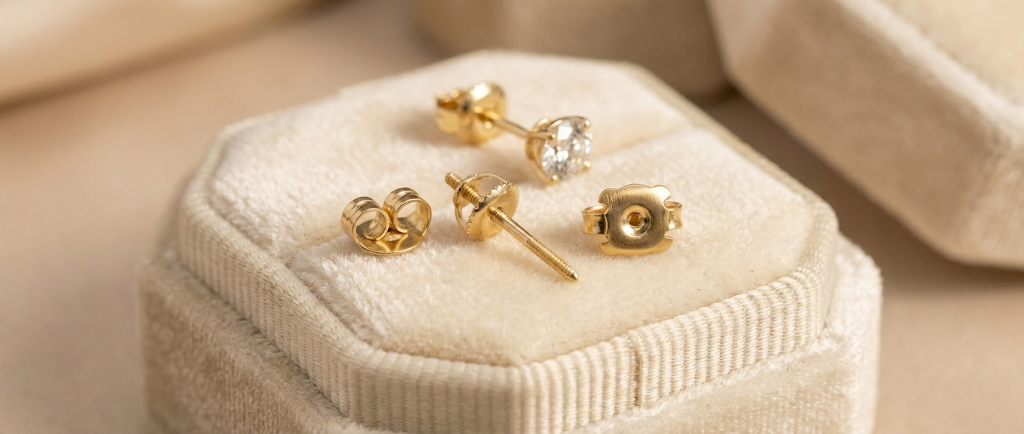
Featured Snippet: What is the most secure earring back?
(Optimized for Google’s Answer Box) The most secure earring back is the locking back, also known as a “La Poussette” backing. This premium closure features a dual-action mechanical trigger. To slide the backing onto or off the earring post, you must squeeze both sides of the lock simultaneously. If the back accidentally catches on clothing, it locks into a special groove on the post, completely preventing the earring from falling out.
Are screw backs better than push backs?
Yes, screw backs are significantly more secure than standard push backs. While push backs rely solely on friction to stay in place (which can wear down and loosen over time), screw backs feature a threaded post. You have to literally screw the backing onto the earring like a nut on a bolt.
However, screw backs take a bit more time and dexterity to put on and take off. If you are someone who takes their Diamond Stud Earrings off every single night, you might find screw backs slightly annoying. But for security, they easily beat push backs.
What are friction backs (push backs)?
Friction backs, commonly called “push backs” or “butterfly backs,” are the standard closures found on most everyday earrings. They work by sliding onto a smooth earring post, relying on the tension of the curved metal loops (the “butterfly wings”) to grip the post tightly.
While they are extremely convenient and easy to use, they are not recommended for heavy or highly valuable earrings. Over time, the metal can stretch, reducing the friction and increasing the risk of the earring slipping off unnoticed.

Earring Back Comparison Chart
Here is a quick breakdown to help you choose the right closure for your lifestyle and budget.
| Closure Type | Security Level | Ease of Use | Best For |
|---|---|---|---|
| Push Back (Friction) | Low / Moderate | Very Easy | Lightweight, everyday fashion jewelry |
| Screw Back | High | Moderate (takes time) | Children’s earrings, valuable studs worn 24/7 |
| Locking (La Poussette) | Ultimate | Easy once learned | Heavy or expensive diamond studs |
Which earring back is best for heavy earrings?
For heavy diamond studs or large gemstone earrings, Locking Backs (La Poussette) or large-disc push backs are the best options. Heavy earrings tend to droop forward on the earlobe. A high-quality locking back, or a friction back with a wide, flat metal disc, will stabilize the earring and keep it sitting flush and straight against your ear.
According to jewelry experts at the AGS, regularly checking your earring backs for wear and tear is a crucial part of fine jewelry maintenance. If your push backs feel loose, a jeweler can easily tighten them or upgrade your posts to a more secure system.
Summary
Choosing between the different types of earring backs comes down to balancing convenience and security. For inexpensive fashion jewelry, standard push backs are perfectly fine. However, if you are investing in fine jewelry, especially diamonds, spending a little extra to upgrade to Screw Backs or La Poussette Locking Backs is the smartest way to protect your investment. Remember, it is always cheaper to buy a secure backing than to replace a lost diamond! To keep your secure earrings sparkling, don’t forget to read our guide on How to Clean Gold & Diamond Jewelry at Home.
How to Measure Ring Size at Home (Accurate DIY Methods)
(TL;DR – Quick Summary for Busy Readers)
-
The String/Paper Method: Wrap string or paper around your finger, mark the overlap, and measure in millimeters (mm).
-
The Existing Ring Method: Measure the inside diameter of a ring that already fits perfectly.
-
The Secret Method: Borrow a ring for a few minutes and trace the inside circle on a piece of paper.
-
Pro Tip: Always measure your fingers at the end of the day when they are warm and slightly swollen for the most comfortable fit.
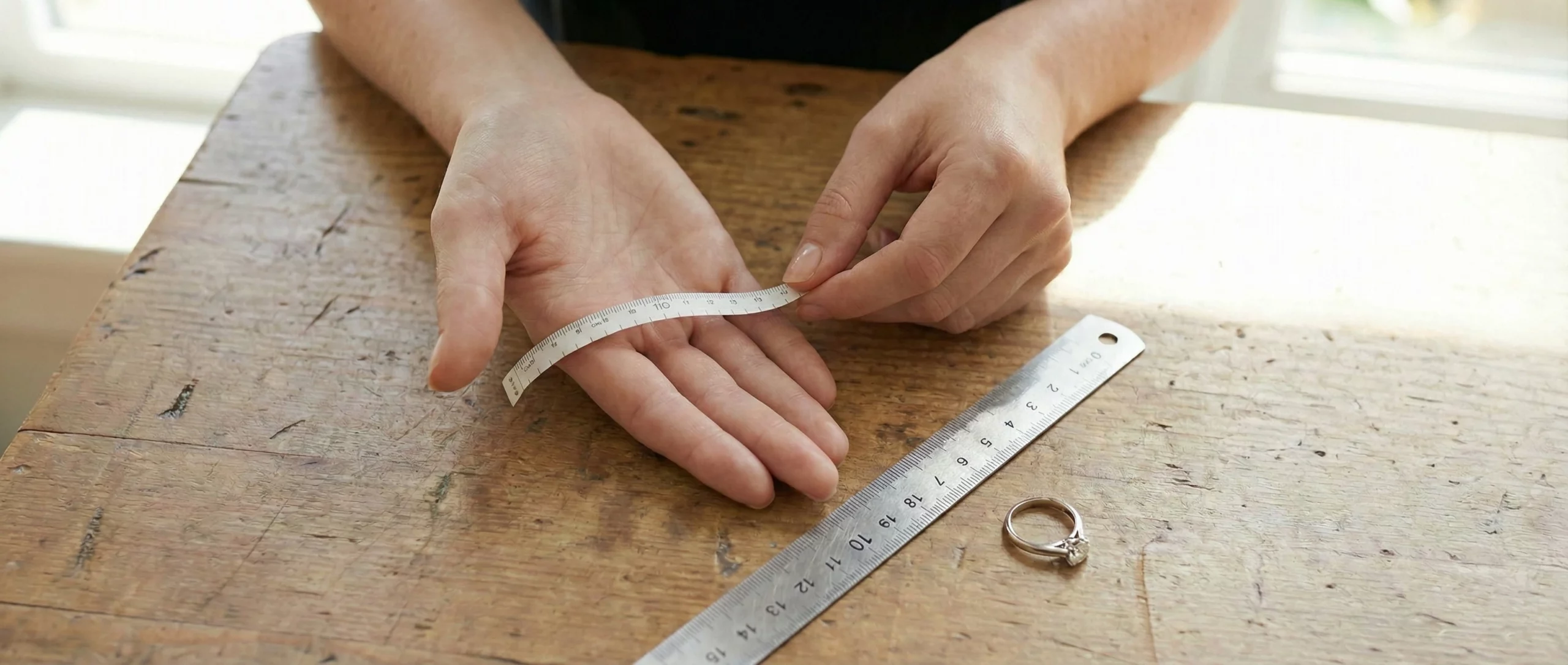
Featured Snippet: How do I measure my ring size at home?
To accurately measure your ring size at home, cut a thin strip of paper or string and wrap it snugly around the base of your intended finger. Make sure the paper can still slide comfortably over your knuckle. Mark the exact point where the ends overlap with a pen. Finally, lay the paper flat, measure the length in millimeters using a ruler, and compare that circumference to a standard US ring size chart to find your perfect fit.
What is the string and paper method for measuring ring size?
The string and paper method is the easiest way to find your ring size using basic household items. By wrapping a flexible material around your finger, you are measuring the circumference.
Follow these exact steps:
-
Cut a piece of string or a strip of paper about 4 inches long and 0.5 inches wide.
-
Wrap it snugly (but not too tightly) around the base of the intended finger.
-
Use a pen to mark where the string or paper overlaps to form a complete circle.
-
Unroll it and measure the distance from the edge to the pen mark using a ruler (in millimeters).
-
Match your measurement to the chart below. (E-E-A-T Note: Make sure the string can easily slide over your knuckle, as the knuckle is often the widest part of the finger).
Ring Size Conversion Chart (US Sizes)
Here is a quick reference table to convert your millimeter measurement (circumference) into standard US ring sizes.
| Circumference (mm) | US Ring Size | European (EU) Size |
|---|---|---|
| 46.8 mm | Size 4 | 47 |
| 47.4 mm | Size 4.25 | 47.5 |
| 48.0 mm | Size 4.5 | 48 |
| 48.7 mm | Size 4.75 | 49 |
| 49.3 mm | Size 5 | 49.5 |
| 50.0 mm | Size 5.25 | 50 |
| 50.6 mm | Size 5.5 | 51 |
| 51.2 mm | Size 5.75 | 51.5 |
| 51.9 mm | Size 6 | 52 |
| 52.5 mm | Size 6.25 | 52.5 |
| 53.1 mm | Size 6.5 | 53 |
| 53.8 mm | Size 6.75 | 54 |
| 54.4 mm | Size 7 (Avg. Women’s) | 54.5 |
| 55.1 mm | Size 7.25 | 55 |
| 55.7 mm | Size 7.5 | 56 |
| 56.3 mm | Size 7.75 | 56.5 |
| 57.0 mm | Size 8 | 57 |
| 57.6 mm | Size 8.25 | 57.5 |
| 58.3 mm | Size 8.5 | 58 |
| 58.9 mm | Size 8.75 | 59 |
| 59.5 mm | Size 9 (Avg. Men’s) | 59.5 |
| 60.2 mm | Size 9.25 | 60 |
| 60.8 mm | Size 9.5 | 61 |
| 61.4 mm | Size 9.75 | 61.5 |
| 62.1 mm | Size 10 | 62 |
| 62.7 mm | Size 10.25 | 62.5 |
| 63.4 mm | Size 10.5 | 63.5 |
| 64.0 mm | Size 10.75 | 64 |
| 64.6 mm | Size 11 | 64.5 |
| 65.3 mm | Size 11.25 | 65 |
| 65.9 mm | Size 11.5 | 66 |
| 66.6 mm | Size 11.75 | 66.5 |
| 67.2 mm | Size 12 | 67.5 |
| 67.8 mm | Size 12.25 | 68 |
| 68.5 mm | Size 12.5 | 68.5 |
| 69.1 mm | Size 12.75 | 69 |
| 69.7 mm | Size 13 | 70 |
How do you secretly measure a ring size for a surprise proposal?
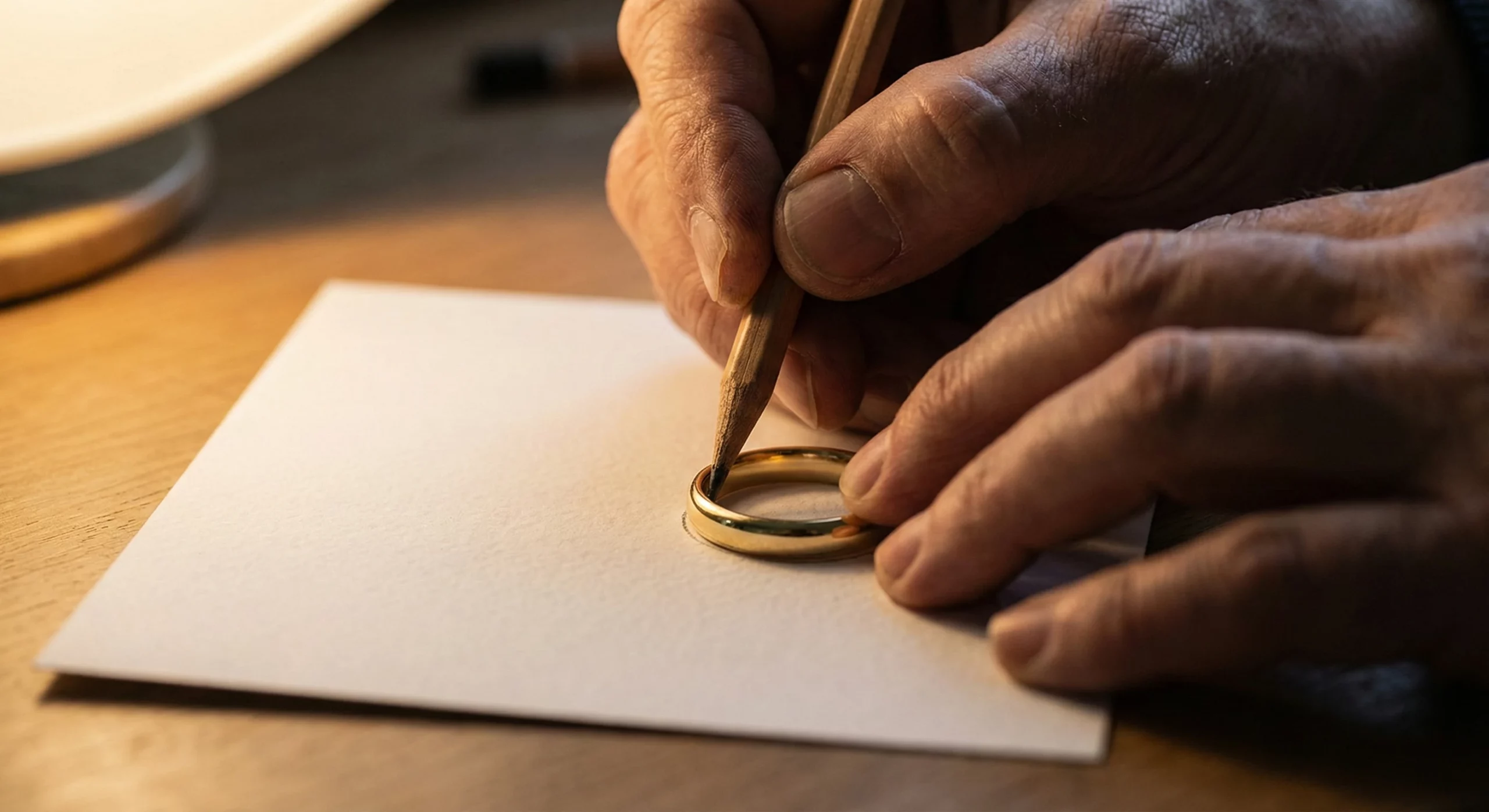
The best way to secretly measure a ring size is to borrow a ring that your partner already wears on their left ring finger. Take the ring and trace the inside circle onto a piece of paper with a sharp pencil. Alternatively, you can press the ring into a bar of soap to create an impression.
Take that piece of paper or soap to a local jeweler, and they can accurately measure the diameter from your trace. If you cannot sneak the ring away, ask a close friend or family member—they often know or can casually find out! For extra guidance on secret sizing before a proposal, retailers offer printable sizers you can use discreetly at home.
What is the most accurate way to measure ring size at home?
For jewelry-grade precision, professional gemologists recommend confirming your finger circumference against an official standard; the Gemological Institute of America (GIA) is the industry authority on gem and jewelry standards. That said, the most accurate DIY method is purchasing a plastic ring sizer gauge online. These look like tiny zip-ties with numbers printed on them.
While the string method is great in a pinch, string can stretch and paper can bend, leading to a size that is slightly off. A plastic ring sizer costs just a few dollars, easily slips over your knuckle, and gives you a professional-grade reading. Once you have your exact size, you can confidently shop our Engagement Rings Category without worrying about resizing.
Does temperature affect your ring size?
Yes, temperature significantly affects your ring size. Leading jewelers, including Tiffany & Co., advise measuring under normal body-temperature conditions for the most reliable fit. Cold weather causes your blood vessels to constrict, making your fingers shrink (sometimes by a full half-size). Hot weather and physical activity cause your fingers to swell.
Pro Tip: For the most accurate reading, measure your fingers at the end of the day when they are warm. This ensures the ring will be comfortable even when your hands are slightly swollen. If you are ever stuck between two sizes, always order the larger size. It is much easier for a jeweler to size a ring down than to stretch it up.
Summary
Figuring out how to measure ring size at home doesn’t have to be stressful. Whether you use a piece of string, trace an existing ring for a surprise, or buy a cheap plastic sizer, taking a few minutes to measure accurately will save you the hassle of resizing later. Remember to measure when your hands are warm, and always account for the size of your knuckles!
Natural vs. Lab-Grown Diamonds: What’s the Real Difference?
The question comes up in almost every engagement ring conversation now: natural vs. lab-grown diamonds — what is the real difference, and does it matter? The short version is that the difference is one of origin, not of substance. Everything else — price, value over time, availability and how the trade treats them — follows from that single fact.
This guide covers what each one is, how they are made and graded, what they actually cost, what happens to their value, and how to decide which belongs in your ring.
Natural vs. Lab-Grown Diamonds: The Short Answer
- Are lab-grown diamonds real? Yes. Both are pure crystallised carbon with identical chemical, physical and optical properties.
- Do they look different? No. Not to the eye, not under a loupe, and not to a standard diamond tester.
- Price: Lab-grown diamonds typically cost 70–90% less than a comparable natural diamond, and the gap has continued to widen.
- Value over time: Natural diamonds retain a portion of their value; lab-grown diamonds currently have very little resale value.
- The trade-off: Size and quality today versus scarcity and retained value tomorrow.

Are Lab-Grown Diamonds Real Diamonds?
Yes. A lab-grown diamond is a real diamond — it has the same chemical composition, crystal structure, hardness and light performance as a mined diamond. The only difference is that it crystallised in a growth chamber over a few weeks rather than in the Earth’s mantle over hundreds of millions of years.
This is not marketing language; it is the legal position. Under the US Federal Trade Commission’s Jewelry Guides (16 CFR Part 23), laboratory-created diamonds may be described as diamonds, provided the description is accompanied by a clear disclosure such as “laboratory-created”, “laboratory-grown” or “[manufacturer]-created” so that no buyer could mistake the stone for a mined one.
What this means in practice: any reputable seller must tell you which you are buying, in plain language, on the invoice and the grading report. If a listing is ambiguous about origin, that is a reason to walk away — not a bargain.
Is There Any Physical Difference?
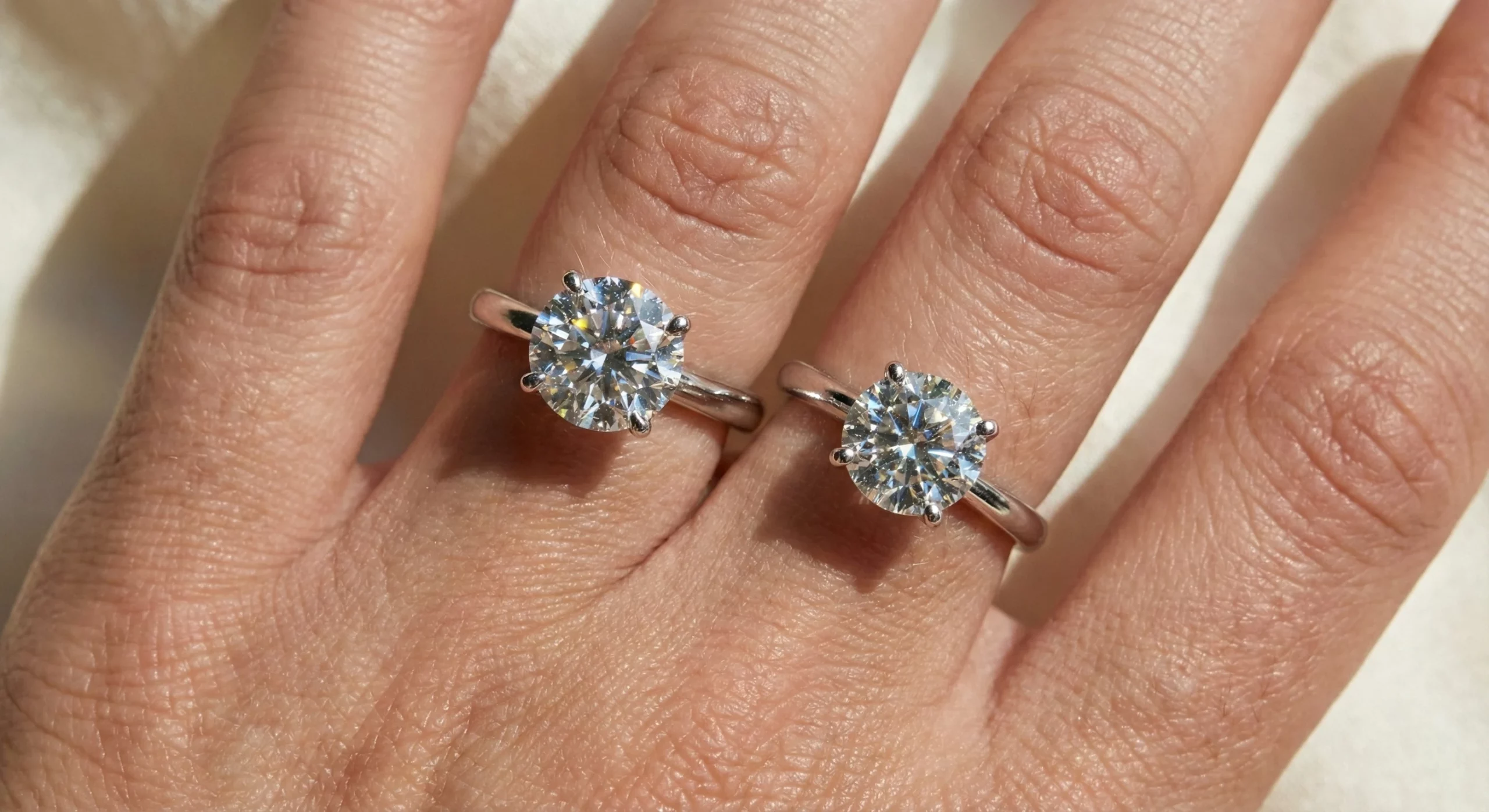
Chemically and structurally, no. Both score 10 on the Mohs scale, share the same refractive index of about 2.42, and disperse light into the same fire. Placed side by side, they are indistinguishable to the naked eye — and a lab-grown stone is exactly as suitable for daily wear in an engagement ring as a natural one.
The differences are microscopic and forensic. Natural diamonds often contain mineral inclusions formed in the Earth; lab-grown stones may show trace metallic flux inclusions (HPHT) or particular growth striations (CVD), along with different fluorescence and phosphorescence patterns. None of this is visible to a buyer, and none of it affects beauty or durability.
How Lab-Grown Diamonds Are Made
Two technologies dominate, and the method affects cost far more than it affects the finished stone.
| HPHT | CVD | |
|---|---|---|
| Full name | High Pressure, High Temperature | Chemical Vapour Deposition |
| Process | Replicates mantle conditions — carbon dissolved in molten metal crystallises on a seed under extreme pressure | Carbon-rich gas is broken down in a vacuum chamber and deposited layer by layer onto a seed plate |
| Typical growth time | Days to a few weeks | Two to four weeks |
| Common characteristics | May show metallic inclusions; sometimes magnetic | May show growth striations; often post-growth treated to improve colour |
| Best known for | Fancy coloured stones, smaller sizes | Large, high-clarity colourless stones |
Can a Jeweler Tell the Difference?
Not by looking. A standard thermal diamond tester measures thermal conductivity, and because a lab-grown diamond is a diamond, it reads “diamond”. A 10x loupe will not reveal the origin either.
Identification requires laboratory instruments — spectroscopy and specialised screening equipment that detect trace nitrogen patterns, strain and fluorescence signatures. Major labs including GIA and IGI run exactly this equipment, which is why an independent grading report is the only reliable proof of origin.

Grading Reports: What to Insist On
Buy the report, not the sales pitch. Whichever type of stone you choose:
- Ask for an independent report from GIA or IGI. In-house or “appraisal certificates” from the seller are not the same thing.
- Check the origin line. A GIA Laboratory-Grown Diamond Report states the growth method and that the stone is laboratory-grown.
- Look for the laser inscription. Most lab-grown stones are inscribed on the girdle with the report number and the words “laboratory-grown”. Ask to see it under magnification.
- Compare like with like. Grading standards can differ between laboratories, so a G/VS2 from one lab is not always identical to a G/VS2 from another. Judge the stone in person as well as on paper.
Price: How Much Do You Actually Save?
Lab-grown diamonds generally sell for 70–90% less than a comparable natural stone, and in larger sizes the gap is wider still. Production capacity has expanded enormously and growing costs have fallen, which has pushed wholesale prices down year after year.
In practical terms, a budget that buys a well-cut natural diamond of roughly one carat will often buy a lab-grown stone of two carats or more at a similar or better clarity and colour grade. That is a real, visible difference on the hand — and it is the single biggest reason lab-grown has taken so much of the bridal market.
There is a second way to spend the saving: upgrade everything else. A better cut grade, a more substantial setting, or a move from 14k gold to platinum. If you are weighing that, our guides to 14k vs. 18k gold and white gold vs. platinum explain where that money shows.
Resale and Long-Term Value
This is the honest catch, and it deserves to be stated plainly. Lab-grown diamonds currently have very little resale value.
A natural diamond is a finite good; supply is limited by geology. A lab-grown diamond is a manufactured product, and manufactured products get cheaper as production scales and technology improves. A stone bought today competes on the second-hand market against a newer, cheaper equivalent tomorrow. Natural diamonds are not investments either — retail markup means most resell well below purchase price — but they do retain a meaningful floor that lab-grown stones do not.
Practical consequences worth knowing:
- Upgrade or trade-in programmes are far more common and more generous for natural stones. Ask before you buy if this matters to you.
- Insurance replacement values for lab-grown stones should be reviewed periodically, since replacement cost falls over time.
- If a piece is intended to be inherited, that is an argument for natural — not because lab-grown is inferior, but because scarcity is what holds value across generations.
Quick Comparison
| Feature | Natural diamond | Lab-grown diamond |
|---|---|---|
| Composition | Crystallised carbon — a real diamond | Crystallised carbon — a real diamond |
| Hardness | 10 on the Mohs scale | 10 on the Mohs scale |
| Origin | Formed in the Earth over geological time | Grown in a chamber in weeks |
| Appearance | Identical to the eye | Identical to the eye |
| Price | Full market price | Roughly 70–90% less |
| Size for the budget | Smaller | Substantially larger |
| Resale value | Retains a portion | Very low to none |
| Availability of large stones | Rare and expensive | Readily available |
| Grading report | GIA / IGI | GIA / IGI, marked laboratory-grown |
| Emotional appeal | Rarity, tradition, geological history | Modern, accessible, controllable origin |
What About Ethics and Sustainability?
This deserves a more careful answer than either side usually gives.
Lab-grown diamonds avoid mining entirely — no open pits, no tailings, no questions about the provenance of a rough stone. That is a genuine advantage. However, growing diamonds is energy-intensive, and the environmental footprint depends heavily on whether that energy comes from renewables or coal. Claims of “carbon neutral” or “sustainable” should be backed by third-party certification; the FTC has warned marketers on both sides against unsubstantiated environmental claims.
On the natural side, the Kimberley Process and modern chain-of-custody programmes have significantly changed the industry since the 1990s, and diamond mining is a major source of employment and public revenue in several countries. Neither option is unambiguously “the ethical one” — the responsible move is to buy from a seller who can tell you specifically where the stone came from and show the documentation.
Which Should You Choose?
Choose a lab-grown diamond if:
- Size and visual impact for your budget are the priority
- You want a higher colour and clarity grade than you could otherwise afford
- You are comfortable treating the ring as jewelry rather than as a store of value
- Avoiding mining matters to you personally
Choose a natural diamond if:
- The romance of a stone formed over a billion years is part of the meaning
- You want the piece to hold a portion of its value, or to be inherited
- You may want to use a trade-in or upgrade programme later
- Rarity itself is what you are buying
Frequently Asked Questions
Will a lab-grown diamond pass a diamond tester?
Yes. Standard thermal and electrical testers identify it as diamond, because it is diamond. Only specialised laboratory screening equipment distinguishes origin.
Do lab-grown diamonds get cloudy or lose their sparkle?
No. They do not degrade, discolour or cloud over. Like any diamond, they look dull when coated in skin oils and lotions — our guide to cleaning jewelry at home restores the sparkle in about ten minutes.
Are lab-grown diamonds cheaper because they are lower quality?
No. They are cheaper because supply is not constrained by geology. Lab-grown stones are available in the highest colour and clarity grades, often more easily than natural stones of the same grade.
Can you insure a lab-grown diamond?
Yes, on the same terms as any fine jewelry. Because replacement costs have been falling, it is worth reviewing the declared value every few years so you are neither under- nor over-insured.
Is a lab-grown diamond appropriate for an engagement ring?
Absolutely. It is a real diamond with identical hardness and light performance, and it will wear exactly as well over a lifetime. The decision is about value and meaning, not durability.
What is the difference between lab-grown diamonds and moissanite or cubic zirconia?
A large one. Moissanite is silicon carbide and cubic zirconia is zirconium dioxide — different materials, different hardness, different optical behaviour. A lab-grown diamond is chemically identical to a mined diamond; simulants are not diamonds at all.
Do lab-grown diamonds come with a certificate?
Reputable ones do. Look for a GIA or IGI laboratory-grown report and a matching laser inscription on the girdle.
The Bottom Line
Both are real diamonds. A lab-grown stone offers a bigger, brighter ring today for dramatically less money, with a transparent origin and no mining. A natural stone offers scarcity, tradition and a value floor that a manufactured product cannot match. Neither is a mistake — they are simply answers to different questions.
At Camellia Jewelry we set both, and every design can be made either way, so you can compare the same ring with a natural or a lab-grown centre stone before you commit. Explore our handcrafted engagement rings, our lab diamond engagement rings, or read about how our custom rings are made.
Sources and further reading: FTC Jewelry Guides, 16 CFR Part 23; GIA News & Research.